
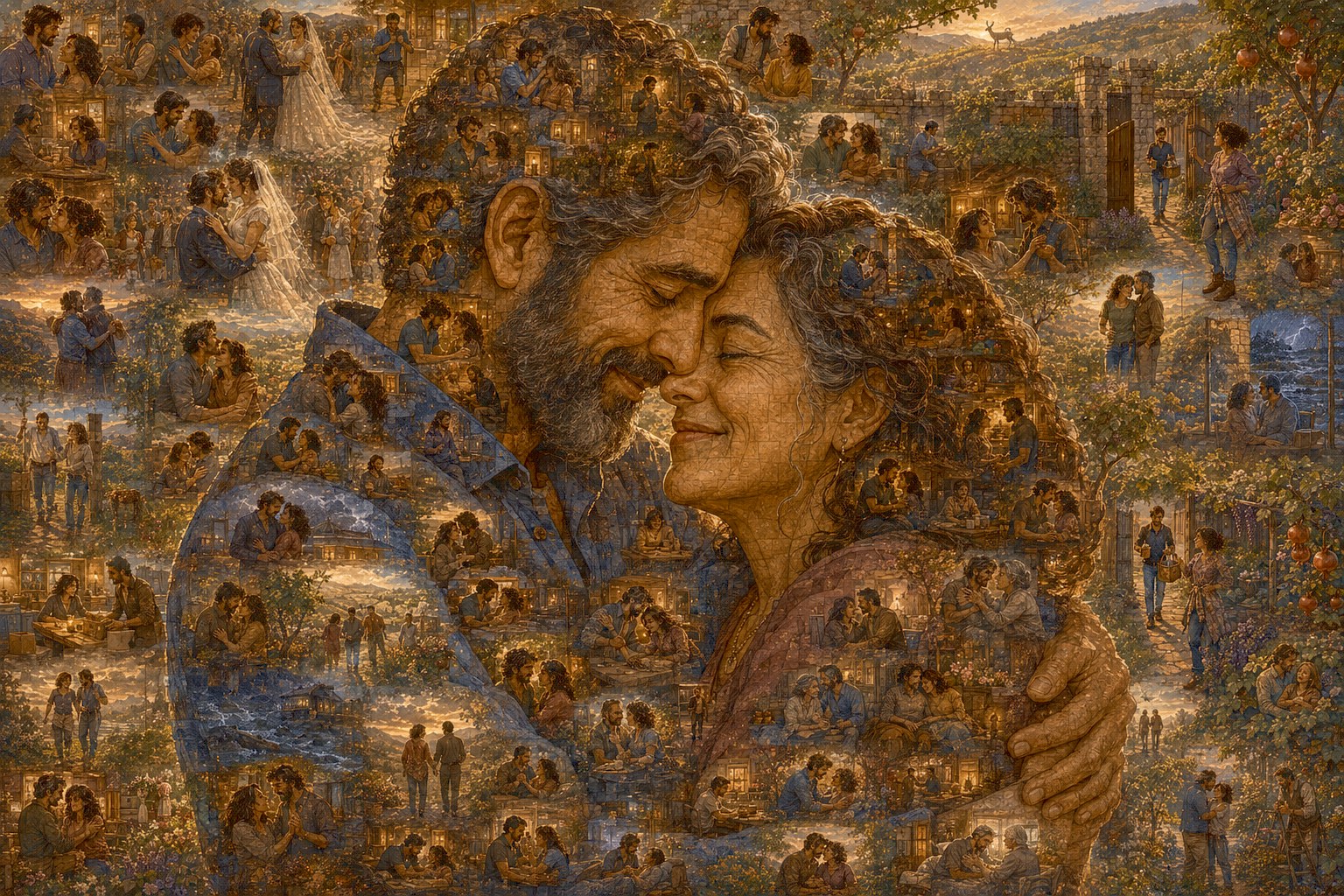
We have reached the end of the poem, which means we can finally do something we have deliberately resisted throughout this study: back away from the individual scenes and look at the whole thing. We have spent twelve studies standing close enough to examine individual tiles—the vineyards, gardens, gazelles, walls, daughters of Jerusalem, nighttime searches, royal processions, bodies, spices, seals, silver, and more goats than most modern love poetry could survive. Now we need to back up and see what picture those pieces make together.
That matters especially with Song of Songs because individual verses from this book are unusually easy to detach from the poem that gives them meaning. “I am my beloved’s, and my beloved is mine.” “You are all beautiful, my love.” “Do not stir up, nor awaken love, until it so desires.” “Love is strong as death.” “Many waters can’t quench love.” Each can survive quite comfortably on a wedding invitation or decorative sign. After walking through the entire Song, however, those statements no longer stand alone. We have watched the relationship around them develop, and the repeated language and imagery have accumulated meaning as the poem has progressed.
The Song begins not with an explanation of marriage, a command concerning sexuality, or even an introduction to the lovers. It begins with desire.
Song of Songs 1:1–4 (WEB)
The Song of songs, which is Solomon’s.
Let him kiss me with the kisses of his mouth;
for your love is better than wine.
Your oils have a pleasing fragrance.
Your name is oil poured out,
therefore the virgins love you.
Take me away with you.
Let’s hurry.
The king has brought me into his rooms.
We will be glad and rejoice in you.
We will praise your love more than wine!
They are right to love you.
The first substantial voice we hear belongs to the woman, and the first thing we learn about her is wonderfully uncomplicated: she wants this man to kiss her. The Song never apologizes for beginning there. Romantic and sexual desire are allowed onto the page before anyone stops to defend their existence, because the poem assumes they belong within the world God created.
But that opening desire does not remain contextless for long. Within a few verses we learn that the woman who wants these kisses also has a history. She is conscious of her appearance and of the effect the sun has had upon her. Her brothers have been angry with her. They made her work vineyards belonging to others while she could say, “I haven’t kept my own vineyard.” Before we know very much about the man she desires, the woman herself has already emerged as a person rather than merely the object of someone else’s attraction.
That remains true throughout the Song. She speaks constantly. She wants, remembers, searches, warns, dreams, invites, complains, praises, questions, and answers. At times she carries the poem for long stretches while the man disappears from view. When he returns, he does not silence her voice by making her merely the subject of his praise. He listens for it. Near the beginning he says, “Let me hear your voice; for your voice is sweet,” and his final words in the entire Song return to the same desire: “Let me hear your voice!”
The woman is seen, but she is also heard.
That combination helps us understand the Song’s extraordinary attention to bodies. Neither lover is remotely embarrassed about physical attraction. The man examines the woman with an enthusiasm that produces some of the strangest compliments modern readers will encounter in Scripture. Her hair becomes a flock of goats descending a mountain, her teeth become freshly washed sheep, her neck becomes a tower, and her breasts become twin fawns and later clusters of a palm tree. The woman eventually answers with an equally enthusiastic description of the man from head to foot.
Ancient Near Eastern romance apparently had considerably more livestock involved than ours.
Yet the metaphors matter less as anatomical descriptions than as expressions of delight. These lovers are not providing neutral assessments of one another. The man can look at the woman and say:
Song of Songs 4:7 (WEB)
You are all beautiful, my love.
There is no spot in you.
He is not issuing an objective dermatological report.
He is looking at the woman he loves, and throughout the Song that particularity becomes increasingly important. The woman calls her beloved outstanding among ten thousand. The man calls her unique among queens, concubines, and maidens without number. Neither statement requires us to conclude that these are objectively the two most physically attractive human beings in the ancient Near East. The poetry is showing us what happens when affection becomes attached to a particular person.
The world contains alternatives. The Song never pretends otherwise. There are daughters of Jerusalem, virgins, queens, concubines, young men, and eventually the immense royal world associated with Solomon. Yet as the number of possible alternatives grows, the language of the lovers continually narrows: my beloved, my love, my dove, my sister, my bride. Among the many, each has become particular to the other.
That is why the declarations of belonging become so important as the poem progresses. Early desire eventually becomes:
Song of Songs 2:16 (WEB)
My beloved is mine, and I am his.
He browses among the lilies.
Later the order changes:
Song of Songs 6:3 (WEB)
I am my beloved’s,
and my beloved is mine.
He browses among the lilies.
And eventually the woman can say:
Song of Songs 7:10 (WEB)
I am my beloved’s.
His desire is toward me.
The wording shifts slightly, but the movement is significant. The woman begins the Song knowing what she wants. As the poem develops, desire becomes surrounded by mutual knowledge and belonging. By chapter 7 she does not merely know that she desires him. She knows where his desire is directed.
That helps explain why the Song’s scenes of absence matter so much. Twice the woman searches for the man she loves during nighttime scenes whose precise relationship to dreams, memories, fantasies, or events remains difficult to establish. We did not need to solve that question to understand what those scenes contribute to the poem. His absence matters because he matters. Love has made another person’s presence significant enough that losing it hurts.
The vulnerability created by desire is therefore part of the reason the Song repeatedly warns the daughters of Jerusalem:
Song of Songs 2:7 (WEB)
I adjure you, daughters of Jerusalem,
by the roes, or by the hinds of the field,
that you not stir up, nor awaken love,
until it so desires.
The warning returns in 3:5 and again in 8:4. When we first heard it, we had barely seen what awakened love could become. By the final occurrence, the poem has shown us.
This love can reorder someone’s emotional world around another person. It produces longing, sexual desire, joy, vulnerability, exclusivity, and the pain of absence. It eventually produces a desire not merely for another kiss but for permanence. The refrain therefore does not interrupt the Song’s celebration of desire. It exists because the Song takes desire seriously enough to know where it can lead.
And something fascinating happens after the final warning in 8:4.
The warning disappears.
Immediately afterward the poem moves toward its strongest description of mature love.
Song of Songs 8:5–7 (WEB)
Who is this who comes up from the wilderness,
leaning on her beloved?
Under the apple tree I aroused you.
There your mother conceived you.
There she was in labor and bore you.
Set me as a seal on your heart,
as a seal on your arm;
for love is strong as death.
Jealousy is as cruel as Sheol.
Its flashes are flashes of fire,
a very flame of Yah.
Many waters can’t quench love,
neither can floods drown it.
If a man would give all the wealth of his house for love,
he would be utterly scorned.
The sequence matters. The Song has warned repeatedly against awakening love prematurely, and then, when love is fully awake, it does not tell the lovers to suppress it. The woman emerges leaning upon her beloved and asks to become a seal upon his heart and arm. The desire for kisses that opened the poem has not disappeared. It has grown around something larger.
The woman who wanted his mouth now wants his heart.
That does not represent a movement from physical love toward a supposedly superior nonphysical love. Nothing physical has been discarded. The later chapters are some of the most explicitly erotic material in the entire poem. Rather, desire has acquired depth. The kisses, bodies, fragrances, vineyards, gardens, wine, fruit, and spices now belong inside friendship, exclusivity, mutual belonging, and a desire for permanence.
The repeated garden and vineyard imagery allows us to watch that development from another angle. Near the beginning of the Song, the woman says:
Song of Songs 1:6 (WEB)
My mother’s sons were angry with me.
They made me keeper of the vineyards.
I haven’t kept my own vineyard.
Near the end she says:
Song of Songs 8:12 (WEB)
My own vineyard is before me.
The thousand are for you, Solomon;
two hundred for those who tend its fruit.
Those statements almost frame the woman’s development. Early in the poem she has been placed in vineyards belonging to others while her own vineyard has gone unkept. By chapter 8 she can speak emphatically about what belongs to her. Between those two statements, vineyard and garden imagery becomes increasingly associated with her body, sexuality, and love.
The crucial scene comes in chapter 4. The man describes her as an enclosed garden, locked spring, and sealed fountain. The imagery is simultaneously protective and abundant. Behind the enclosure are pomegranates, spices, fragrance, water, and fruit. What is enclosed is not barren. The boundary surrounds something desirable.
Then the woman herself speaks:
Song of Songs 4:16 (WEB)
Awake, north wind, and come, you south!
Blow on my garden, that its spices may flow out.
Let my beloved come into his garden,
and taste his precious fruits.
The garden opens because she invites the beloved into it. Later she invites him into the countryside and promises, “There I will give you my love.” By chapter 8 she can look backward upon that development and say, “I am a wall,” while also saying that her vineyard remains hers.
Seen from the level of the whole Song, the wall and the open garden are not opposites. They belong together. The woman can give deliberately because what she gives was not indiscriminately available. The Song’s restraint and its erotic enthusiasm arise from the same understanding of intimacy: something valuable can be guarded precisely so that it can eventually be given.
That is also why the little sister appears where she does. Immediately after the Song’s great declaration about love, we meet a girl who has not yet reached physical maturity. Her family wonders what should be done for her when the possibility of marriage arrives. The mature woman answers from the other side of that development: “I am a wall, and my breasts are like towers.” The contrast is unmistakable. One girl has not reached the season of awakened love. The woman speaking has.
The Song therefore places immature and mature sexuality beside one another near its conclusion. Maturity does not consist in having less desire. If anything, the Shulammite has become more explicit about her desire as the poem progresses. What has developed is her capacity to know what belongs to her, guard it, choose where it belongs, and give it.
That makes the vineyard language immediately following the little-sister scene especially significant. Solomon possesses a vineyard at Baal Hamon. It is leased to keepers, produces fruit, and generates large amounts of silver. The exact financial arrangement in 8:11–12 remains difficult to reconstruct, but the poem places economic value directly beside the woman’s declaration that her vineyard is hers.
That happens only a few verses after we were told that if a man offered all the wealth of his house for love, his offer would be despised.
We should be careful here because the larger role of Solomon remains one of the Song’s genuine interpretive difficulties. Some readers reconstruct a story in which the Shulammite rejects wealthy Solomon in favor of a shepherd whom she genuinely loves. The Song contains pieces that can support that reading: a beloved associated with pastoral imagery, Solomon’s wealth and royal world, queens and concubines, and finally the juxtaposition between Solomon’s profitable vineyard and the woman’s own vineyard. But the poem never narrates that proposed story explicitly, and we should not turn a plausible reconstruction into something the text states.
What we can see without reconstructing the missing narrative is a larger contrast running through the poem. Solomon represents abundance on an extraordinary scale. His procession contains warriors, cedar, silver, gold, purple, perfume, and a crown. He is associated with queens, concubines, vineyards, and enormous wealth.
The lovers repeatedly speak another language of value.
Among women without number, one woman is unique. Among ten thousand men, one man is the beloved. The garden is not taken but invited into. The vineyard is not simply an economic asset. And when the poem finally speaks directly about the price of love, it tells us that an entire household’s wealth cannot purchase it.
Royal abundance cannot manufacture particular love.
Whether Solomon is himself one of the lovers or functions in some more complicated relationship to them does not change that basic point. The Song continually places what can be accumulated beside something that cannot. Silver can purchase goods, build magnificent processions, compensate vineyard keepers, and display royal power. It cannot create the words my beloved.
That contrast brings us back to the Song’s persistent language of exclusivity. The lovers’ mutual belonging is not ownership in the economic sense. “My beloved is mine, and I am his” works precisely because the claim runs in both directions. Neither person becomes a commodity possessed by the other. Each remains a person capable of speaking, desiring, inviting, withholding, and giving.
The woman can therefore say both “I am my beloved’s” and “my vineyard is mine.” Those claims do not contradict one another. Her belonging to him is meaningful precisely because she possesses something capable of being given. The man does not acquire her in the way Solomon possesses a vineyard. She gives herself to the man she calls her beloved, and he gives himself to her.
That distinction helps us see why the Song is so intensely physical without reducing either lover to a body. The lovers notice bodies constantly, but those bodies never become detached from the persons inhabiting them. After the woman’s enormous description of the man in chapter 5, she concludes:
Song of Songs 5:16 (WEB)
His mouth is sweetness;
yes, he is altogether lovely.
This is my beloved, and this is my friend,
you daughters of Jerusalem.
The man she desires physically is also her friend.
The same integration appears from his side at the end of the poem. This man has spent eight chapters demonstrating that he is quite capable of noticing the woman’s body. Yet his final request is:
Song of Songs 8:13 (WEB)
You who dwell in the gardens,
with friends in attendance,
let me hear your voice!
The body has not stopped mattering. Her answer immediately returns to the erotic world of gazelles, mountains, and spices. But neither has the body swallowed the person. He still wants to hear her, and she still wants him near.
That final exchange also returns us to language from near the beginning. In chapter 2 he asked to hear her voice and called her to arise and come away. She watched him approach like a gazelle or young stag across the mountains. At the end, he again asks for her voice, while she now gives the invitation: “Come away, my beloved! Be like a gazelle or a young stag on the mountains of spices!”
The poem has curved back toward its beginning without simply returning us to where we started. The images are familiar, but the relationship around them is not. Desire remains, yet it now exists within a history of seeking, finding, delight, vulnerability, intimacy, mutual belonging, and the request to be sealed upon the heart.
The Song begins with longing and ends with longing.
What changes is what the longing has come to contain.
That gives us the literary mosaic. But Song of Songs does not exist by itself. It sits inside a canon that begins with creation, moves through Israel’s history, reaches its center in Christ, and ends in resurrection and new creation. Once we have allowed the Song to speak first as the poem it actually is, we can back away another step and ask where this celebration of human love belongs within that larger picture.
The natural place to begin is Genesis.
Genesis 2:22–25 (WEB)
Yahweh God made a woman from the rib which he had taken from the man,
and brought her to the man. The man said,
“This is now bone of my bones,
and flesh of my flesh.
She will be called ‘woman,’
because she was taken out of Man.”
Therefore a man will leave his father and his mother, and will join with his wife, and they will be one flesh. The man and his wife were both naked, and they were not ashamed.
Marriage, embodied human existence, sexual differentiation, nakedness without shame, and one-flesh union all belong to the biblical story before sin enters it. That matters enormously for reading Song of Songs. Scripture’s foundational word about the human body and marital sexuality is not contamination but creation.
Genesis 3 explains why those gifts are now experienced amid shame, domination, selfishness, pain, and broken relationships. It does not retroactively make the gifts themselves evil. Lust can distort sexual desire without making sexual desire a mistake. Adultery can violate marital exclusivity without making exclusivity itself possessive. Exploitation can turn another person’s body into an object without making bodily delight inherently degrading.
Song of Songs gives us one of Scripture’s most sustained pictures of the created good itself.
Much of the Bible necessarily discusses sexuality when something has gone wrong—adultery, rape, prostitution, incest, lust, exploitation, divorce, or forbidden unions. If those were the only passages we emphasized, we could easily begin thinking Scripture talks about sex primarily because sex is dangerous.
Then Song of Songs walks into the canon wanting kisses.
Nobody needs to repent because the woman thinks her beloved smells good. The man does not need deliverance because he enjoys his wife’s breasts. The woman does not need to suppress her attraction because she finds the man’s body magnificent. The Song allows embodied attraction to exist as something genuinely good while still surrounding it with wisdom, exclusivity, and restraint.
That created reality also explains why marriage can carry theological meaning elsewhere in Scripture. The prophets repeatedly use marriage to describe Yahweh’s covenant relationship with Israel. Idolatry can be described as adultery because covenant belonging is particular. Betrayal matters because faithfulness matters. Jealousy matters because an exclusive relationship has been violated.
The prophets are not secretly decoding Song of Songs when they use that imagery. They are drawing upon the same created institution the Song celebrates. Human marriage possesses characteristics capable of carrying theological comparison: belonging, faithfulness, exclusivity, intimacy, jealousy, betrayal, and covenant commitment.
The New Testament continues that pattern when Paul reaches back to Genesis while speaking about Christ and the church.
Ephesians 5:25–32 (WEB)
Husbands, love your wives, even as Christ also loved the assembly and gave himself up for her, that he might sanctify her, having cleansed her by the washing of water with the word, that he might present the assembly to himself gloriously, not having spot or wrinkle or any such thing, but that she should be holy and without defect. Even so husbands also ought to love their own wives as their own bodies. He who loves his own wife loves himself. For no man ever hated his own flesh, but nourishes and cherishes it, even as the Lord also does the assembly, because we are members of his body, of his flesh and bones. “For this cause a man will leave his father and mother and will be joined to his wife. Then the two will become one flesh.” This mystery is great, but I speak concerning Christ and of the assembly.
Notice Paul’s direction of reasoning. Actual husbands are commanded to love actual wives. The command reaches back to the actual one-flesh marriage of Genesis, and then Paul tells us that this created relationship also points beyond itself toward Christ and the church.
The theological significance does not erase human marriage. It depends upon it.
That gives us a responsible way to understand why Christian readers throughout history so readily heard Christ and the church while reading Song of Songs. The instinct behind the connection was not entirely mistaken. Scripture really does use marriage to describe God’s covenant relationship with his people, and the New Testament really does identify marriage as a mystery that speaks concerning Christ and the church.
The mistake came when interpreters tried to find Christ by assigning a theological counterpart to every detail of the Song.
Once that method begins, there is almost no way to control it. The woman’s breasts can become the Old and New Testaments, Jews and Gentiles, faith and love, or whatever pair an interpreter requires. Teeth can become preachers. Spices can become virtues. Kisses can become revelation. The ingenuity may be impressive, but the meaning is supplied by the interpreter rather than discovered from the poem.
We do not need to do that to reach Christ.
The canonical road is already there. Genesis establishes marriage as a created one-flesh union. The prophets use marriage to describe Yahweh’s covenant relationship with Israel. Jesus identifies himself as the bridegroom. Paul connects marriage explicitly with Christ and the church. Revelation brings the biblical story toward its conclusion with the marriage of the Lamb.
Revelation 19:6–9 (WEB)
I heard something like the voice of a great multitude, and like the voice of many waters, and like the voice of mighty thunders, saying, “Hallelujah! For the Lord our God, the Almighty, reigns! Let’s rejoice and be exceedingly glad, and let’s give the glory to him. For the marriage of the Lamb has come, and his wife has made herself ready.” It was given to her that she would array herself in bright, pure, fine linen, for the fine linen is the righteous acts of the saints. He said to me, “Write, ‘Blessed are those who are invited to the marriage supper of the Lamb.’” He said to me, “These are true words of God.”
The Bible begins human history with a marriage in a garden and approaches its conclusion with the marriage of the Lamb as the new creation arrives. Song of Songs belongs inside that biblical world.
Its contribution is not that the Shulammite was secretly speaking about Jesus whenever she asked her beloved to kiss her. Her breasts remain breasts. Her vineyard can carry sexual meaning. The man really does desire the woman’s body, and she really does desire his. We do not need to evacuate the ordinary meaning of those things before allowing the book to become theological.
The goodness of creation is theological. The goodness of the human body is theological. The dignity of freely given love is theological. Faithfulness is theological. Wisdom governing desire is theological. The distinction between gift and possession is theological. We do not need to turn pomegranates into spiritual virtues to discover God in a book celebrating the world he made.
At the same time, placing the Song within the whole canon prevents us from making romantic love carry more weight than the poem or Scripture can sustain. Human marriage is genuinely good, but it is not ultimate. Jesus tells us that in the resurrection people neither marry nor are given in marriage. The strongest husband cannot save his wife from death, and the most faithful wife cannot raise her husband from the grave.
Human love can be strong as death.
Christ conquers death.
That difference does not diminish the lovers of the Song. It puts their love where every created gift belongs: beneath the God who gave it. Marriage can be treasured without becoming salvation. A beloved can be precious without becoming God. Human marriage can point toward Christ and his people precisely because it is a real created good that is nevertheless not the final destination of the biblical story.
Seen from that distance, Song of Songs no longer looks like the strange biblical book Christians need to explain away. It fits remarkably well.
Genesis tells us that embodied human life, male and female, marriage, nakedness, and one-flesh union belong to God’s good creation. Song of Songs lets us hear what delight in that created gift can sound like. The prophets draw upon marriage to speak about covenant faithfulness and betrayal. Christ comes as the bridegroom. Paul takes the one-flesh union of Genesis and says it speaks concerning Christ and the church. Revelation finally gives us the marriage supper of the Lamb.
None of that requires us to pretend the Song was an allegory all along.
It requires us to let each part of Scripture make its own contribution to the larger picture.
And that brings us back to the method with which we began this study. We started by refusing to decide what Song of Songs was supposed to mean before listening to what it actually said. We followed repeated words and images through the poem. We allowed ambiguous scenes to remain ambiguous when the text did not settle them. We resisted the temptation to make every verse deliver an immediate theological lesson. We studied the individual tiles closely enough that, when we finally backed away, the mosaic could emerge from the text rather than being painted over it.
The result is not a less theological Song of Songs.
It is a Song that belongs naturally within the theology of creation.
The poem begins with a woman wanting kisses and ends with that same woman calling for her beloved to come near. Between those moments, desire becomes attached to a person, the person becomes precious, absence becomes painful, intimacy becomes guarded and given, belonging becomes mutual, and love eventually asks for permanence. The woman who could once say that her own vineyard had gone unkept can finally say that her vineyard is hers. The lovers who begin by admiring one another eventually speak about a love no flood can extinguish and no fortune can purchase.
The opening desire was never the problem.
It simply had somewhere to grow.
That is why the great statement of chapter 8 belongs so naturally near the end. The poem has finally shown us enough of love that it can tell us what kind of thing we have been watching:
Song of Songs 8:6–7 (WEB)
Set me as a seal on your heart,
as a seal on your arm;
for love is strong as death.
Jealousy is as cruel as Sheol.
Its flashes are flashes of fire,
a very flame of Yah.
Many waters can’t quench love,
neither can floods drown it.
If a man would give all the wealth of his house for love,
he would be utterly scorned.
The woman who began by asking for kisses eventually asks for a seal. The kisses did not turn out to be shallow. They became part of something larger: friendship, vulnerability, exclusivity, sexual intimacy, mutual belonging, and the desire for enduring attachment.
Then, remarkably, the poem does not end with that great declaration.
It returns to the lovers.
Song of Songs 8:13–14 (WEB)
You who dwell in the gardens,
with friends in attendance,
let me hear your voice!
Come away, my beloved!
Be like a gazelle or a young stag
on the mountains of spices!
He still wants to hear her.
She still wants him near.
After eight chapters, all the imagery finally resolves into something wonderfully ordinary: two people who have become precious to one another and have not stopped turning toward one another.
That is the Song as a whole.
And before we begin asking what we should do with it, we should let the picture stand.
Conclusion
Song of Songs is a celebration of human romantic love as a good part of God’s creation. It begins with desire and never becomes embarrassed by that desire, but neither does it treat desire as sovereign. The repeated warnings against awakening love make sense precisely because the poem eventually shows us how powerful awakened love can become. Desire creates vulnerability, seeks exclusivity, longs for intimacy, and eventually asks for permanence.
Across the poem, the repeated images accumulate around that development. The vineyard once neglected becomes the vineyard the mature woman can call her own. The enclosed garden becomes the garden she freely opens to her beloved. The woman who can say “I am a wall” is also the woman who enthusiastically gives her love. The lovers who repeatedly experience separation eventually speak with the confidence of mutual belonging. Royal abundance and Solomon’s silver stand beside a kind of love that cannot be accumulated, commanded, or purchased.
The Song therefore refuses several false choices. Bodies can matter without persons becoming objects. Sexual desire can be celebrated without becoming self-justifying. Boundaries can protect intimacy without treating intimacy as dirty. Two people can belong to one another without either becoming property. Friendship and erotic desire can inhabit the same relationship. Restraint and delight can serve the same good.
When we place that human love inside the larger biblical story, we do not need to turn the poem into an allegory. Marriage already belongs to Scripture’s theological vocabulary because it belongs first to God’s creation. Genesis gives us the one-flesh union. The prophets use marriage to speak of covenant. Christ comes as bridegroom. Paul speaks of marriage concerning Christ and the church. Revelation ends with the marriage of the Lamb.
Song of Songs contributes to that story by allowing human romantic love to remain gloriously human.
The book never needed rescuing from its sexuality.
It needed to be read closely enough that we could see why that sexuality belongs in Scripture.
We have now done the close work.
We have stood near enough to see the tiles.
Now we have backed away far enough to see the mosaic.