
Song of Songs 8:13–14 (WEB)
You who dwell in the gardens,
with friends in attendance,
let me hear your voice!
Come away, my beloved!
Be like a gazelle or a young stag
on the mountains of spices!
Song of Songs ends surprisingly quietly. After royal processions, nighttime searches, locked gardens, vineyards, queens and concubines, extravagant descriptions of the lovers’ bodies, and finally the declaration that love is strong as death and beyond purchase, the poem closes with two people speaking to one another. He wants to hear her voice. She wants him to come.
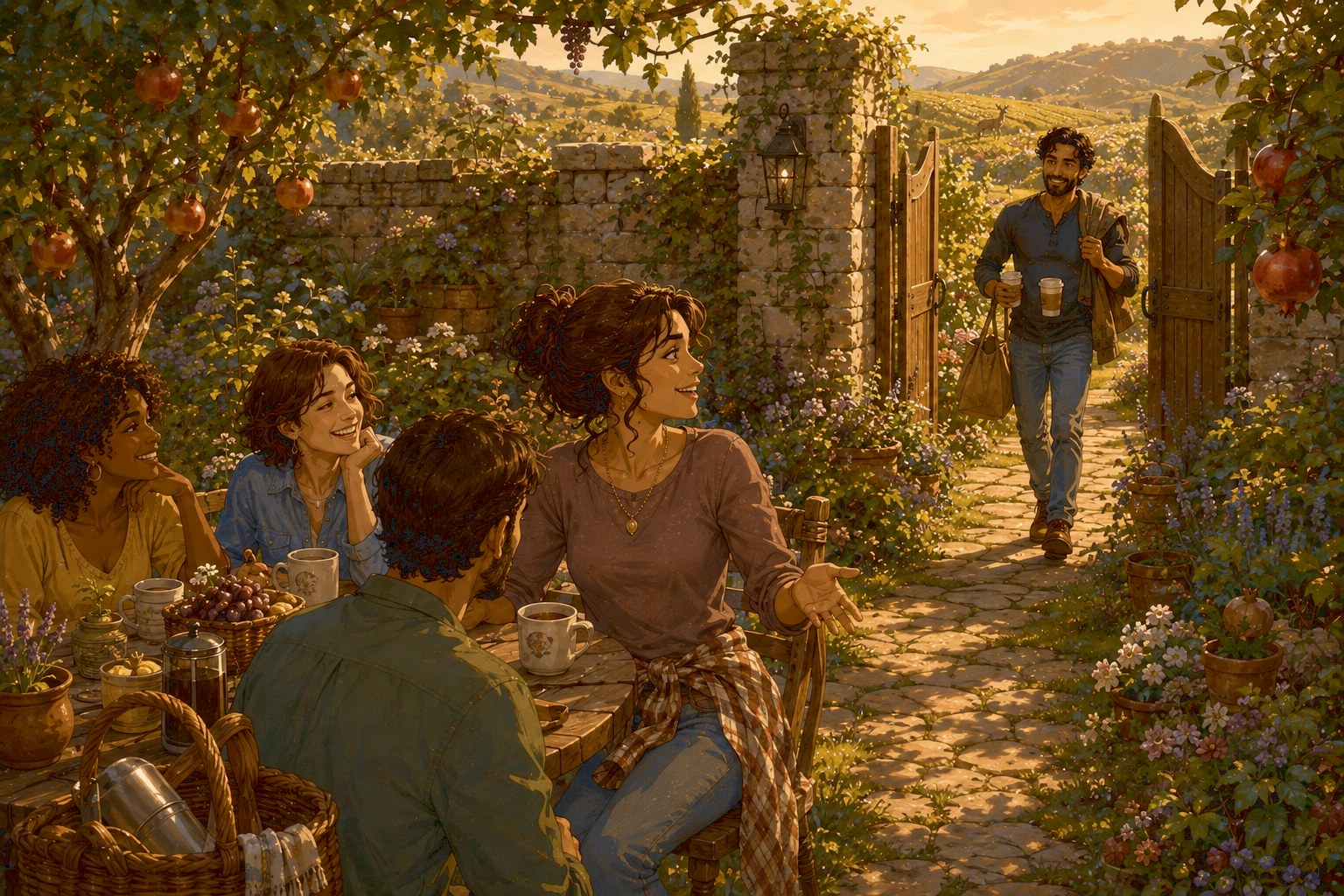
The man speaks first: “You who dwell in the gardens, with friends in attendance, let me hear your voice!” Gardens are familiar territory by now. The Song has surrounded these lovers with vineyards, orchards, lilies, pomegranates, spices, fountains, and flowing water, and in chapter 4 the woman herself was described as “a locked up garden, a locked up spring, a sealed fountain.” She eventually invited her beloved into that garden.
Song of Songs 4:16 (WEB)
Awake, north wind, and come, you south!
Blow on my garden, that its spices may flow out.
Let my beloved come into his garden,
and taste his precious fruits.
Here she is not explicitly identified with the garden; she is dwelling among the gardens while companions listen to her. The man’s attention, however, is not primarily on the setting or even on the people around her. He wants to hear her.
That request takes us much further back in the poem.
Song of Songs 2:13–14 (WEB)
The fig tree ripens her green figs.
The vines are in blossom.
They give out their fragrance.
Arise, my love, my beautiful one,
and come away.
My dove in the clefts of the rock,
in the hiding places of the mountainside,
let me see your face.
Let me hear your voice;
for your voice is sweet
and your face is lovely.
Near the beginning of their relationship, he wanted to see her face and hear her voice. After everything that has happened between them, he still does.
That matters in a poem famous for celebrating physical attraction. There is no reason to sanitize that attraction now. This man has praised nearly every visible part of the woman’s body, sometimes more than once and occasionally through comparisons that probably worked considerably better in the ancient world than they would on a modern anniversary card. Her eyes overwhelm him. Her body captivates him. He has been anything but subtle about wanting her.
Yet his final words are not another description of her body. They are, “Let me hear your voice.”
The request fits the woman we have encountered throughout the Song because she has never been merely a beautiful body being observed by a man. She speaks constantly. She tells us what she wants, remembers, fears, enjoys, and desires. She speaks to her beloved, the daughters of Jerusalem, the watchmen, and her family. She searches, questions, praises, invites, and warns. At several points she carries the poem for long stretches herself. Her beloved does not merely tolerate that voice while appreciating the rest of her. From chapter 2 onward, her voice has been part of what he finds beautiful.
The Song therefore closes with physical and personal intimacy still joined together. Earlier the woman could describe the man from head to foot and then tell the daughters of Jerusalem, “This is my beloved, and this is my friend.” Now the man who has spent the poem delighting in her body wants to hear what she has to say. Neither companionship nor sexual desire has displaced the other as the relationship matured.
That is a remarkably ordinary place for such extravagant poetry to land. Marriage eventually contains far more conversation than gazelles bounding over mountains. The couple who once struggled to keep their hands off one another will eventually have to decide what is for dinner, whether somebody paid the electric bill, why the dog is making that noise, and who was supposed to buy coffee. Song of Songs does not suggest that sexual attraction should disappear into domestic companionship, but it does give us a relationship capable of containing both. The beloved is someone you want to touch and someone you still want to hear.
The woman answers him immediately:
“Come away, my beloved! Be like a gazelle or a young stag on the mountains of spices!”
Her response also takes us back toward the beginning.
Song of Songs 2:8–10, 16–17 (WEB)
The voice of my beloved!
Behold, he comes,
leaping on the mountains,
skipping on the hills.
My beloved is like a roe or a young hart.
Behold, he stands behind our wall!
He looks in at the windows.
He glances through the lattice.
My beloved spoke, and said to me,
“Rise up, my love, my beautiful one, and come away.”
My beloved is mine, and I am his.
He browses among the lilies.
Until the day is cool, and the shadows flee away,
turn, my beloved, and be like a roe or a young hart
on the mountains of Bether.
The correspondence is substantial. We again hear voices, gazelles or young stags, mountains, and the invitation to come away. But the roles have been beautifully reversed. In chapter 2, he called to her: “Arise, my love, my beautiful one, and come away.” Now she calls to him: “Come away, my beloved!” He asked to hear her voice near the beginning, and he still asks for it at the end. She once watched him approaching over the mountains like a gazelle, and the last image she gives us is the same man summoned to come like a gazelle again.
The Song has therefore returned to its beginning without simply repeating it. Much has happened between those two scenes. Desire has awakened. The lovers have experienced absence and reunion, longing and fulfillment. The locked garden has opened. Their language of belonging has deepened from “My beloved is mine, and I am his” to “I am my beloved’s. His desire is toward me.” Love has finally been described as strong as death, and the woman has declared that her vineyard is hers to give. Yet after all that development, they have not graduated beyond wanting one another.
The final reference to the “mountains of spices” makes that especially clear. In 2:17, the WEB has “the mountains of Bether,” translating harei-bether, an uncertain expression that may contain a place-name. Here we have harei besamim, “mountains of spices.” The similarity of the expressions helps us hear the echo, while the change to spices draws upon imagery that has become richly erotic during the course of the Song. Chapter 4 filled the woman’s garden with spikenard, saffron, calamus, cinnamon, myrrh, aloes, and “all the best spices” before she invited her beloved to enter and taste its fruit. By chapter 8, “mountains of spices” cannot sound like neutral geography. Her final invitation still carries the sensual world the Song has spent eight chapters constructing.
Maturity, then, has not meant progressing from physical desire to something supposedly more spiritual. The Song refuses that division. Conversation, friendship, exclusivity, commitment, and sexual desire belong within the same relationship. His final desire is to hear her voice, and hers is for him to come bounding toward the mountains of spices. Scripture apparently sees no need to choose between the two.
There is another feature of the final exchange worth noticing. Both lovers remain active. He asks; she responds. He desires something from her; she desires something from him. Even after all their language of mutual belonging, neither has become a possession that the other simply takes for granted. “I am my beloved’s” has never meant that pursuit is finished because ownership has been secured. Their belonging remains personal and reciprocal.
That gives the ending an unusual realism. Stories about romance naturally concentrate on getting the couple together because uncertainty creates drama. Will they meet? Will they fall in love? Will whatever separates them finally be overcome? Once the answer is yes, the wedding arrives, the credits roll, and “happily ever after” takes care of whatever comes next. Marriage can consequently be imagined as the conclusion of pursuit.
Song of Songs refuses to end there. Its final picture is of two people who already belong to one another and are still reaching toward one another. He wants her attention. She wants his presence. Fulfillment has not produced indifference.
That is a far more useful picture of lasting romance than attempting to preserve the emotional conditions of courtship forever. People change. Responsibilities multiply. Familiarity grows. Bodies age. The circumstances in which two people first fell in love cannot be permanently recreated, nor would most couples want to spend forty years behaving exactly as they did during their first six months together. What can remain is the movement represented here: continuing to turn toward the particular person you love.
The man’s request is therefore simple but significant: “Let me hear your voice.” He presumably knows her voice very well by now. Familiarity has not made listening unnecessary. In fact, knowing another person creates the possibility of deeper attention while also creating the temptation to stop paying attention because we assume we already know what they are going to say. The Song leaves the man still interested.
Her response shows the same continuing interest: “Come away, my beloved.” She is no longer searching the streets in anxiety as she did earlier in the poem. She does not need to discover whether this man desires her; that question has been answered repeatedly. Secure love can still say, “Come,” because knowing that someone belongs with us does not eliminate wanting to be with them.
The final exchange therefore brings voice and presence together, something the Song has done repeatedly. In chapter 2 the woman first announced, “The voice of my beloved!” and then described him coming across the mountains. His voice announced his presence. He then wanted to see her face and hear her voice. Throughout the poem the lovers speak to draw one another near, call when separated, praise when together, and use language to make their desires known. For a poem famous for bodies, Song of Songs contains an extraordinary amount of talking.
That is because it never gives us bodies detached from persons. Sexual intimacy exists within a relationship saturated with communication. These lovers look and touch, but they also listen, answer, praise, invite, question, search, misunderstand, reconcile, and speak again. The woman is not merely seen. She is heard.
Perhaps that explains why the Song does not end at 8:7. “Many waters can’t quench love” would have made a magnificent final line. The declaration that all the wealth of a household cannot purchase love sounds like the sort of statement upon which a poet ought to close the book. Instead we get the little sister, Solomon’s vineyard, and finally two people talking.
That is not an anticlimax. It brings the great claims about love back into the ordinary relationship in which those claims must be lived. Love may be strong as death, but human beings experience that love through countless smaller acts of attention: listening when the other person speaks, responding when they reach toward us, inviting them near, and continuing to learn someone who has already become familiar.
The final verses reduce that reciprocity to its simplest form. He reaches toward her with a request: “Let me hear your voice.” She reaches toward him with an invitation: “Come away, my beloved!” Both requests require a response. That mutuality has characterized the Song from the beginning. The woman has never been merely pursued; she pursues. The man has never merely been desired; he desires. Both speak and both listen. Both admire and both invite. Even their language of belonging is reciprocal: “My beloved is mine, and I am his.”
Their unity has therefore never required either person to disappear. The woman remains a woman with a voice worth hearing. The man remains a man whose presence she desires and invites. They belong to one another while remaining two persons capable of freely turning toward one another. That distinction is essential to intimacy. Becoming one flesh does not mean becoming one personality, and marital unity does not require one spouse’s desires, interests, or voice to be absorbed into the other. The Song’s lovers are united precisely as two people who continue choosing each other.
The final verse leaves that choosing active. We are never told that the man arrives. The poem simply leaves him moving in our imagination, like the gazelle who first came leaping over the mountains near the beginning. There is no epilogue explaining where they lived, how many children they had, or whether they eventually became the elderly couple embarrassing everyone by continuing to flirt at family gatherings. The poem does not need one. Its final image already tells us what matters.
She calls.
He is the one she wants.
And the Song leaves him coming.
That ending preserves one of the strongest themes running through the entire book: particularity. Earlier the man looked among queens, concubines, and maidens without number and called his dove unique. The woman called him outstanding among ten thousand. Chapter 8 declared that wealth cannot purchase love because love cannot be reduced to a commodity whose value can be met by a sufficiently large offer. The final exchange expresses that same truth without silver, flames, floods, or elaborate poetry.
He wants her voice.
She wants her beloved.
That is where Song of Songs finally lands. Love has become mature without becoming generic, secure without becoming passive, and familiar without becoming indifferent. The lovers belong to one another, but belonging has not ended desire. They have found each other, but they continue turning toward each other.
Conclusion
Song of Songs 8:13–14 gives an unexpectedly simple ending to an extravagant book. The man’s final request is, “Let me hear your voice.” The woman’s final response is, “Come away, my beloved!” Both statements return us to language from near the beginning of the Song. He wanted to hear her then and wants to hear her now. He once called her to come away; now she calls him. She once watched him approaching like a gazelle across the mountains; the poem ends by placing that image before us again.
After everything the Song has said about physical beauty, the woman remains someone worth listening to. After everything it has said about belonging, the man remains someone worth inviting near. After three warnings not to awaken love prematurely, love is now fully awake without having exhausted itself.
The Song does not end because desire has disappeared. It ends with two people who have found where their desire belongs.
Prayer
Father, thank you for the gift of being known and loved by another person. Teach us not merely to speak love but to listen. Give husbands and wives genuine interest in one another so that familiarity produces deeper knowledge rather than indifference.
Help marriages hold together the things your Word holds together: friendship and desire, conversation and affection, faithfulness and delight. Keep us from reducing intimacy to physical attraction, but also keep us from treating physical affection as something immature that committed love eventually leaves behind.
Teach us to keep turning toward the people we love. When years and responsibilities make attention difficult, help us listen again. When familiarity makes us careless, remind us that the person beside us remains someone to know, not merely someone we already know.
May husbands and wives continue to seek one another’s voice and welcome one another’s presence. Let the love that first drew them together deepen through years of choosing, listening, giving, forgiving, laughing, desiring, and remaining.
And teach us to receive every good human love with gratitude to you, the God from whom every good gift comes.
In Jesus’ name, amen.