
Most of us have experienced the embarrassment of confidently explaining something that turned out to be completely wrong.
Imagine arriving at work one morning and noticing a coworker walk right past you. They don’t smile, they don’t wave, and they don’t say a word. By itself, that’s all you’ve actually observed. Those are the facts. Yet it rarely stops there. Before long, your mind begins connecting dots that may not even exist. Maybe they’re upset with me. Maybe I offended them yesterday. Maybe they’re angry about something I said last week. Without realizing it, you’ve moved from observation to interpretation, and you’ve done it in a matter of seconds.
Later that day you discover the coworker received a phone call early that morning telling them a close family member had died. Instantly your entire understanding of the situation changes. The observations haven’t changed at all. They still walked past you. They still didn’t speak. What changed was the explanation you attached to those observations.
That happens because our minds are remarkably good at filling in gaps. We see a handful of facts and naturally begin constructing a story that ties them together. Sometimes we arrive at the correct conclusion. Sometimes we don’t. The important thing is recognizing that there is a difference between what we know and what we think those facts mean.
The same thing happens when we read Scripture. We read a verse, notice a few details, and almost immediately begin explaining them. There is nothing wrong with that; interpretation is a necessary part of Bible study. The difficulty comes when we confuse our explanation with the text itself. We become so confident in the story we’ve built that we stop asking whether the biblical author was actually telling that story in the first place.
Everything we’ve done so far in this book has been preparing us for this moment. We’ve learned to read entire books, to pay attention to context, to recognize genre, and to observe carefully. Those habits weren’t the destination. They were the foundation. Now we begin building on that foundation by asking one of the most important questions in Bible study:
How do we move from what the text says to what the author meant without adding our own ideas along the way?
If interpretation is unavoidable, does that mean every interpretation is equally valid?
I don’t believe so.
Every person who opens the Bible is going to interpret what they read. There isn’t a switch we can flip that allows us to read words without assigning meaning to them. The question isn’t whether we will interpret. The question is whether our interpretation is being led by the author or by ourselves.
I think that’s where many of us get into trouble.
Sometimes we approach a passage hoping it will answer a question the author was never trying to answer. Other times we already have a conclusion in mind before we begin reading, and without realizing it we start looking for evidence that supports what we’ve already decided. It’s a very human tendency. We all do it in one way or another because we naturally look for information that confirms what we already believe.
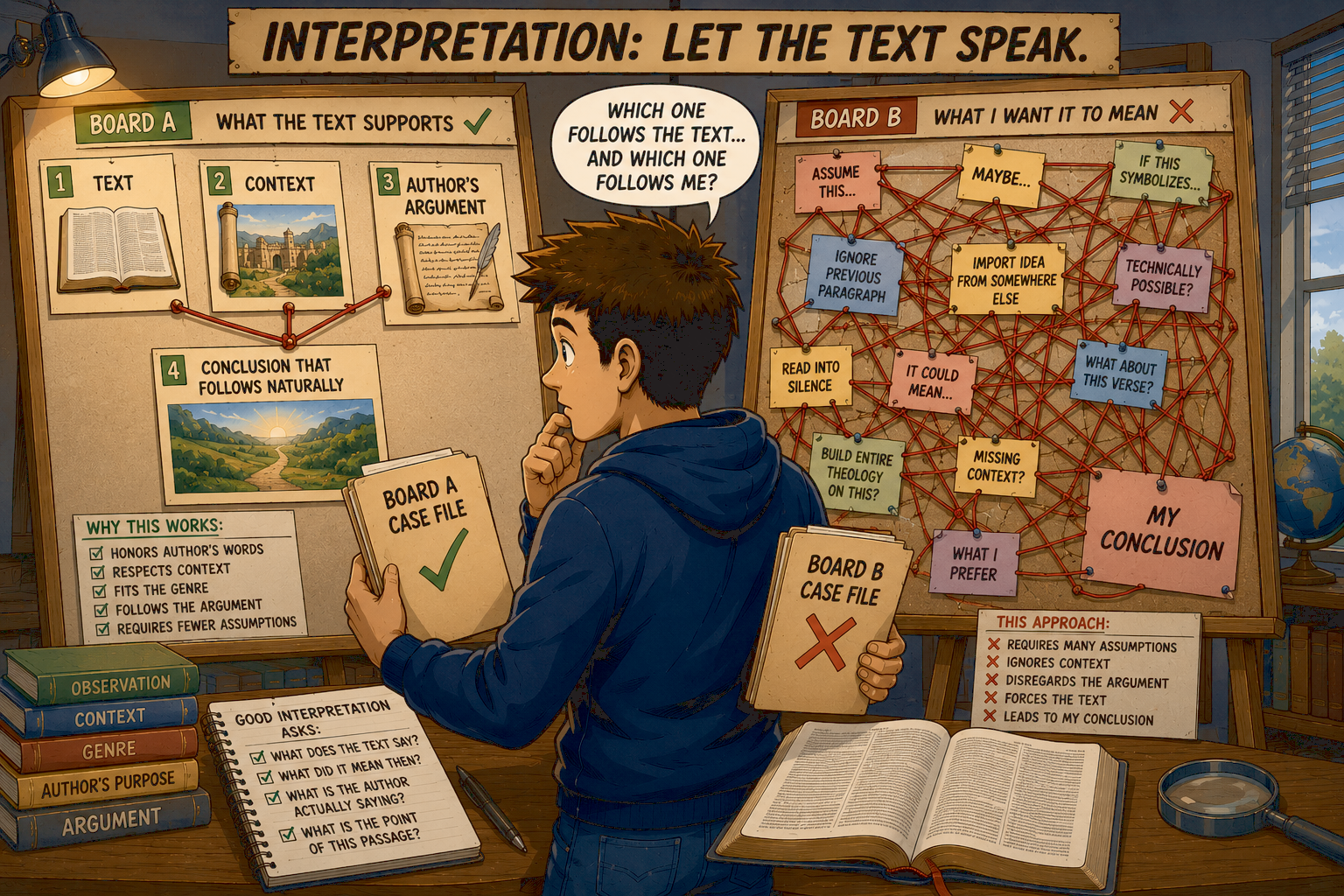
The discipline of good interpretation pushes against that instinct. Instead of asking, “Can I make this verse support my conclusion?” it asks a much more difficult question: “Is my conclusion the one this author was trying to lead me toward?”
Those are very different questions.
The first places me in control of the conversation. The second leaves the author in control.
That is why observation is so important. The more evidence I gather before reaching a conclusion, the more likely it is that my interpretation will grow naturally out of the passage instead of being imposed upon it. Context, genre, repeated ideas, the flow of the argument, and the purpose of the book all act as safeguards. They don’t do the interpreting for me, but they keep pulling me back toward the author’s intended meaning whenever I’m tempted to wander.
I’ve found that faithful interpretation is often less about discovering something no one has ever seen before and more about having the humility to let the text lead me where it has been pointing all along. Sometimes that confirms what I already believed. Sometimes it challenges me. Either way, I want my conclusions to be shaped by Scripture rather than asking Scripture to conform to my conclusions.
One question has become increasingly helpful to me over the years whenever I’m weighing two possible interpretations of a passage.
Which one requires fewer assumptions?
Suppose one interpretation can be demonstrated directly from the words on the page. The argument follows naturally from the author’s train of thought, fits the context, respects the genre, and doesn’t require me to import ideas from somewhere else. Now suppose another interpretation reaches a different conclusion, but only after making several assumptions the text never states. It may still be possible, but I immediately become more cautious.
I’ve found that many disagreements in Bible study don’t begin because someone ignored the Bible altogether. They begin because two people disagree about how many assumptions they’re willing to make. One person is content to stop where the evidence stops. The other continues building beyond what the author actually wrote.
That doesn’t mean every assumption is wrong. Communication often involves reasonable inferences, and the biblical authors expected their readers to connect ideas. The question is whether those inferences are being driven by the text or by our own preferences.
I’ve tried to make it a habit to ask myself a simple question whenever I arrive at a conclusion:
“Can I show someone why I believe this from the passage itself?”
If the answer is yes, my confidence grows.
If the answer is, “Well, you have to assume…” then I know I’ve reached a place where I should hold my conclusion with a little more humility.
I’ve discovered that there is great freedom in admitting the difference between what the text clearly says and what I think is a reasonable conclusion. Those two things are not always equal, and treating them as though they are has been the source of countless unnecessary disagreements among sincere Christians. The closer my interpretation stays to what the author actually wrote, the firmer the ground beneath my feet becomes.
That realization also changed the way I think about certainty.
For a long time, I had a tendency to treat every conclusion I reached as though it deserved the same level of confidence. If I believed it, I defended it with equal conviction, whether the passage stated it plainly or whether I had arrived there after connecting several ideas together.
I don’t think that’s a healthy way to read any book, and I certainly don’t think it’s the healthiest way to read the Bible.
There are truths that Scripture states with remarkable clarity. The death and resurrection of Christ, salvation by grace through faith, the reality of sin, the coming judgment, and the lordship of Christ are not conclusions that depend upon a long chain of assumptions. The biblical authors repeatedly and explicitly teach them. Those are places where we can stand with great confidence because our confidence rests on what the text plainly says.
There are other subjects, however, where arriving at a conclusion requires more careful reasoning. We compare passages, weigh different interpretations, and attempt to understand how several texts fit together. That work is worthwhile, and Christians should engage in it thoughtfully. At the same time, I think wisdom requires us to recognize that a conclusion built upon several inferences should often be held with more humility than one resting upon an explicit statement of Scripture.
I’ve found that making this distinction has been incredibly freeing. It allows me to be deeply convinced where Scripture speaks clearly while remaining teachable where my conclusions depend upon a series of interpretive decisions. Rather than weakening my confidence in the Bible, it has strengthened it because my confidence is now tied to the strength of the biblical evidence rather than to the strength of my own opinions.
That doesn’t mean we become indecisive or refuse to hold convictions. It simply means our confidence should be proportional to the evidence. Where the biblical authors speak plainly, we should speak plainly. Where careful reasoning is required, we should reason carefully, hold our conclusions honestly, and remain willing to have them corrected if Scripture demonstrates that we’ve misunderstood the author’s intent.
One of the greatest tests of our interpretation doesn’t come while we’re studying a difficult passage.
It comes when we encounter another passage that seems to challenge the conclusion we’ve already reached.
At that moment, we have a choice.
We can immediately begin explaining away the new passage so our existing view remains untouched, or we can slow down and ask whether the biblical author is forcing us to reconsider something we previously believed.
I don’t mean that every difficult verse should cause us to abandon our convictions. If that were the case, we’d never believe anything for very long. Mature interpretation requires patience. It requires weighing all of Scripture before reaching a conclusion. At the same time, I don’t think we should be so committed to our own systems that we’re unwilling to let a passage challenge them.
I’ve found it helpful to imagine building a puzzle. If one piece refuses to fit, I have two options. I can force it into the place I expected it to go, or I can admit that perhaps I’ve misunderstood the picture I’m trying to assemble. Forcing the piece may make me feel as though I’ve solved the puzzle, but it doesn’t actually solve anything. It only creates problems that become more obvious as more pieces are added.
The Bible deserves better than that.
Every passage has a rightful place, and our task is to discover how the biblical authors fit together rather than forcing one author to say what another never intended. When Paul, Moses, David, Luke, or John speak, each deserves to be heard on his own terms before we begin connecting his words to the rest of Scripture. Only then can we begin building a theology that grows out of the text instead of requiring the text to fit a theology we have already constructed.
I think this is one of the reasons humility is so essential to interpretation. The goal is never to prove that my system is correct. The goal is to understand what God has revealed. If that requires adjusting my understanding, then it is my understanding that should move, never the text.
One habit that has served me well is asking not only what an interpretation explains, but also what it leaves unexplained.
Almost every interpretation sounds convincing when we only focus on the evidence that supports it. The real test comes when we begin asking harder questions. Does this conclusion account for the entire passage, or only part of it? Does it explain the verses that seem inconvenient, or does it quietly move past them? Does it fit naturally within the flow of the author’s argument, or does it require me to set certain details aside because they don’t fit my conclusion?
I’ve noticed that weaker interpretations often have a common characteristic. They spend most of their time explaining why they’re right and very little time explaining the evidence that appears to point in another direction. Stronger interpretations don’t have that luxury. They have to wrestle honestly with every part of the text, even the parts that initially seem difficult to reconcile.
That doesn’t mean a good interpretation answers every question. Some passages remain challenging, and faithful Christians will continue disagreeing about them. It does mean that we should resist the temptation to build our conclusions by collecting only the evidence we already like. If a verse seems to push against my interpretation, I want to know why. Perhaps I’ve misunderstood that verse. Perhaps I’ve misunderstood the passage I’m studying. Either way, pretending the tension doesn’t exist won’t help me arrive at the truth.
I’ve found that some of my greatest growth has come from the passages that refused to fit neatly into the conclusions I had already reached. Those moments forced me back into the text with fresh eyes. Sometimes I came away more convinced than before because the evidence held together. Other times I discovered that my interpretation had been carrying more weight than the passage itself could support.
That’s one of the reasons I no longer fear difficult passages. They are often God’s way of reminding me that my loyalty belongs to His Word, not to my first impression of it.
Over the years, I’ve also become suspicious of interpretations that continually move me farther away from the text instead of bringing me back to it.
There are certainly passages that require careful study. Some questions take years of reading, comparing Scripture with
Scripture, and thinking through difficult issues before we arrive at a conclusion. There is nothing wrong with hard work. In fact, we’ve already established that careful Bible study often requires it.
What has made me cautious is something different.
If an interpretation can only survive by constantly appealing to information outside the passage while paying less and less attention to the passage itself, I begin asking whether I’ve lost sight of the author’s argument. The purpose of historical background, theology, language studies, and commentaries is to help me understand the text more accurately, not to replace it. The farther my explanation drifts from what the author actually wrote, the more carefully I think it deserves to be examined.
I’ve found that faithful interpretation has a way of bringing me back to the page. After hearing an explanation, I should be able to return to the passage and say, “I see why you reached that conclusion.” The interpretation should illuminate the text rather than compete with it. It should help me notice things the author actually said, not distract me with ideas the author never discussed.
That doesn’t mean the simplest interpretation is always the correct one, nor does it mean every difficult passage has an easy answer. It simply means that a good interpretation leaves the biblical author at the center of the conversation. Even after I’ve benefited from teachers, commentaries, and years of study, I should still find myself reading the passage with greater clarity rather than greater dependence on someone else’s explanation.
I think that’s a healthy test for any interpretation. When all is said and done, does it send me back to the Scriptures with a better understanding of what the author wrote, or has it quietly shifted my attention somewhere else? The best interpretations I’ve encountered have always done the former. They haven’t replaced the text. They’ve helped me see it more clearly.
One of the greatest obstacles to good interpretation has very little to do with the Bible.
It has to do with our pride.
No one enjoys discovering they’ve been wrong. We invest time in our conclusions. We teach them to others. We defend them in conversations. Sometimes we’ve believed them for decades. By the time evidence begins pointing in another direction, changing our minds can feel like admitting defeat.
I don’t think it should.
If my goal is to understand God’s Word, then discovering that I misunderstood a passage isn’t a failure. Refusing to correct that misunderstanding would be.
Imagine taking a wrong turn while driving. The moment you realize it, you have a choice. You can keep driving because you’ve already committed to that road, or you can turn around and continue toward your destination. No one congratulates the driver who stubbornly continues in the wrong direction simply because turning around would be embarrassing. We recognize that correcting the mistake is part of reaching the destination.
Bible study is much the same way.
Every correction brings us closer to the author’s intended meaning. Every time we allow Scripture to reshape one of our conclusions, we aren’t moving farther away from the truth; we’re moving closer to it. That is something to celebrate, not something to resist.
I think that perspective changes the atmosphere of Bible study. Instead of feeling threatened by difficult passages or alternative interpretations, we begin welcoming opportunities to examine our conclusions more carefully. We stop asking, “How can I defend what I’ve always believed?” and begin asking, “What best explains what the author wrote?”
That is a very different posture.
It replaces the desire to win with the desire to understand.
And in my experience, Christians who remain teachable throughout their lives rarely do so because they are always right. They remain teachable because they have decided that being corrected by Scripture is one of God’s greatest kindnesses. They know that every time His Word exposes one of their mistakes, it is also leading them one step closer to the truth He intended them to know.
As we’ve worked through this chapter, I hope you’ve noticed that interpretation is both simpler and more demanding than many of us imagined.
It’s simpler because we aren’t searching for hidden meanings buried beneath the text. We aren’t trying to discover secret messages that only a handful of people have been able to unlock. We’re reading ordinary language written by real authors who intended to communicate with real people.
At the same time, interpretation is demanding because it requires something from us. It requires patience when we’d rather rush to a conclusion. It requires humility when we’d rather defend our opinions. It requires honesty when the evidence begins pointing somewhere we didn’t expect to go. Above all, it requires a willingness to let the biblical author lead the conversation instead of insisting that he answer the questions we most want to ask.
If you’ve followed the progression of this book, you’ve probably noticed that every chapter has been building toward this point. We learned to read whole books because books provide context. We learned to recognize genre because authors communicate through different kinds of writing. We learned to observe because interpretation depends upon seeing what is actually on the page. None of those disciplines compete with one another. Together, they protect us from arriving at conclusions that the author never intended us to reach.
Of course, interpretation is not the final step. God did not give us His Word merely so we could arrive at correct con- clusions. He gave it so that we might know Him, trust Him, and be transformed by the truth He has revealed. A correct interpretation that never changes the reader has still fallen short of the purpose of Scripture.
That raises one final question.
Once we’ve done the hard work of understanding what the biblical author meant, how do we faithfully bridge the gap between their world and ours? How do we move from the original meaning of the text to living in light of that truth today without twisting the passage to fit our own circumstances?
That is the task of application, and it is where we now turn.