
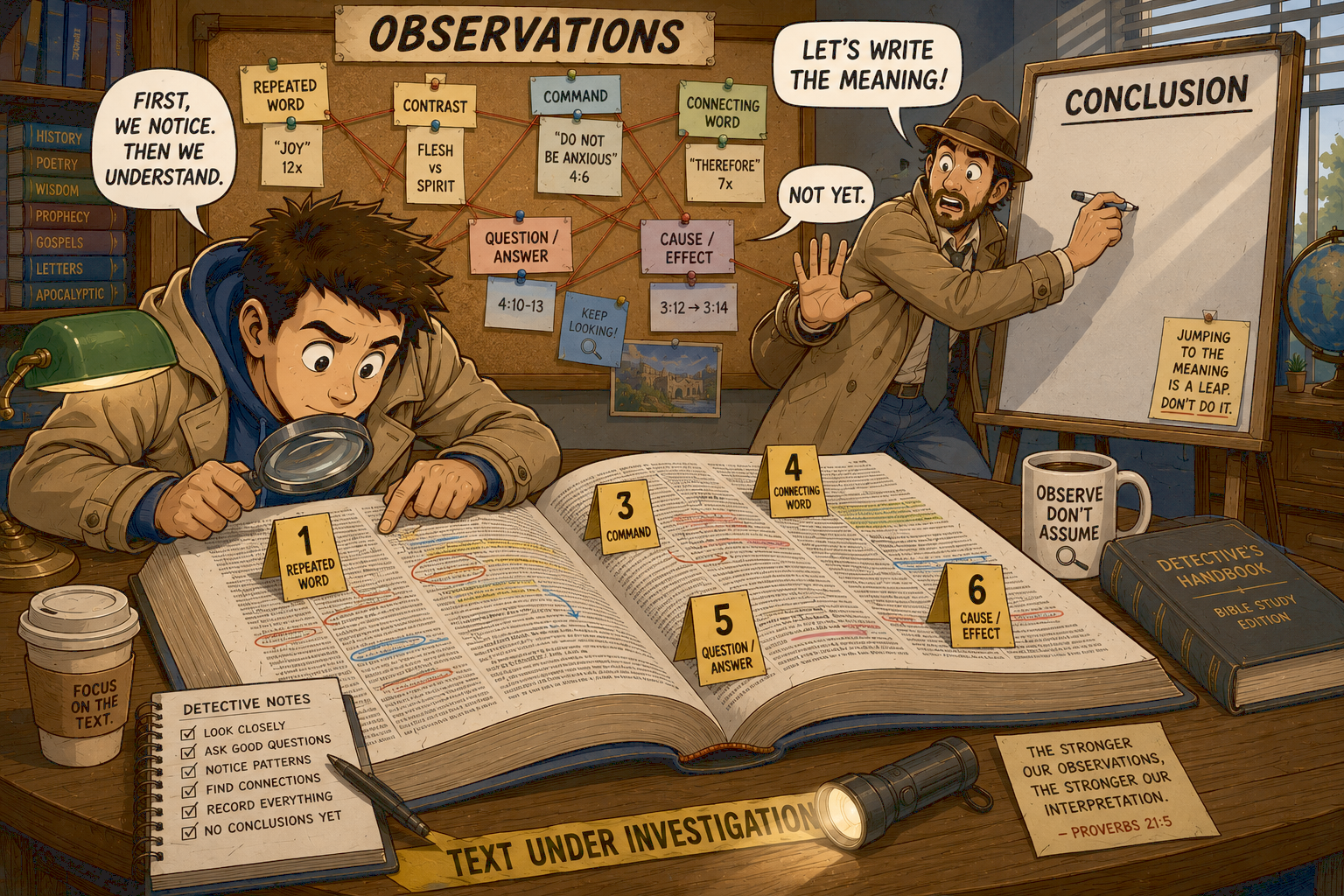
Have you ever finished a movie only to have someone ask a question that makes you realize you weren’t paying nearly as much attention as you thought?
“What color was the car?”
“I don’t know.”
“What was the man’s name?”
“I don’t remember.”
“Did you notice the picture hanging on the wall during that conversation?”
“What picture?”
The funny thing is that you watched the entire movie. Your eyes never left the screen. You saw every scene, heard every conversation, and followed the story well enough to understand what was happening. Yet the moment someone began asking specific questions, you discovered there was a difference between seeing and observing.
Reading can be exactly the same way.
Most of us have finished a chapter of the Bible only to realize we couldn’t answer some very basic questions about what we just read. What subject was the author discussing? Did he repeat any words or ideas? Was he answering a question? Was he correcting a misunderstanding? Did his tone change at any point? Often we simply don’t know, not because the information wasn’t there, but because we never trained ourselves to look for it.
I don’t mean that as a criticism.
Observation is a skill.
Like any other skill, it improves with practice.
The encouraging part is that becoming a better observer doesn’t require learning Greek, attending seminary, or buying a shelf full of expensive books. It begins by slowing down long enough to notice what the author has already placed on the page. In many ways, observation is simply paying attention with purpose. Instead of reading until we reach the end of the chapter, we begin asking ourselves what the author keeps drawing our attention toward.
That may sound almost too simple, but I’ve become convinced that many interpretive mistakes don’t begin because we reached the wrong conclusion. They begin because we overlooked the evidence the author had already given us. Before we can interpret faithfully, we first have to become careful observers. Fortunately, that’s a skill every Christian can develop, and it starts with learning to notice what has been there all along.
One of the easiest mistakes to make while reading the Bible is thinking we’ve observed something when we’ve actually interpreted it.
Those aren’t the same thing.
Suppose I read that Jesus crossed the Sea of Galilee. That’s an observation. It’s simply something the text tells me happened.
Now suppose I begin explaining why He crossed the sea, what theological significance the journey has, or how it applies to my life. None of those things are observations. They may be good conclusions, and they may even be correct conclusions, but they come after I’ve first observed what the text actually says.
That order matters.
Imagine a detective arriving at a crime scene. If he decides who committed the crime before gathering any evidence, we wouldn’t call him a very good detective. We would expect him to examine the scene, collect the evidence, interview witnesses, and only then begin drawing conclusions. The quality of his conclusions depends upon the quality of his observations.
Bible study works much the same way.
The stronger my observations, the stronger my interpretation is likely to be. If my observations are careless, rushed, or incomplete, there’s a good chance my conclusions will be as well. That’s one of the reasons I’ve tried to become comfortable sitting with a passage before deciding what I think it means. I want to gather as much evidence as I can before reaching a conclusion.
This is also one of the reasons sincere Christians sometimes arrive at different interpretations. They aren’t always disagreeing because they reason differently. Sometimes they’re reasoning from different observations. One person notices something another completely overlooked. Another sees a connection that hadn’t occurred to anyone else. That’s why learning to observe carefully is so valuable. It gives us a stronger foundation before we ever begin interpreting what we’ve read.
As we continue through this chapter, we’re going to practice exactly that. For a little while, we’re going to resist the urge to explain the text. Instead, we’re simply going to learn to notice it. It’s amazing how much begins to stand out once we give ourselves permission to look before we leap.
Let’s try an experiment.
The next time you sit down to read a chapter of Scripture, make yourself one promise.
Don’t try to interpret it.
I know that sounds strange. After all, understanding the Bible is the whole reason we’re reading it. But for just one reading, resist the temptation to answer every question that pops into your mind. Instead, pretend you’re an investigator arriving at the scene for the first time. Your job isn’t to solve the case. Your job is to notice everything you can before you decide what any of it means.
You may be surprised by what happens.
Without even trying, you’ll begin seeing things you missed before. Certain words seem to appear again and again. An idea that looked unimportant the first time suddenly feels central because the author keeps returning to it. A question is asked early in the chapter and quietly answered later. A command is followed by a reason. An illustration explains an argument. None of those observations require special training. They were always there. Slowing down simply gives you the opportunity to notice them.
I’ve found that observation has a way of rewarding patience. The first reading introduces me to the passage. The second begins to reveal its structure. By the third or fourth reading, I often notice connections that never stood out before. The text hasn’t changed. I’ve simply become a better observer because I stopped reading as though my only goal was to reach the end of the chapter.
That is one of the habits worth developing as early as possible. We live in a world that rewards speed. We skim articles, scroll through posts, and consume information as quickly as we can. Scripture invites us to do something very different. It invites us to linger. The biblical authors were not writing to be skimmed. They were writing to be understood, and understanding often comes to those who are willing to slow down long enough to notice what has been sitting on the page all along.
As I began reading more slowly, I also realized something that should have been obvious all along.
Authors leave clues.
Not hidden clues.
Obvious ones.
Think about the last conversation you had with a friend. If they repeated the same concern three or four times, you wouldn’t assume it was accidental. If they suddenly changed the subject, you’d notice. If they asked a question and then spent the next several minutes answering it, you’d naturally follow their reasoning. We don’t need someone to teach us those instincts because we use them every day.
The biblical authors communicate the same way.
When Paul repeats a word several times, there’s usually a reason. When Luke spends far more time describing one event than another, he’s directing our attention somewhere. When Moses pauses the narrative to explain something, he expects us to notice that the interruption matters. Good writers are constantly guiding their readers, not by hiding their point, but by emphasizing it.
The challenge isn’t that those clues are difficult to find. The challenge is that we’re often reading with our eyes fixed on the finish line instead of the road beneath our feet. We want to know what the passage means, so we rush toward an interpretation before we’ve paid attention to the signals the author has placed along the way.
I’ve become convinced that observation is really an exercise in learning to pay attention to emphasis. Every author has countless facts they could include and countless others they could leave out. The things they repeat, the details they expand, the questions they answer, and even the order in which they present their material are rarely random. Those decisions help us understand what the author considered important.
The more I notice those patterns, the less I feel like I’m forcing meaning onto the text. Instead, I begin following the path the author has already laid out for me. That’s where observation becomes so rewarding. Rather than inventing significance, I’m discovering the significance the author intentionally built into the passage.
One of the most encouraging discoveries I’ve made is that good observation isn’t about seeing everything the first time.
In fact, I hope you don’t.
If you did, there would be very little reason to return to the passage. One of the joys of reading Scripture is discovering that familiar passages continue rewarding careful attention years after we first encountered them. Not because God is constantly changing their meaning, but because we are growing as readers.
Think about a favorite book you’ve read more than once. The second reading is rarely identical to the first. You already know the story, so your attention is free to settle on details you overlooked before. You notice conversations that foreshadow later events. You recognize why a particular character was introduced. Small details that once seemed insignificant suddenly fit into the larger picture.
The Bible often rewards us in the same way.
Each time we return to a passage, we bring with us a better understanding of the book, its context, and its purpose. Because of that, details that once seemed ordinary begin to stand out. A repeated phrase catches our attention. A transition suddenly makes sense. An illustration connects with an argument we hadn’t fully understood before. None of those observations require us to invent new meaning. They simply deepen our appreciation for the meaning that has been there all along.
That has taught me not to become discouraged when I realize I’ve overlooked something. Instead, I see it as an invitation to keep reading. Careful observation isn’t a race to see who can discover the most details. It’s the patient practice of learning to listen more carefully each time we open God’s Word. Every passage doesn’t have to reveal everything at once. Sometimes the author is inviting us to stay with him a little longer, and in doing so, we find that what seemed familiar still has much to teach us.
As I became more attentive to what the biblical authors included, I also began noticing something else.
They were constantly deciding what not to include.
That may not seem significant at first, but every author makes those decisions. No one records every conversation, every detail, or every event. Writing always involves selection. The author chooses what serves his purpose and leaves the rest behind.
That realization changed the kinds of questions I asked while reading.
Instead of wondering why the author didn’t tell me everything I wanted to know, I began asking why he chose to tell me what he did.
Why does Luke spend so much time on this event but only a few verses on another?
Why does Paul repeat this idea but never mention something I’m curious about?
Why does Moses slow the story down here and move quickly through another section?
Those aren’t questions born out of skepticism. They’re questions that assume the author was writing intentionally.
I’ve found that those questions often lead to better observations than trying to answer questions the passage was never attempting to address. Every biblical author had far more material available than could fit into a single book. Under the inspiration of the Holy Spirit, each one selected exactly what was needed to accomplish God’s purpose.
That means I don’t need to be frustrated by what isn’t on the page.
My responsibility is to pay careful attention to what is.
The more I trust that the author wrote intentionally, the more closely I find myself following his train of thought instead of constantly trying to lead him somewhere else. In the end, that’s what observation really is. It’s giving the author the courtesy of believing he knew what he was doing and then taking the time to notice the path he has carefully laid before us.
One unexpected result of learning to observe more carefully is that it has made me slower to become overly confident in my first impression of a passage.
There was a time when I could read a verse, immediately decide what it meant, and move on without another thought. The more I studied, however, the more I realized how often there were details I hadn’t noticed the first time through. Sometimes it was a repeated word. Sometimes it was the flow of the argument. Other times it was a simple transition that completely changed the relationship between two paragraphs.
That realization wasn’t discouraging.
It was freeing.
It reminded me that I didn’t have to rush toward a conclusion simply because I had finished reading the chapter. If I was still observing, I was still making progress. In fact, some of the most profitable time I’ve spent in Scripture has come before I ever attempted to interpret what I was reading.
I think our culture has conditioned us to value answers more than questions. We feel pressure to arrive at a conclusion as quickly as possible, as though taking our time somehow reflects uncertainty or weakness. Good readers know better. They understand that careful observation is not a delay in the process; it is part of the process. The quality of our interpretation is often determined long before we begin explaining a passage. It is determined by how carefully we first listened to the author.
That has become one of the simplest prayers I pray before opening my Bible.
“Lord, help me to see what is actually here.”
Not what I expect to find.
Not what I’ve always been told is there.
Not what would be most convenient for my argument.
Simply what You inspired the author to write.
If I can begin there, I’ve already taken a significant step toward handling God’s Word faithfully.
Up to this point, we’ve been talking about observation in fairly broad terms. We’ve said that it involves slowing down, paying attention, and allowing the author to guide us through the passage. All of that is true, but observation becomes much easier once you begin practicing it for yourself.
The encouraging news is that observation is not a gift given to a select few. It isn’t reserved for pastors, professors, or people who know Greek and Hebrew. Like learning to play an instrument or recognizing the face of an old friend in a crowd, it develops over time. The more you do it, the more natural it becomes.
That also means you shouldn’t become discouraged if you don’t notice everything at first. No one does. Every careful reader has looked back on a passage they thought they understood and later discovered details they had completely overlooked. That isn’t evidence of failure. It’s evidence that they continued growing as readers.
In the chapters ahead, we’re going to spend less time talking about these principles and more time putting them into practice. We’ll look at passages together, make observations before drawing conclusions, and intentionally slow the process down. My hope is that, by watching the process repeatedly, you’ll begin doing it almost without thinking. Eventually you’ll open a passage and find yourself noticing patterns, questions, repeated ideas, and transitions that once slipped by unnoticed.
That’s really the goal of this book.
Not that you would memorize a collection of rules, but that you would slowly develop the instincts of a careful reader. Once those instincts begin to take root, you’ll discover that good Bible study feels less like following a formula and more like listening attentively to someone who has something important to say.
Observation, by itself, isn’t the goal.
I can notice every repeated word, every transition, every question, and every literary feature in a passage, yet still fail to understand what the author meant. Observation alone doesn’t produce interpretation.
It produces evidence.
That’s an important distinction because good interpretation doesn’t begin with conclusions. It begins with evidence. The more carefully I observe the text, the stronger the foundation becomes for everything that follows. If I overlook what the author emphasized, ignore the flow of his argument, or fail to notice the details he intentionally included, I shouldn’t be surprised if my conclusions begin drifting away from his intended meaning.
In many ways, observation is an act of humility. Before I tell the text what I think it means, I first allow the text to tell me what it actually says. I resist the temptation to rush ahead because I recognize that understanding usually belongs to those who are patient enough to gather the evidence before drawing their conclusions.
That has become one of the most valuable lessons Scripture has taught me. I no longer feel the need to arrive at an answer as quickly as possible. I’d rather spend another hour making careful observations than spend years defending a conclusion that was built on a careless reading.
As we’ve seen throughout this book, every step builds upon the one before it. We read entire books because books provide context. We pay attention to genre because authors communicate through different kinds of writing. We learn to observe because interpretation depends upon seeing what the author has actually written. None of these ideas stand alone. Together, they form the habits of a careful reader.
The next step is learning what to do with those observations. Once we’ve gathered the evidence, how do we arrive at sound conclusions without adding to the text or taking away from it? That is the task of interpretation, and it is where we turn next.