
Reading the Bible the Way It Was
Written
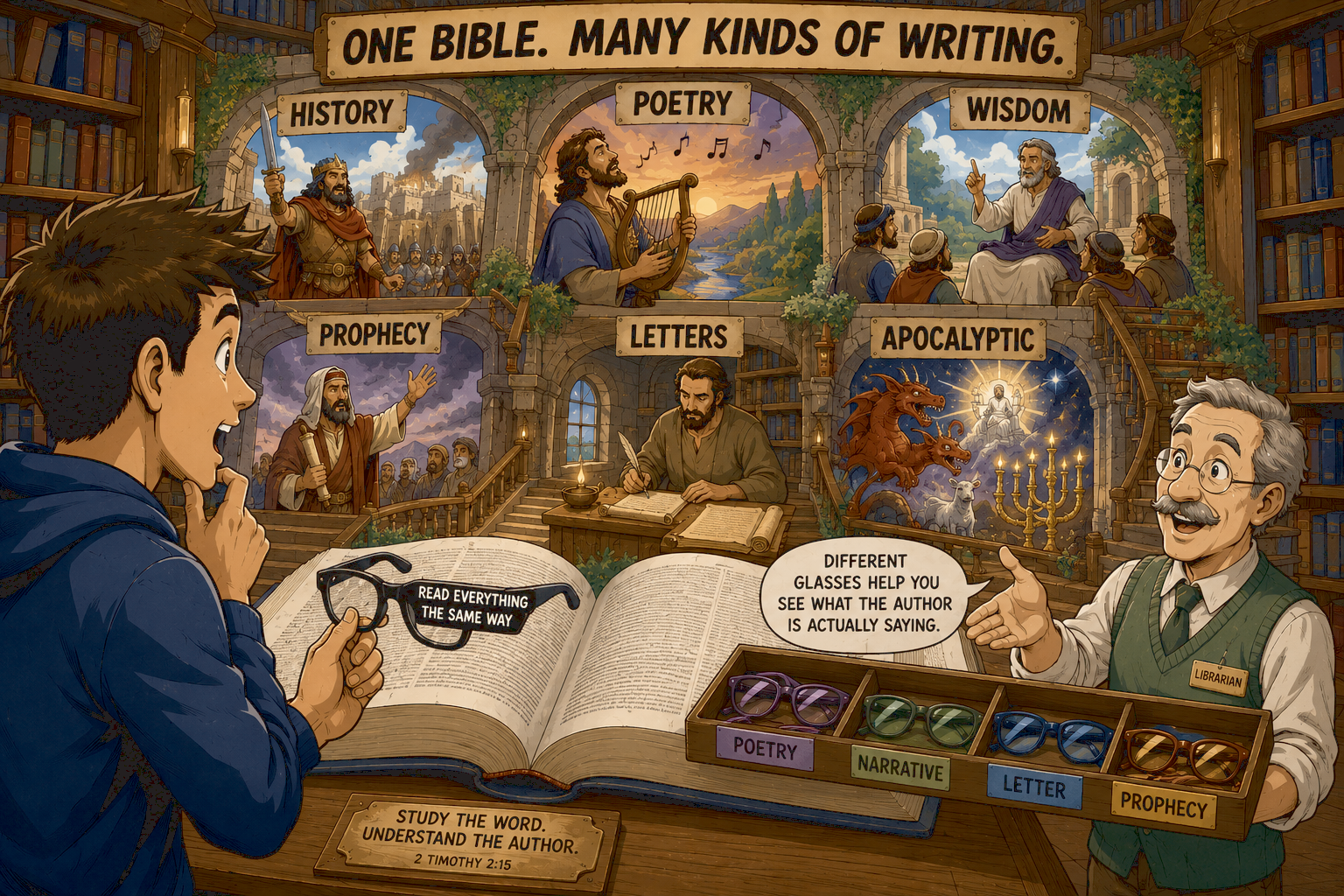
So the Bible is a book. I know that because it has a cover. It even says “Bible” right there on the front. If I begin at Genesis and read all the way to Revelation, I can honestly say I’ve read a book. Well…not exactly. I’ve actually read more than sixty books. Not only that, but I’ve read many different kinds of books gathered together into one volume. Some of those books are historical accounts. They’re telling us about events that took place in the lives of real people at particular moments in history. Some are letters. They are correspondence written by one person to another or to a particular church for a specific reason. Some are poetry. They communicate through imagery, parallelism, and emotion in ways that history never attempts to do. Some are collections of wisdom. Some are prophecy. Some contain vivid apocalyptic imagery that communicates in a way unlike anything else in Scripture. The point I’m slowly working my way toward is a simple one. I don’t read every kind of writing the same way. When I pick up one of The Lord of the Rings novels, I don’t read it the same way I would read Antiquities of the Jews. Why? Because they aren’t trying to accomplish the same thing. One is telling a fictional story through an imagined world. The other is attempting to record history. If I read Tolkien expecting historical documentation, I’ll completely misunderstand what he is trying to do. If I read Josephus as though he were writing fantasy, I’ll miss his purpose just as badly. We understand this instinctively everywhere else. Before we decide what a piece of writing means, we usually recognize what kind of writing it is. The Bible deserves the same courtesy. If God chose to communicate through history, we should read it as history. If He chose to communicate through poetry, we should allow poetry to communicate the way poetry does. If He inspired a letter, we should read it as a letter. The meaning doesn’t change because of the genre, but our expectations should. Every author expects his readers to understand the kind of writing they have in front of them, and the biblical authors are no exception.
Recognizing the kind of writing we’re reading doesn’t change whether it’s true.
It changes how the truth is being communicated.
Think back to school for a moment.
Your history teacher might tell you that a battle took place in a particular year, between particular nations, resulting in a particular outcome. Every detail is intended to communicate historical fact.
Then you walk into English class and read a poem describing the sunrise as “painting the sky with fire.”
Nobody raises their hand and objects, “Actually, the sky isn’t on fire.”
Everyone understands what the poet is doing.
The poet isn’t lying.
The historian isn’t being unimaginative.
They’re communicating truth in different ways because they’re writing different kinds of literature.
The Bible does exactly the same thing.
When David writes, “The Lord is my shepherd,” no one imagines that God literally spends His days herding sheep through the hills of Israel. We instinctively recognize that David is using imagery to communicate something wonderfully true about God’s care, protection, and guidance. The picture isn’t less true because it’s poetic. In many ways, it communicates those truths more beautifully than a straightforward definition ever could.
Likewise, when Luke tells us that Jesus entered a particular city, met particular people, and spoke particular words, he isn’t writing poetry. He’s recording history. We honor his writing by reading it as history, just as we honor David’s writing by reading it as poetry.
This is one of the beautiful things about Scripture.
God didn’t choose one form of communication and force every biblical author to write the same way. Instead, He inspired each author to communicate through the kind of writing best suited to what He wanted to reveal. Sometimes that meant history. Sometimes it meant poetry. Sometimes it meant a personal letter. Sometimes it meant prophecy filled with vivid imagery.
The truth never changes.
The way it is communicated sometimes does.
Recognizing that isn’t making excuses for the Bible.
It’s simply allowing each author to speak in the way God inspired him to speak.
Understanding the different kinds of writing in Scripture also reminds us of something wonderfully simple.
Your Bible doesn’t come with a secret decoder ring.
There’s a reason for that.
God didn’t inspire a code.
He inspired history, letters, poetry, wisdom, prophecy, and apocalyptic literature. None of those forms of writing require us to discover a hidden key before we can begin understanding them. They require us to read them according to the way they were written.
If I handed you a letter from your grandmother, you wouldn’t begin searching for a secret meaning hidden beneath every sentence. You would simply read the letter.
If I handed you a history book, you wouldn’t assume every event was symbolic.
If I handed you a poem, you wouldn’t insist every image had to be taken with wooden literalism.
You already know how to read these kinds of writing because you’ve been reading them your entire life.
The Bible isn’t asking you to learn an entirely new form of communication.
It’s asking you to recognize the form that’s already in front of you.
I think that should encourage us.
Sometimes Christians speak as though the Bible is a giant puzzle that only a handful of experts have learned to solve. That picture has never made much sense to me. God gave His Word to His people, not to an elite class of codebreakers. He intended it to be read, understood, believed, and obeyed.
That doesn’t mean every passage is equally simple. Some sections will require careful study, and others have challenged faithful believers for centuries. But difficult is not the same thing as hidden.
The Bible isn’t a cryptogram.
It isn’t a treasure map with clues scattered beneath the surface.
It is God’s revelation, communicated through ordinary human language, using ordinary forms of writing, so that ordinary people can come to know the extraordinary God who gave it.
If that’’s true, then the next question is obvious.
What kinds of writing do we actually find in the Bible?
We could spend an entire book answering that question, but for our purposes, we only need a broad understanding of the major kinds of literature God chose to use.
Some books tell history.
When you’re reading books like Joshua, Judges, Kings, or Acts, you’re reading accounts of people, places, and events. That doesn’t mean every person in those books should be imitated. History records what happened, not necessarily what should have happened. Sometimes the Bible records tremendous acts of faith. Other times it records some of humanity’s darkest moments. The author’s goal is often to tell you what happened before asking you to consider why it happened.
Other books are letters.
We’ve already seen this with Philippians. A letter is written by someone to someone else for a reason. That means we’re listening in on a real conversation between real people. Before we ask what that letter means for us, we first ask what it meant to those who first received it. Once we’ve understood that, we’re in a much better position to understand how its truths apply to us today.
Then there is poetry.
Poetry slows us down. Rather than simply giving us information, it paints pictures, stirs our emotions, and helps us feel the weight of truth. When David writes about green pastures, still waters, and the shadow of death, he isn’t trying to confuse us. He’’s communicating in a way that prose never could. The imagery serves the truth rather than hiding it.
We’ll also encounter wisdom literature.
Wisdom literature teaches us how life generally works in God’s world. It offers observations, principles, and practical instruction for living wisely. That is different from an unconditional promise. Understanding that distinction protects us from expecting wisdom sayings to function as guarantees they were never intended to be.
Finally, there are prophecy and apocalyptic literature.
These books often contain vivid imagery, symbolism, visions, and poetic language. They can seem intimidating at first, but they weren’t written to frustrate God’s people. Like every other part of Scripture, they were written to communicate. The key is allowing them to communicate according to the kind of writing they are instead of forcing them to behave like a historical narrative or a personal letter.
Notice what all of these have in common.
They are different roads leading to the same destination.
Every genre communicates truth.
Every genre reveals God.
Every genre deserves to be read according to the way God inspired it to be written.
Once we begin doing that, many passages that once seemed strange or confusing become much easier to understand, not because we’ve discovered a secret method, but because we’ve finally started reading them the way their authors intended.
Once we understand that the Bible contains different kinds of writing, another question naturally follows.
What happens if I read one genre as though it were another?
The answer is simple.
I’ll probably misunderstand it.
Take the Gospels as an example.
They contain prophecy. Jesus predicts future events. But the
Gospels themselves are not prophetic books in the same sense as Isaiah or Ezekiel. They are historical accounts recording the life, ministry, death, and resurrection of Jesus Christ.
That distinction matters.
When I read Jesus saying, “Truly, I say to you, this generation will not pass away until all these things take place,” I first need to remember what kind of book I’m reading.
I am reading history.
Matthew is recording something Jesus actually said to a particular audience at a particular moment in history.
The first question, therefore, isn’t, “What is Jesus saying to me about my generation?”
The first question is, “What did Jesus mean when He said those words to the people standing in front of Him?”
Only after I understand that historical event can I begin asking what implications it has for Christians today.
If I skip that first step and immediately read the passage as though Matthew were writing a prophetic book directly to twenty-first-century readers, I’ve quietly changed the genre. I’ve stopped reading history and started reading myself into the story. Once that happens, it becomes very easy to assign meanings to the passage that Matthew never intended his readers to find.
This isn’t unique to prophecy.
If I read poetry as though it were a scientific textbook, I’ll misunderstand it.
If I read Proverbs as though every proverb were an unconditional promise, I’ll misunderstand it.
If I read a personal letter without remembering that it was written to real people facing real circumstances, I’ll misunderstand it.
In every case, the mistake is the same.
I have asked the author to write a different kind of book than the one he actually wrote.
The safest approach is the simplest one.
Let history be history.
Let poetry be poetry.
Let letters be letters.
Let prophecy be prophecy.
When we allow each biblical author to communicate through the form God inspired him to use, we place ourselves in the best position to hear what God intended to say through that author.
I’ve occasionally heard people worry that paying attention to genre somehow weakens our confidence in the Bible.
I’ve never understood that concern.
Recognizing the kind of writing God inspired doesn’t lessen His Word any more than recognizing a hymn as a hymn somehow makes it less true than a sermon. Truth isn’t determined by the form in which it is communicated. It’s determined by the God who communicates it.
In fact, I would argue that ignoring genre is what ultimately weakens our confidence in Scripture.
If I insist on reading poetry like history, I will eventually accuse the poet of saying things he never intended to say. If I treat wisdom literature like a list of unconditional guarantees, I’ll become confused when life doesn’t unfold the way I expected. If I read a historical account as though every event were secretly about me, I’ll slowly lose sight of what God actually accomplished in history.
None of those problems exist because the Bible failed to communicate.
They exist because I asked the Bible to be something it never claimed to be.
One of the beautiful things about Scripture is that it never apologizes for the way it communicates. The historical books read like history because God chose to reveal Himself through history. The letters read like letters because God chose to shepherd His churches through correspondence written by apostles to real congregations. The Psalms sing because songs often express truths that prose cannot. The prophets speak with urgency because they were calling people to repentance and warning of God’s coming judgment.
Every genre is perfectly suited to the purpose God gave it.
That means my task isn’t to flatten them into one style of writing. My task is to appreciate each one for what it is. When I do that, I don’t lose confidence in Scripture. I gain confidence that God knew exactly what He was doing when He inspired each biblical author to write in the way that he did.
The more I study the Bible, the more convinced I become that God’s wisdom is seen not only in what He chose to say, but also in how He chose to say it.
That means the question isn’t whether one genre is more important than another.
The question is whether I’m willing to let each author communicate in the way God inspired him to communicate.
If I insist that every passage be read exactly the same way, I’m no longer listening to the author. I’ve already decided how the conversation is going to work before he has spoken his first sentence.
Imagine receiving a birthday card from your grandmother.
You open it expecting a heartfelt note, but instead you begin criticizing it because it doesn’t explain how to assemble a bookshelf. No one would read a birthday card that way because no one expects it to accomplish the same purpose as an instruction manual.
The same principle applies to Scripture.
When I open a Psalm, I shouldn’t expect it to read like the book of Acts. When I open Romans, I shouldn’t expect it to read like Proverbs. When I open Revelation, I shouldn’t expect it to sound like a personal letter to a local church. Each author is accomplishing something different, and recognizing that doesn’t weaken the authority of Scripture. It honors the way God chose to give it.
This also explains why the Bible sometimes feels so rich to read. You’re not reading the same kind of writing for fifteen hundred pages. One day you’re walking through Israel’s history. The next you’re listening to David pour out his heart in song. Then you’re reading a letter from Paul, followed by the visions of John. Reading through the Bible is less like reading a single novel and more like spending a day moving from one classroom to another. The subjects change, the style changes, and the way truth is presented changes, but the Teacher remains the same.
Once I began looking at the Bible that way, I stopped expecting every book to answer every question in the same manner. Instead, I began asking a much simpler question: “Why did God choose this kind of writing to communicate this truth?”
I’ve found that question opens the door to understanding far more often than trying to force every passage into the same mold.
That may sound like a small adjustment, but I think it has enormous practical consequences.
Imagine reading through the Psalms and coming across the words, “The rivers clap their hands.” No one stops and wonders what kind of sound a river makes when it applauds. We instinctively recognize poetic imagery because we know the kind of book we’re reading. The language is painting a picture rather than describing a literal event.
Now imagine carrying that same expectation into the book of Acts.
Luke tells us that Paul boarded a ship, traveled to a particular city, spoke with particular people, and was eventually imprisoned. If we suddenly decided that all of those events were merely symbolic, we wouldn’t be respecting the genre. We’d be ignoring it. Luke intended his readers to understand those events as history, and that’s how we honor his writing.
The opposite mistake is just as easy to make. We can become so committed to reading everything with strict literalism that we strip poetry of the very thing that makes it poetry. David says the mountains skip like rams and the trees clap their hands, not because he expects us to believe trees have palms, but because those images communicate joy, celebration, and the greatness of God in a way ordinary prose never could.
Neither author is being unclear.
Neither author is trying to deceive us.
Each is simply communicating according to the kind of writing God inspired him to produce.
Once we recognize that, many passages become less intimidating. We stop trying to make every book sound the same, and we begin appreciating the remarkable variety God has woven into His Word. The message remains unified because its Author is one, but the voices through which He speaks are wonderfully diverse, each contributing something unique to the grand story of redemption.
The more I study the Scriptures, the more convinced I become that God didn’t accidentally choose these different forms of communication.
There are things history can accomplish that poetry cannot.
There are things a personal letter can accomplish that history cannot.
There are things prophecy can communicate with a force that ordinary prose often cannot.
God could have inspired every biblical author to write the same way. He didn’t.
Instead, He gave us a library of books, each making its own unique contribution while together telling one unified story. That variety isn’t something to overcome. It’s something to appreciate.
The next time you open your Bible, before asking what a passage means, take just a moment to ask what kind of writing you’re reading. That one question has a way of changing every question that follows. A letter invites you into a conversation. History invites you to witness what God has done. Poetry invites you to slow down and feel the weight of truth. Wisdom teaches you how to live skillfully in God’s world. Prophecy calls God’s people to faithfulness, while apocalyptic literature reminds us that, despite appearances, God remains sovereign over history.
None of those books are competing with one another.
They are working together.
Each contributes something the others cannot, and each deserves to be read according to the way God inspired it.
Once we begin reading the Bible that way, we discover that genre isn’t another obstacle standing between us and understanding. It’s actually one more gift from God, helping us hear each biblical author exactly as he intended to be heard.
As we’ve worked through this chapter, I hope one thing has become clear.
The Bible isn’t one kind of book.
It’s a collection of books written over many centuries by different authors, using different forms of communication, all inspired by the same God. History records what God has done. Letters address real people facing real situations. Poetry stirs the heart through imagery. Wisdom teaches us how to live skillfully. Prophecy calls God’s people to repentance and faithfulness. Apocalyptic literature pulls back the curtain and reminds us that God remains sovereign even when the world appears to be in chaos.
None of those books compete with one another.
Together, they reveal God in ways that no single genre ever could.
Recognizing those differences doesn’t make the Bible more complicated. In many ways, it makes it easier to understand because we stop asking authors to write books they never intended to write. Instead, we allow each one to communicate in the way God inspired him to communicate.
I think that’s one of the great themes running through this book.
God is not a poor communicator.
Again and again we’ve discovered that many of our difficulties don’t arise because God failed to speak clearly, but because we’ve approached His Word with assumptions it never asked us to bring. We read verses without their context. We confuse our traditions with the text. We ask history to function like prophecy, poetry to function like history, and letters to function like timeless collections of disconnected sayings. None of those habits help us hear God’s voice more clearly.
The encouraging news is that every one of those habits can be changed.
As we learn to read entire books, pay attention to context, recognize genre, and listen patiently to the biblical authors, we find ourselves growing in confidence—not confidence in our own abilities, but confidence that God has communicated in a way that can be understood by those willing to listen carefully.
That brings us to the next step.
Knowing the kind of writing we’re reading is only part of becoming a careful reader. The next question is just as important.
Once we’ve opened the right book and understood the kind of writing we’re reading, how do we begin noticing what the author is actually doing on the page?
That is where we turn next.