
We’ve spent the first two chapters asking questions that had to be answered before we ever began talking about interpretation. We needed to know whether the Bible could actually be under- stood, and we needed to understand why sincere Christians often reach different conclusions even while reading the same Scriptures. Those questions weren’t distractions from our goal. They were the foundation upon which everything else in this book will stand.
Now it’s finally time to begin building.
If you’ve stayed with me this far, you’re probably hoping I’m about to hand you a list of rules for interpreting the Bible. In a sense, that’s exactly where we’re headed. We will eventually discuss context, historical setting, literary genre, figures of speech, authorial intent, and a number of other principles that have helped Christians read the Scriptures carefully for centuries.
But if I simply hand you a list of rules, I think we’ll miss something even more important.
Good Bible reading doesn’t begin with techniques.
It begins with learning to listen.
That may sound almost too simple, but I think it’s one of the easiest things for us to forget. Every time we open the Scriptures, someone is speaking. Moses is speaking. David is speaking. Isaiah is speaking. Matthew is speaking. Paul is speaking. More importantly, through those human authors, God is speaking. Before we ask what a passage means to us, before we decide how it applies to our lives, and before we fit it into a theological system, we have a much simpler responsibility.
We have to listen carefully to what the author is actually saying.
That sounds obvious, yet it is surprisingly difficult to do. We’ve already seen some of the reasons why. We bring traditions, assumptions, favorite teachers, and years of previous experience to every passage we read. All of those things compete for our attention. They are constantly tempting us to hear what we expect instead of what the author actually wrote.
So before we learn any interpretive principle, I want to suggest a change in posture.
Instead of opening your Bible with the question, “What do I think this passage means?” try opening it with a different question:
“What is the author trying to communicate?”
That single question has transformed my own study more than any commentary I’ve ever purchased or any debate I’ve ever watched. It reminds me that my job is not to invent meaning, improve the author’s argument, or rescue the text from difficult conclusions. My first responsibility is much simpler than that.
My responsibility is to listen.
Everything else we learn in this book will simply help us become better listeners.
Imagine receiving a letter from your grandfather.
As you sit down to read it, one question naturally guides everything you do. You aren’t trying to discover what the letter means to you. You aren’t trying to uncover a secret message hidden between the lines. Your first concern is much simpler.
“What was my grandfather trying to tell me?”
That question shapes the way you read every sentence. If he mentions a difficult season in his life, you don’t immediately change the subject in your mind because a different idea feels more meaningful to you. If he tells a story from his childhood, you don’t interrupt halfway through and decide the story must really be about something else. You patiently allow him to finish his thought because you assume he wrote with purpose.
I think that’s exactly the posture we should bring to Scripture.
Every biblical book was written by a real person, to real people, in a real place, at a real moment in history. Those authors weren’t randomly arranging words on a page and hoping someone, somewhere, would eventually find a meaning that worked for them. They sat down to communicate. They had a reason for writing. They wanted their readers to understand something.
That simple observation has enormous consequences.
If the author’s purpose matters, then my first responsibility as a reader is not to ask what a passage means to me. My first responsibility is to understand what it meant when the author wrote it. Only after I’ve done that am I ready to ask how that truth should shape my own life. We often reverse that order. We rush to application before we’ve taken the time to understand the message itself. In our eagerness to find something personally meaningful, we sometimes overlook what the author was actually trying to communicate.
Throughout this book, we’re going to practice slowing ourselves down. We’ll learn to ask questions before reaching conclusions. We’ll resist the temptation to read our experiences into the text before we’ve listened carefully to the experience of the author. It takes patience, but patience is often the difference between reading Scripture faithfully and merely reading our own ideas into Scripture.
This principle is so foundational that nearly everything else we’ll learn grows out of it. Context matters because authors write in context. History matters because authors lived in history. Grammar matters because authors used language to communicate. Even application depends upon first understanding what the author intended to say. If we miss that starting point, every step that follows becomes much less certain.
So before we learn a single interpretive tool, I want to encourage you to develop a single habit. Every time you open your Bible, pause for a moment and ask yourself:
“What is this author trying to communicate to his original readers?”
If that question becomes second nature, you’ve already taken one of the most important steps toward becoming a careful reader of Scripture.
One of the reasons we have become so accustomed to reading individual verses is because our modern Bibles contain chapter and verse numbers. They are tremendously helpful. If I ask you to turn to Gospel of John 3:16, you’ll know exactly where to go. They give us common reference points, making it possible for Christians all over the world to discuss the same passage without confusion.
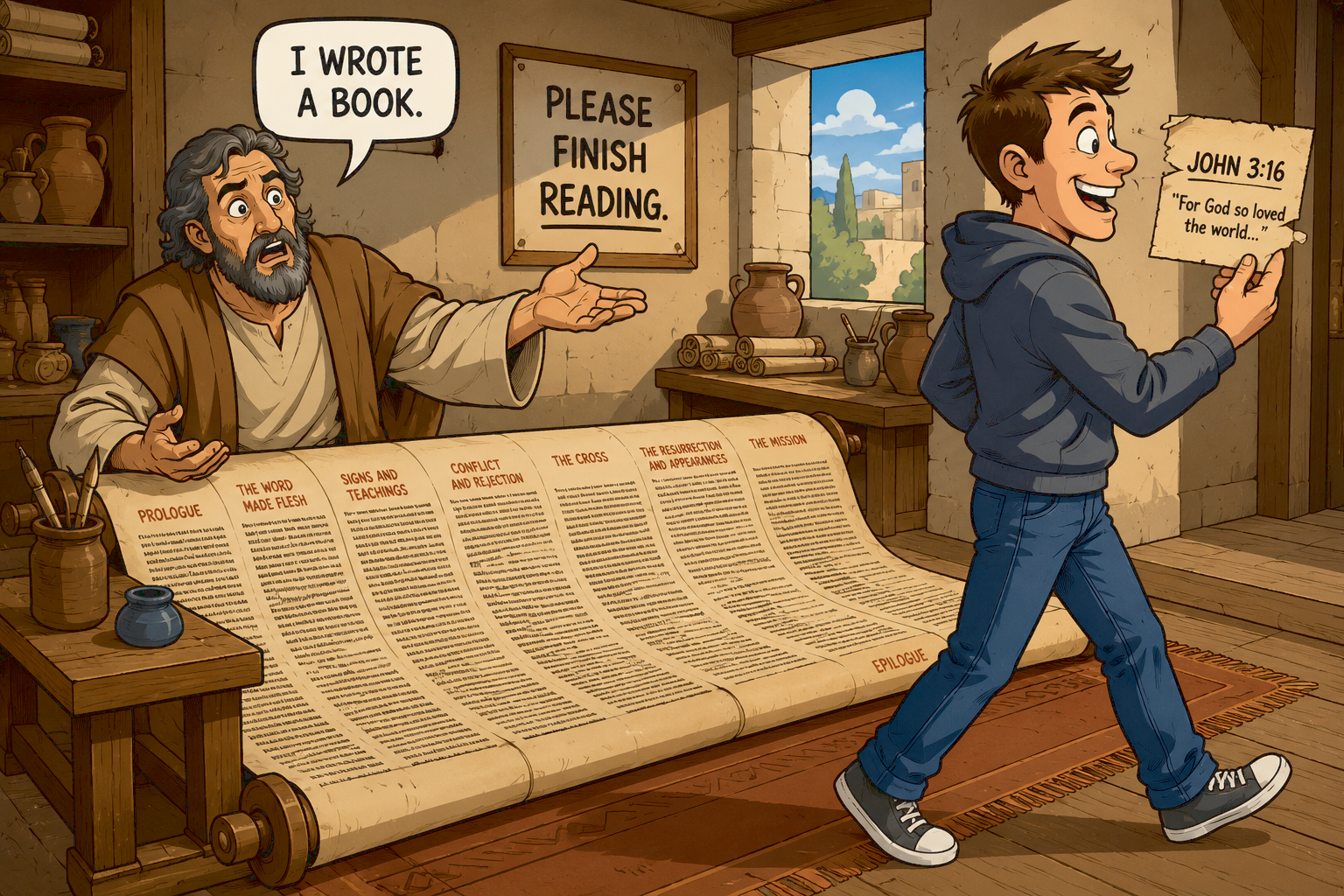
What we sometimes forget is that the biblical authors didn’t write chapter 3, verse 16.
They wrote books.
The chapter and verse divisions were added centuries later, not because they were inspired, but because they were useful. They help us find a passage quickly, but they were never intended to encourage us to treat each verse as though it were an independent thought disconnected from everything around it.
Take perhaps the most famous verse in the entire Bible, John 3:16. Almost every Christian knows it. Many people have memorized it. You’ve probably seen it on signs at football games, written on T-shirts, and quoted in countless sermons.
But what is John actually talking about?
What conversation is taking place?
Why does John include those words at this point in his Gospel instead of somewhere else?
Those questions cannot be answered by reading verse 16 alone.
They are answered by reading the chapter.
Better yet, by reading the book.
John didn’t expect his readers to open a scroll, locate the sixteenth verse of the third chapter, read one sentence, roll the scroll back up, and say, “Well, I understand what John meant.” He expected them to read his Gospel from beginning to end, allowing each chapter to build upon the one before it until his purpose became clear.
That simple realization changed the way I approached Scripture. Instead of asking, “What does this verse say?” I began asking, “Why is this verse here?” Those are obviously different questions. The first can often be answered by reading a sentence. The second requires us to listen to the author’s entire argument.
If we are going to become careful readers of the Bible, we have to learn to think more like the people who first received these books. They didn’t have isolated verses.
They had letters.
They had Gospels.
They had books.
And that’s how they read them.
There is another benefit to reading the Bible this way that I don’t think can be overstated.
It protects us.
One of the easiest ways to introduce bad theology is to separate a verse from the conversation it belongs to. Once a verse has been detached from its chapter, its book, and its historical setting, it can often be made to support ideas the author never intended to communicate. The words themselves haven’t changed, but their meaning has been quietly pulled away from the argument that originally gave them life.
This is one of the reasons proof-texting is so dangerous.
Proof-texting isn’t simply quoting Scripture. Every Christian should quote Scripture. The problem arises when verses are gathered together to support a conclusion without first asking what each author was actually communicating in his own context. Instead of allowing the Bible to shape our theology, we begin using the Bible to defend a theology we’ve already decided upon.
Many of the theological movements that have caused confusion in the Church rely heavily on this approach. They quote the Bible—sometimes a great deal of it—but quoting the Bible is not the same thing as explaining the Bible. A passage must first be understood within the flow of the author’s argument before it can be faithfully applied. When that step is skipped, almost any idea can be given a biblical appearance.
That’s one of the reasons I’m generally cautious with devotional books. I’m not suggesting they’re all unhelpful. Many have encouraged Christians for generations. Their purpose, however, is usually devotion rather than careful exposition. They often begin with an isolated verse and immediately move to a personal application. Sometimes that application is entirely faithful to the text. Other times it quietly bypasses questions that should come first.
What did the author mean?
Who was he writing to?
How would the original readers have understood these words?
Only after we’ve wrestled with those questions are we ready to ask the question that naturally follows:
What does this mean for me?
That order matters.
The Bible was written for our instruction, encouragement, correction, and growth. But before we can faithfully apply God’s Word to our lives, we must first allow the biblical author to say what he intended to say. Application that ignores meaning may be inspiring for a moment, but it will never be as transformative as truth understood in its proper context.
As we continue building these principles, another question naturally comes to the surface.
Who was this book written to?
It’s such an ordinary question that we ask it almost without thinking in every other area of life. Imagine finding a letter in your mailbox addressed to your neighbor. You wouldn’t assume every instruction in that letter applied directly to you. You would immediately recognize that someone else was the intended recipient. At the same time, you would also understand that you could still learn something by reading it. You might gain insight into the person who wrote it, understand something about your neighbor’s circumstances, or discover principles that are broadly applicable even though the letter was never addressed to you personally.
For some reason, we often forget to ask that same question when we open the Bible.
One of the most helpful observations I’ve ever encountered is this: the Bible was written for us, but it was not written directly to us. Every book of Scripture had an original audience. Moses wrote to Israel. Paul wrote to churches scattered throughout the Roman Empire and to individuals he knew personally. The prophets addressed real nations facing real circumstances. Those historical audiences are not an inconvenience that we must somehow work around. They are one of the greatest helps we have in understanding the text because they allow us to listen in on the conversation the author was actually having.
That doesn’t make the Bible less relevant to us. Quite the opposite. It gives us a reliable starting point. Before asking how a passage applies to my own life, I first need to understand what the author intended to communicate to the people who first received his words. Only then can I responsibly ask how that same truth should shape my life today. If I reverse that order, I place myself at the center of a conversation that wasn’t originally addressed to me, and that almost always leads to misunderstandings.
You may have noticed that every principle we’ve discussed so far has required us to slow down rather than speed up. We read books instead of isolated verses. We ask why the author wrote instead of assuming we already know. Now we ask who the author was writing to before we ask how the passage applies to us. None of these habits make Bible reading more complicated. They simply help us hear the conversation as it was originally intended to be heard, and that places us in a much better position to faithfully understand and apply God’s Word.
By this point, you may have noticed that we’ve spent as much time asking questions as answering them. That isn’t an accident. Careful Bible reading begins with learning to ask the right questions before rushing toward an answer.
If I could encourage every Christian to develop a habit, it would be this: become relentlessly curious about the text itself.
Don’t be satisfied with a conclusion simply because you’ve heard it repeated for years. Ask why the author chose these words instead of different ones. Ask why this event is included while another is left out. Ask why a conversation appears at this point in the book instead of somewhere else. Ask why the author spends an entire chapter developing one idea but only a few sentences on another. Questions like these are not signs of unbelief. They are signs that you are paying attention to the author instead of merely searching for a familiar conclusion.
One of the things I’ve come to appreciate is just how often the biblical authors answer our questions if we’re patient enough to let them finish. A passage that seems confusing in the middle of a chapter frequently becomes much clearer by the end of it. An idea that appears difficult on its own often makes perfect sense once you’ve followed the author’s argument from the beginning. More than once I’ve spent a great deal of time searching for an explanation, only to discover that the author had already provided it a few paragraphs later.
That realization changed the way I study. My first instinct is no longer to ask, “Who can explain this to me?” My first instinct is to ask, “Have I listened carefully enough yet?” Sometimes the answer is yes, and I benefit tremendously from the work of faithful teachers who have studied the passage far more deeply than I have. Other times the honest answer is no. I was so eager to reach a conclusion that I never gave the author the opportunity to make his own argument.
Not every passage is simple. Some require patient study. Others require historical research or careful attention to lan- guage. There is nothing wrong with that. But I have become convinced that many of the difficulties we experience are not because Scripture is unclear. They arise because we ask the text to answer questions it was never written to answer while overlooking the questions the author is actually addressing.
The habit of asking better questions has made me a better reader. It has forced me to slow down, pay attention, and trust that the author usually knows where he’s going long before I do. I think you’ll find the same is true for you.
Once I began slowing down and asking better questions, I noticed something else about the way I had been reading the Bible.
I was often in a hurry.
Not physically. Mentally.
I’d read a verse and almost immediately begin deciding what it meant, how it applied to my life, and whether it agreed with what I already believed. In the space of a few seconds, I had skipped over the one thing I should have been doing first.
I should have been observing.
Observation sounds almost too simple to be important, yet I have become convinced it is one of the most neglected parts of Bible study. We are eager to interpret because interpretation feels productive. We are eager to apply because application feels practical. Observation, on the other hand, feels slow. It requires us to resist the urge to jump ahead and instead spend time noticing what is actually on the page.
Read a passage two or three times before trying to explain it. Pay attention to repeated words and recurring ideas. Notice who is speaking and who is listening. Ask yourself what question is being answered or what problem is being addressed. Look for words like therefore, because, but, and so that. Those small words often reveal how the author’s argument fits together, yet they are easy to overlook when we’re reading quickly.
I’ve found that many passages become much less mysterious simply because I took the time to observe before I tried to interpret. The temptation is to think that careful Bible study begins with finding an explanation. More often than not, it begins with noticing something I completely missed the first time I read the passage.
There is a reason detectives spend so much time collecting evidence before they offer an explanation. Once they settle on a theory too early, every new piece of evidence is unconsciously interpreted to support that theory. Bible study isn’t all that different. If I decide what a passage means before I’ve carefully observed what it actually says, I will almost always find a way to make the text fit my conclusion.
The discipline of observation protects us from that mistake. It forces us to let the evidence come first and our conclusions come afterward. I have found that this simple change in approach has saved me from many avoidable errors and has given me far more confidence in the conclusions I eventually reach because they arise from the text instead of being imposed upon it.
One habit that has helped me, is learning to become comfortable saying, “I don’t know.”
That wasn’t easy for me.
I like answers. I like things neatly tied together. When I encounter a difficult passage, my first instinct is to find an explanation as quickly as possible. In the past, that usually meant reaching for a commentary or searching the internet before I had spent much time thinking through the passage myself. There is certainly a place for those resources, but I eventually realized I was often borrowing someone else’s conclusion before I had really wrestled with the text on my own.
Now I try to do something different.
If I come across a passage I don’t understand, I don’t feel obligated to solve it immediately. I’ll make a note in the margin. I’ll write down the question that’s bothering me. Sometimes I’ll keep reading because the author may answer it himself a few pages later. Other times I’ll let the question sit for a few days while I continue reading other parts of Scripture. More often than you might expect, the answer arrives naturally because I’ve given the Bible the opportunity to explain itself instead of demanding an immediate solution.
I’ve found that unanswered questions are not nearly as dangerous as premature answers.
An unanswered question keeps me searching.
A premature answer often convinces me to stop searching.
There is a great deal of wisdom in patiently allowing the evidence to accumulate before reaching a conclusion. We expect that kind of patience in every other area of life. We would think very little of a doctor who diagnosed a patient before hearing the symptoms or a judge who announced a verdict before listening to the witnesses. Yet we sometimes do exactly that when we read the Bible. We encounter a difficult verse, settle on the first explanation that sounds reasonable, and then spend years defending it without ever asking whether it truly fits the author’s argument.
Patience has become one of my greatest teachers. It has reminded me that understanding Scripture is not a race. God isn’t grading me on how quickly I arrive at an answer. My responsibility is much simpler than that. My responsibility is to be an honest reader who is willing to keep listening until the author has finished speaking.
There is another habit that has changed the way I read the Bible, and at first it almost feels backwards.
When I encounter a difficult passage, my first instinct used to be to leave it.
I’d start flipping pages, looking for another verse that seemed to answer my question. Before long I had five different passages open, a commentary on my desk, three browser tabs on my computer, and I had completely forgotten to finish reading the chapter where my question first arose.
I’ve learned that this approach often creates more confusion than clarity.
Don’t misunderstand me. The Bible absolutely helps us understand the Bible. Later passages often shed light on earlier ones, and biblical authors regularly build upon ideas introduced by those who came before them. Scripture is beautifully interconnected.
The problem isn’t comparing Scripture with Scripture.
The problem is comparing Scripture before we’ve understood the passage we’re actually reading.
I’ve found it helpful to ask myself a simple question before turning another page:
“Have I given this author a fair opportunity to explain himself?”
Have I finished the chapter?
Have I understood the argument?
Have I paid attention to the reason this book was written?
Have I listened to the conclusion before looking somewhere else for an explanation?
Those questions have saved me from leaving a passage too quickly. More than once I’ve discovered that the answer I was searching for was already unfolding in the next paragraph. I was simply too impatient to let the author finish his thought.
There will certainly be times when another passage of Scripture provides valuable insight, and we should never hesitate to make those connections. But I have become convinced that the safest order is to let each biblical author speak for himself before inviting another author into the conversation. Once I’ve done everything I can to understand a passage in its own setting, I’m in a much better position to see how it fits within the larger story of Scripture.
That approach has another benefit as well.
It helps ensure that I’m building my understanding from the text outward instead of importing ideas into the text from somewhere else. It’s a slower way to read, but I’ve found that slower reading often leads to clearer understanding.
As I began paying closer attention to the flow of a book, I noticed something I had overlooked for years.
Biblical authors argue.
When I use the word argue, I don’t mean they are quarreling with someone. I mean they develop ideas. They begin with one point, build upon it, answer objections, introduce examples, draw conclusions, and then move on to the next idea. In other words, they write the same way thoughtful people communicate today.
Once I saw that, I stopped reading the Bible as though every paragraph had dropped out of the sky independent of the one before it.
Instead, I began asking, “Why did the author say this next?”
That’s a surprisingly helpful question.
Why did Paul move from this subject to the next one?
Why did John include this miracle immediately after the previous conversation?
Why does Matthew arrange these events in this order?
Why does Moses tell this story before giving that command?
Those questions forced me to pay attention to the author’s train of thought instead of treating each paragraph as a brandnew conversation.
I’ve found that misunderstanding often begins the moment we interrupt that train of thought. We isolate a paragraph from the chapter, a chapter from the book, or a statement from the argument that produced it. Once that happens, we’re no longer following the author. We’re following ourselves.
The more I study Scripture, the more convinced I become that the biblical authors were remarkably careful writers. They weren’t randomly collecting stories or sayings. They were leading their readers somewhere. Every chapter moves the conversation forward. Every section contributes to a larger purpose. Sometimes that purpose is obvious. Sometimes it takes patience to discover. Either way, I have found it far more rewarding to follow the path the author laid out than to blaze one of my own.
That simple change has affected almost every passage I study. Before I ask what a paragraph means by itself, I first ask what it contributes to the author’s larger purpose. More often than not, that single question prevents me from wandering into conclusions the author was never trying to communicate in the first place.
One lesson took me much longer to learn than I care to admit.
Words don’t get their meaning from me.
That probably sounds obvious, but think about how often we define a word the way we use it instead of the way the author is using it. Language works because words have meaning, but those meanings are always shaped by the person speaking, the audience listening, and the conversation taking place. If we ignore any one of those three things, we greatly increase our chances of misunderstanding what is being said.
We experience this every day without realizing it. Ask ten people what the word “love” means, and you’ll likely hear ten slightly different answers. Some will think of romance. Others will think of sacrifice. Others will think of family or friendship. The word itself hasn’t changed, but the conversation determines how it should be understood.
The Bible is no different.
When a biblical author uses a word repeatedly, I don’t want to begin with the definition I already have in my head. I want to know how he is using it. Sometimes his meaning will be exactly what I expected. Other times it will be richer, narrower, or even slightly different than the way I normally think about that word. The only reliable way to discover that is to keep reading and let the author define his own language.
I’ve found that the best dictionary for understanding a biblical author is often the biblical author himself. If Paul keeps returning to a particular idea, I want to see how he develops it before I rush to an outside definition. If John repeatedly uses a word throughout his Gospel, I want to observe the pattern he is creating. Authors are usually very good at explaining themselves if we’re patient enough to let them.
That principle has saved me from a surprising number of mistakes. Instead of assuming I know what a word means because it’s familiar, I’ve learned to ask a different question:
“How is this author using this word here?”
That small change has repeatedly reminded me that my task is not to teach the author my vocabulary. My task is to learn his.
Another big change in my Bible reading happened when I stopped beginning with myself.
That may sound strange because we naturally want to know how a passage applies to our lives. That’s a good desire. The Bible was given to instruct us, correct us, encourage us, and point us toward Christ. Wanting to know how God’s Word should shape your life is exactly the right instinct.
The difficulty comes when application becomes our first question instead of our last.
Imagine reading a letter from a friend and interrupting every paragraph to ask, “How does this relate to me?” You would almost certainly misunderstand the letter because your attention would constantly be shifting away from the author’s message and back toward yourself. Before a message can be applied, it must first be understood. That is true whether you’re reading a letter from a friend, a newspaper article, or the Scriptures.
I’ve become convinced that many disagreements over the Bible begin right here. We are so eager to discover what a passage means for our lives that we skip the more fundamental question of what the author was trying to communicate in the first place. Once we’ve done that, our application may still sound biblical, but it is no longer anchored to the author’s intended meaning.
I’ve found it helpful to think of Bible reading as a simple progression. First, I ask, “What did the author communicate?” Once I have a reasonable answer to that question, I ask, “What truth was God revealing through that communication?” Only then do I ask, “How should that truth change the way I think, live, and worship?” Each question builds naturally upon the one before it. If I skip the first step, the others become increasingly uncertain.
That order has protected me from making the Bible revolve around me. The Scriptures are God’s revelation, not my autobiography. I certainly have a place within God’s story, but I am not the center of it. The biblical authors weren’t primarily trying to help me feel better about my Tuesday afternoon. They were revealing God’s character, His purposes, His redemptive work in history, and His call upon His people. The remarkable thing is that when I allow the text to speak on its own terms first, I almost always discover that its application to my own life is deeper, richer, and far more transformative than anything I would have come up with on my own.
By now you may have noticed that none of the principles we’ve discussed are particularly complicated.
You don’t need to learn Hebrew before you can begin using them. You don’t need an expensive library or a seminary education. You don’t need software that can search thousands of books in a few seconds. Those things can all be helpful, and I’m grateful for the resources God has provided His Church. But careful Bible reading begins long before any of those tools become necessary.
It begins by slowing down.
It begins by reading an entire book instead of collecting isolated verses.
It begins by asking why the author wrote, who he was writing to, and how his argument develops from one paragraph to the next. It begins by resisting the temptation to rush toward an application before we’ve taken the time to understand the meaning. None of those habits require extraordinary intelligence. They require patience, humility, and the willingness to let the author lead the conversation.
The more I’ve practiced those habits, the more I’ve realized something surprising. The Bible became less confusing, not because I had learned a secret method of interpretation, but because I had finally stopped fighting the way it was written. For years I was approaching the Scriptures as a collection of isolated sayings that existed to answer whatever question I happened to have that day. The biblical authors, however, weren’t writing collections of disconnected thoughts. They were writing books. Once I began reading them as books, many of the difficulties I had struggled with began resolving themselves naturally because I was finally following the path the author had laid out instead of trying to create one of my own.
I don’t want to give the impression that this removes every difficult passage. It doesn’t. There are verses that faithful Christians have wrestled with for centuries, and there are places where careful readers still disagree. We should expect that. But I have become convinced that many of our disagreements don’t begin in the difficult passages. They begin much earlier, when we fail to read ordinary passages carefully. If we develop good habits in the clear places, we’ll be much better prepared when we encounter the difficult ones.
That is why these principles matter. They aren’t designed to make Bible study academic or complicated. They are meant to help us become better listeners. Every principle we’ve discussed is simply another way of asking the same question:
“What has God communicated through this author?”
If we keep asking that question honestly and patiently, we’ll find ourselves reading the Bible the way its authors expected it to be read.
Reading the Bible this way requires something our culture doesn’t encourage very often.
Patience.
We live in a world that rewards quick answers. If we have a question, we expect a search engine to answer it in seconds. We watch short videos, skim articles, and move from one subject to another almost without thinking. Before long, that same habit begins shaping the way we read Scripture. We want immediate answers to complicated questions, and we become frustrated when the text asks us to slow down instead.
The Bible refuses to be rushed.
It invites meditation rather than haste. It rewards careful attention instead of hurried conclusions. The more time I’ve spent reading the Scriptures, the more I’ve realized that many of the insights I once thought were hidden weren’t hidden at all. They simply required me to stay with the passage longer than I was accustomed to staying.
That has changed the way I approach difficult texts. Instead of asking, “How quickly can I solve this?” I now ask, “What have I overlooked because I was reading too quickly?” That simple change has often been enough to reveal connections I had completely missed. A repeated word suddenly stands out. An argument begins to unfold. A conclusion that once seemed disconnected now makes perfect sense because I’ve finally given the author the opportunity to finish making his point.
If there is one encouragement I’d leave you with before you open your Bible again, it would simply be this: give the author your time.
Read the whole chapter.
Better yet, read the whole book.
Read it again tomorrow.
Then read it once more next week.
Don’t worry if every question isn’t answered the first time through. Understanding is often cumulative. Each reading builds upon the last, and ideas that once seemed unrelated slowly begin connecting into a coherent whole. The biblical authors weren’t trying to overwhelm their readers with isolated facts. They were patiently leading them through an argument, a story, a letter, or a prophecy.
The best thing we can do as readers is to be patient enough to walk that path with them.
As I’ve thought about this over the years, I’m no longer convinced that familiarity with the Bible is the real problem.
I think the problem is often something much more subtle.
Many Christians aren’t deeply familiar with the biblical text itself. They’re familiar with sermons about the text. They’re familiar with devotional thoughts built around the text. They’re familiar with verses shared on social media, favorite illustrations they’ve heard repeated for years, and explanations given by people they trust. None of those things are necessarily bad. In fact, faithful preaching is one of God’s gifts to His Church. The danger comes when our familiarity is with someone else’s explanation more than with the passage itself.
I’ve seen the effect this can have on sincere believers.
Suppose you’re reading a passage you’ve heard explained your entire life. As you work through it carefully, the text doesn’t seem to be saying what you’ve always been told it says. What do you do?
For many Christians, the answer is immediate.
“The problem must be me.”
In one sense, that’s an admirable instinct. We rightly believe that God is perfect and that His Word is true. Those are convictions we should never abandon. But sometimes, without realizing it, we quietly add another assumption: the interpretation I’ve always heard must also be correct. Once that assumption is in place, there is only one possible conclusion. If the text appears to disagree with the explanation, then I must be misunderstanding the text.
I know people who have carried that burden for years. They weren’t doubting Scripture. They were convinced that Scripture agreed with the explanation, and because they couldn’t see it, they concluded they simply weren’t capable of understanding God’s Word.
I don’t think that’s the right conclusion.
There is a difference between questioning Scripture and questioning whether an interpretation of Scripture is accurate. The first is an attack on God’s Word. The second is an act of submission to it. If I open my Bible and honestly ask, “Does this explanation actually arise from the text?” I am not placing myself above Scripture. I’m placing Scripture above every human explanation—including my own.
That is one of the healthiest habits we can develop as readers of the Bible. It frees us from the impossible burden of assuming that every explanation we’ve ever heard is correct, while at the same time increasing our confidence that God’s Word is capable of speaking for itself if we are willing to listen carefully.
That realization also changed the kinds of questions I was willing to ask.
There was a time when I almost felt guilty asking whether a commonly accepted interpretation was correct. It felt as though questioning the interpretation was somehow questioning God. Looking back, I don’t think those two things should ever have been confused.
If someone explains a passage to me, they have performed an act of interpretation. That is true whether the explanation comes from a pastor, a commentary, a study Bible, a friend, or this book. An interpretation is simply one person’s attempt to explain what they believe the biblical author intended to communicate. Some interpretations are excellent. Others are less convincing. The only way to distinguish between them is to compare each one with the text itself.
That shouldn’t frighten us.
In every other area of life we expect explanations to be examined. A history teacher expects students to read the historical sources. A scientist expects experiments to be repeatable. A mathematician expects his work to be checked. We don’t consider those things disrespectful because the goal isn’t to embarrass the teacher. The goal is to determine whether the explanation accurately represents reality.
Bible study should be no different.
The Christian isn’t called to become suspicious of everyone who teaches Scripture. We are called to become readers who care enough about God’s Word to ask whether an explanation faithfully reflects what the author actually wrote. Sometimes it will. Sometimes it won’t. Either way, our confidence should ultimately rest in the text, not in our ability to remember what someone else said about the text.
Ironically, I’ve found that this approach has given me a greater appreciation for faithful teachers, not a lesser one. The men I have learned the most from have never demanded that I trust them instead of the Scriptures. They have consistently pointed me back to the text, encouraging me to read it carefully, think honestly about it, and make sure their conclusions can actually be seen on the page. Those are the kinds of teachers worth listening to because their goal is not to gather followers for themselves, but to help others become better readers of God’s Word.
There is another misunderstanding that often appears at this point.
If we are encouraging Christians to read the Bible for themselves, does that mean every interpretation is equally valid?
Not at all.
In fact, I believe the opposite is true.
The reason we have spent so much time learning to listen to the author is because the author intended to communicate something specific. If a passage can mean whatever I decide it means, then communication has broken down. The goal of careful Bible reading is not to discover a meaning that is true for me. It is to discover the meaning the author intended to communicate. My opinions don’t determine that meaning any more than your opinions do.
That realization is actually freeing.
It means the meaning of Scripture isn’t constantly changing from one reader to the next. It isn’t recreated every time someone opens the Bible. The text has an objective meaning rooted in what the author wrote, to the people he wrote, in the circumstances in which he wrote. Our responsibility is not to create that meaning but to discover it as faithfully as we can.
Of course, that doesn’t mean every passage is equally easy to understand, nor does it mean sincere Christians will never disagree. We have already seen that. But disagreement doesn’t prove there are many correct meanings. More often, it demonstrates that someone has understood the passage more accurately than someone else. That may sound obvious, yet it is an important distinction. We are not searching for our truth. We are searching for the truth the author intended to communicate.
Once I understood that, Bible study became much less about defending my conclusions and much more about following the evidence wherever it led. Sometimes the evidence confirmed what I already believed. Sometimes it challenged me. In either case, the standard never changed. The question remained exactly the same:
“What is the author actually saying?”
As simple as that question is, I have found that returning to it over and over again has protected me from many unnecessary detours. It keeps my attention where it belongs—not on what I hope the passage says, not on what someone else insists it says, but on what is actually there for every careful reader to examine.
Before we move from these principles to the text itself, I want to acknowledge something that is easy to overlook.
None of this is easy.
In fact, I think it can become more difficult the longer you’ve been a Christian.
If you’ve spent decades in a faithful church, sat under sound preaching, and sincerely loved the Lord, you have also spent decades building a framework for understanding Scripture. Much of that framework may be wonderfully biblical. Some parts of it may need refinement. Discovering the difference is rarely an intellectual exercise alone. It can be deeply personal.
I’ve had the privilege of watching this firsthand in my own home.
My wife loves God with all her heart. More than anything else, she wants to know Him as He truly is and to believe what He has actually said. That doesn’t make this process easier for her. In many ways, it makes it harder. When you’ve believed something your entire Christian life, and then you slowly become convinced that the text is saying something different than what you’ve always been taught, it can feel almost heartbreaking. You’re not simply changing your mind about an idea. You’re wrestling with years of memories, trusted teachers, beloved traditions, and sometimes even your sense of spiritual stability.
I’ve watched her walk through those moments with remarkable courage. Not because she enjoys changing her mind, but because she has settled something more important: if God’s Word truly teaches something different, then God’s Word must win. Every time.
That kind of humility has challenged me more than any argument ever could.
It reminds me that our greatest goal is not to be consistent with our past. It is to be faithful to what God has actually communicated. Sometimes those two things happily agree. Sometimes they don’t. When they don’t, we have a decision to make.
My prayer is that all of us—including me—would have the courage to follow the truth wherever God’s Word leads us, even when that path is difficult, uncomfortable, or costs us conclusions we’ve held for many years.
With that attitude in mind, let’s finally turn our attention to the text itself.