
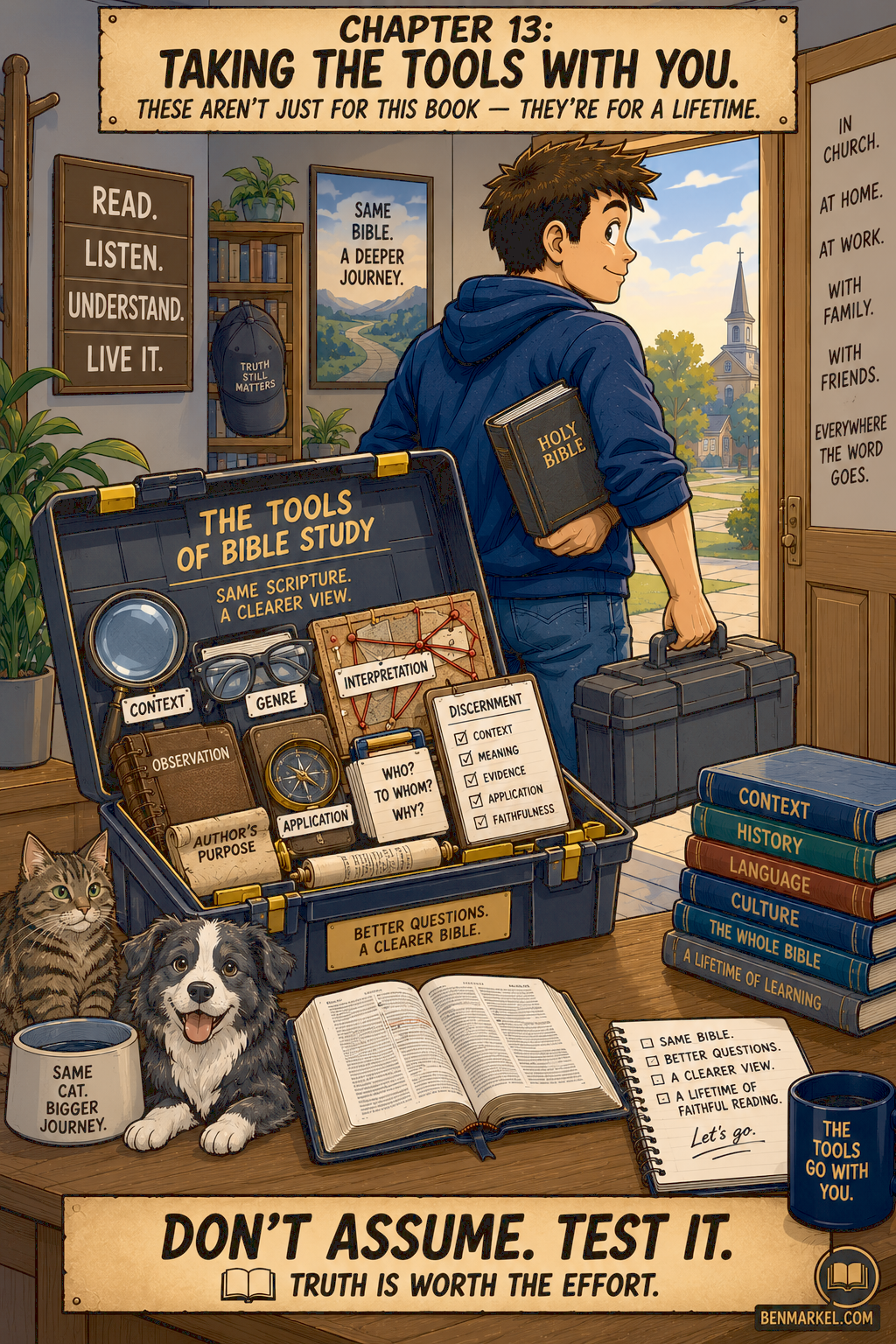
As we come to the end of this book, I don’t want to leave you with another list of rules.
I want to leave you with a way of thinking.
If you’ve forgotten most of what we’ve covered, remember these questions. They will serve you well every time you open your Bible, listen to a sermon, or hear someone confidently say, “The Bible says…”
Start with observation.
What does the passage actually say?
Who is speaking?
Who is being addressed?
What words or ideas are repeated?
What happened before this passage?
What happens after it?
Slow down and see the text before trying to explain it.
Understand the context.
Every verse lives inside a paragraph.
Every paragraph lives inside a chapter.
Every chapter lives inside a book.
Every book was written for a purpose.
Don’t pull verses out of their home and expect them to mean the same thing.
Respect the genre.
Ask what you’re reading.
Is this history?
Poetry?
A letter?
Prophecy?
Wisdom literature?
Apocalyptic writing?
Read each genre according to the way God chose to communicate it.
Interpret before you apply.
What did the biblical author mean to the original audience?
Only after you’ve answered that question should you ask what faithful obedience looks like today.
Don’t skip the author’s meaning to get to your own application.
Distinguish between description and prescription.
The Bible records many things.
Not everything it records is a command.
Ask whether the passage is telling you what happened or telling you what you must do.
Ask whether the conclusion comes from the text.
Am I following the biblical author’s argument?
Or am I asking the Bible to support a conclusion I already wanted?
Be honest enough to let Scripture change your mind.
Test every sermon.
How did it begin?
What was the main point?
Did the biblical text lead the sermon?
Was the context respected?
Did the application grow naturally from the passage?
What evidence was left out?
Don’t judge a sermon by the preacher’s passion, personality, or popularity.
Judge it by whether it faithfully handled God’s Word.
Hold your conclusions with appropriate humility.
Some doctrines are wonderfully clear.
Others require careful study and humble disagreement.
Don’t speak with absolute certainty where Scripture has not.
There is no shame in saying, “I don’t know.”
There is wisdom in it.
Be willing to be corrected.
Perhaps the hardest lesson in this entire book is also the simplest.
You will be wrong.
So will I.
The question is not whether we’ll make mistakes.
The question is whether we’ll allow God’s Word to correct them.
A humble Christian is teachable.
A proud Christian is nearly impossible to help.
Always choose humility.
Finally, remember why you’re doing all of this.
The goal has never been to become an expert at finding flaws in other people’s theology.
The goal has never been to win debates.
The goal has never been to prove yourself right.
The goal is to know God more faithfully, love Christ more deeply, and joyfully submit to what He has revealed.
If these pages have helped you do that, then they have accomplished their purpose.
Now close this book.
Open your Bible.
And let God’s Word have the final word.
A Final Word
If you’ve made it this far, thank you. Not because you’ve finished reading my book, but because you’ve invested your time in becoming a more careful reader of God’s Book. When I first began studying the Bible seriously, I thought the goal was to find answers. The longer I’ve studied, the more I’ve realized the goal is first to become a good listener. We are often so eager to explain a passage, defend a doctrine, or settle a debate that we rush past the simple question, “What does the text actually say?” That question has become one of the most valuable tools in my own study, and I hope it becomes one of yours. If this book has accomplished anything, I hope it has not made you trust me more. I hope it has made you trust your Bible enough to open it more often. I hope it has made you slower to accept a popular interpretation simply because it is popular. I hope it has given you the confidence to ask hard questions, not because you are looking for reasons to doubt God’s Word, but because you love it enough to understand it faithfully. You will still make mistakes. I certainly do. There will be passages that confuse you, verses that challenge long-held beliefs, and questions that take years to answer. Don’t be discouraged by that. The Christian life is not a race to become