
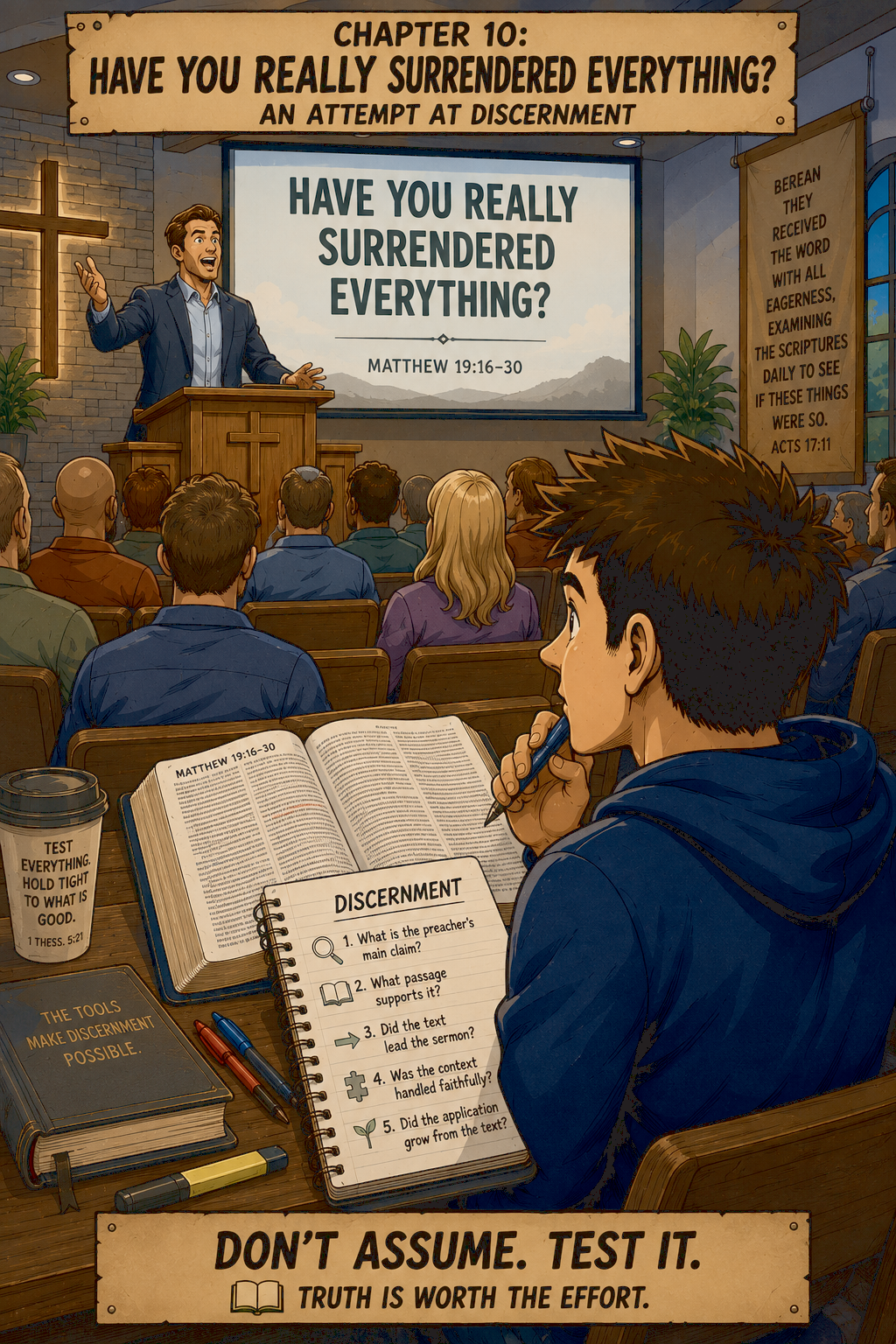
Have You Really Surrendered
Everything?
Church, before we open God’s Word this morning, I want you to answer a few questions honestly.
How many hours did you work this week?
Forty?
Fifty?
Sixty?
Now tell me this.
How many hours did you spend scrolling through your phone?
Watching television?
Browsing the internet?
How much time did you spend reading your Bible?
How much time did you spend praying?
Don’t answer out loud.
Just answer before God.
You see, I think many of us claim Jesus is Lord, but our calendars tell a different story. Our bank accounts tell a different story. Our priorities tell a different story. We say Christ has all of us while carefully holding back the parts of our lives we value most.
This morning I want us to look at what Jesus actually says.
Turn with me to Matthew chapter 19.
A rich young ruler comes to Jesus wanting eternal life. He has kept the commandments. He believes he’s doing well. Yet Jesus looks at him and says, “Go, sell what you possess and give to the poor…then come, follow Me.”
Church, Jesus didn’t negotiate.
He didn’t offer a payment plan.
He didn’t say, “Give what you’re comfortable giving.”
He said, “Sell what you possess.”
Then we read Luke chapter 14.
“Any one of you who does not renounce all that he has cannot be My disciple.”
Cannot.
Not “might not.”
Cannot.
Those are difficult words.
The early church understood exactly what Jesus meant.
Acts chapter 2 tells us they sold their possessions and distributed to anyone who had need.
Acts chapter 4 says they no longer claimed their possessions as their own.
The pattern couldn’t be clearer.
Jesus said it.
The apostles lived it.
The early church obeyed it.
The only question left is…
Why don’t we?
I think I know the answer.
We’ve become attached to things that don’t belong to us.
We call it our paycheck.
Our retirement.
Our house.
Our savings.
Our investments.
But Scripture says everything belongs to God.
Perhaps the greatest idol in the modern church isn’t carved from stone.
Perhaps it’s sitting in our driveway.
Perhaps it’s hanging on our wall.
Perhaps it’s quietly growing in our retirement account while missionaries struggle to eat and churches around the world suffer persecution.
Church, I believe the Holy Spirit is calling people this morning to surrender everything.
Not ten percent.
Everything.
Some of you already know what God is asking you to do.
Sell the second vehicle.
Cash out the retirement account.
Put the house on the market.
Empty the savings account.
Stop storing treasure on earth.
Store it in heaven.
In just a few moments we’re going to receive this morning’s offering.
I don’t want you to give because the church has needs.
I want you to give because Jesus deserves everything.
If you’re waiting until you feel comfortable, you’ll never obey.
Today is your opportunity to prove that Christ owns all of you.
Let’s pray.
Step One: How Does the Sermon Begin?
Before we analyze the verses, let’s pay attention to something many of us never think to examine.
How did the sermon begin?
Did it begin by opening the Scriptures and explaining a passage?
Or did it begin somewhere else?
Go back and read the opening again.
The preacher doesn’t begin with Matthew 19.
He begins by asking questions.
How many hours did you work this week?
How much time did you spend on your phone?
How much time did you spend praying?
How much time did you spend reading your Bible?
Those are effective questions.
In fact, they may even expose real areas where many Christians need to grow.
If I’ve neglected prayer, that’s a problem.
If I’ve ignored God’s Word, that’s a problem.
If I’ve failed to love my wife sacrificially, been absent from my children, or made work my identity, those are all things Scripture genuinely addresses. Feeling conviction over sin is not a bad thing. In fact, it’s often one of God’s greatest kindnesses.
So let’s be careful.
The problem isn’t that the preacher made us feel something.
The problem isn’t even that he asked difficult questions.
The question we should ask is much simpler.
What do those questions have to do with Matthew 19?
Did they arise naturally from the passage?
Or were they preparing us emotionally to accept the conclusion before the passage had a chance to speak?
That distinction matters.
A faithful preacher may begin with a story, a question, or even a difficult challenge. There’s nothing inherently wrong with any of those things. The issue is whether they serve the text or quietly begin replacing it.
As we continue examining this sermon, keep that question in the back of your mind.
Is the sermon leading us toward the passage?
Or is the passage being asked to support the direction the sermon was already traveling?
Those are not the same thing, and learning to recognize the difference is one of the first steps in becoming a discerning listener.
Step Two: What Is the Main Point?
Now that we’ve looked at the introduction, it’s time to identify the sermon’s main claim.
This sounds simple, but it’s one of the easiest places to get lost. A preacher may tell stories, quote multiple passages, and make dozens of observations, but all of those things should be serving one central idea.
So, what is the central idea of this sermon?
Take a moment before reading any further and write it down in one sentence.
Not what verses were quoted.
Not what emotions you felt.
What is the preacher asking you to believe or do?
If your answer was something like, “Christians should be generous,” you’re close, but that isn’t quite what he argued.
Listen to his conclusion again.
He told the congregation to sell their possessions, empty their savings, cash out their retirement accounts, and give everything away. In his view, this wasn’t an act of extraordinary devotion for a few believers. It was the standard of faithful discipleship for every Christian.
Now we have something we can test.
Notice how important this step is.
If we don’t clearly identify the claim, we’ll never know whether the sermon actually proved it. We may walk away saying, “That was a biblical sermon because he quoted a lot of Bible,” without ever asking whether those passages established the conclusion he wanted us to reach.
This is a habit worth developing every Sunday.
Before evaluating a sermon, summarize it in one sentence.
Then ask yourself another simple question.
Did the preacher demonstrate that conclusion from the passages he used, or did he simply state it with great confidence?
Those are two very different things.
From this point forward, we’re no longer evaluating the preacher’s passion or sincerity.
We’re evaluating his argument.
Step Three: Did the Bible Lead the Sermon?
Now we’re finally ready to examine the Scriptures themselves.
Notice that we haven’t said the preacher is wrong.
We haven’t even questioned his sincerity.
We’ve simply identified his conclusion, and now we’re asking the most important question in this entire exercise:
Did the passages he quoted actually lead us to that conclusion?
Let’s start with the rich young ruler.
Before we ask what Jesus meant, ask an even simpler question.
Who was Jesus speaking to?
Was He speaking to a crowd?
To the apostles?
To every future Christian?
Or was He speaking to one man standing directly in front of Him?
The answer matters because we’ve spent this entire book learning not to skip over the original audience.
Now ask another question.
Why did Jesus tell that man to sell everything?
Was Jesus establishing a universal command for every disciple?
Or was He exposing the very thing that kept this particular man from following Him?
Did the preacher ever slow down long enough to answer that question?
Or did he simply move from, “Jesus told this man to sell everything,” to, “Therefore every Christian must sell everything”?
Those are not the same statement.
One comes directly from the text.
The other requires an additional step, and every additional step should make us pause and ask whether the text itself is taking us there.
The same pattern appears throughout the sermon.
Acts tells us believers sold possessions and cared for one another with remarkable generosity.
The preacher immediately turns that historical description into a command for every Christian.
Again, stop and ask the question we’ve been asking throughout this book.
Did Luke make that argument?
Or did the preacher make it?
That question isn’t meant to make us cynical.
It’s meant to keep us honest.
If the biblical author built the conclusion, we should gladly follow him.
If the preacher built the conclusion, we should recognize the difference, no matter how many verses were quoted along the way.
Step Four: Did the Preacher Respect the Context?
By now, you should notice something interesting.
The preacher quoted several passages.
What he didn’t do was spend much time in any of them.
Go back through the sermon and ask yourself a simple question.
How much time did we spend understanding Matthew 19?
Did we ask why the rich young ruler approached Jesus?
Did we ask why Jesus responded differently to him than He did to Zacchaeus or other wealthy people?
Did we continue reading after the young man walked away?
Or did we simply quote the command, reach a conclusion, and move on to the next passage?
Now do the same thing with Luke 14.
Did we stop to understand Jesus’ larger discussion about the cost of discipleship?
Or did we lift one sentence from the chapter before moving somewhere else?
Then look at Acts.
Did we ask what Luke was trying to communicate about the early church?
Did we consider whether he was describing what happened or commanding what must happen in every church throughout history?
Or did we immediately assume that because it happened, it must become a universal requirement?
Notice the pattern developing.
The sermon never really stayed anywhere very long.
It gathered passages that sounded similar, stacked them together, and allowed the combined weight of those verses to produce the conclusion. That approach can feel incredibly convincing because every passage appears to be saying the same thing. The question is whether they actually are.
Remember what we’ve learned throughout this book.
Every passage deserves to be heard before another passage joins the conversation.
If Matthew 19 has something to say, let Matthew say it.
If Luke 14 has something to say, let Luke say it.
If Acts has something to say, let Luke say it there as well.
Only after each passage has been understood on its own should we begin asking how they fit together.
When we reverse that process, it’s remarkably easy to make several passages appear to teach the same thing simply because we’ve never allowed any one of them to speak for itself.
Step Five: What Evidence Was Left Out?
At this point, I want to ask a question that has become one of my favorites whenever I hear a sermon.
What evidence would challenge this conclusion?
That isn’t a cynical question.
It’s an honest one.
If a conclusion is true, it shouldn’t be afraid of the rest of Scripture.
So let’s think about the sermon’s claim.
If every Christian is required to sell everything they own, how does that fit with the rest of the New Testament?
Did the preacher explain why believers still owned homes where churches gathered?
Did he discuss instructions given to Christians about providing for their families?
Did he address passages that speak about generous giving without commanding every believer to liquidate everything they possess?
Did he explain why some wealthy believers appear in the New Testament without first being commanded to surrender every possession?
Notice what we’re doing.
We’re not looking for verses to defeat the sermon.
We’re asking whether the sermon accounted for the biblical evidence that seems to point in another direction.
That’s an important difference.
A faithful preacher should never be afraid of questions like these. If his conclusion is correct, then he should be able to explain how these passages fit together. If he simply ignores them, however, that should cause us to slow down.
One of the easiest ways to make a weak argument sound strong is to present only the evidence that agrees with it. That’s true in politics, it’s true in science, it’s true in everyday conversations, and it’s just as true in preaching.
Faithful interpretation is willing to wrestle with every relevant passage, even the ones that make the conclusion harder to defend. In fact, those are often the passages that strengthen our understanding the most because they force us to ask better questions and refine our conclusions.
As you’ve worked through this sermon, you’ve probably noticed something encouraging.
You haven’t needed secret knowledge.
You haven’t needed a seminary degree.
You haven’t needed to know Greek or Hebrew.
You’ve simply been asking the kinds of questions that careful readers naturally ask, and those questions have exposed weaknesses in the sermon’s argument that might have been easy to miss on a first hearing.
That’s exactly what discernment looks like.
Step Six: What Is Our Verdict?
Now it’s time to answer the question we’ve been working toward.
Did this sermon faithfully handle the passages it preached?
I don’t believe it did.
Notice that I didn’t ask whether the preacher was sincere.
He may have been.
I didn’t ask whether he quoted Scripture.
He certainly did.
I didn’t ask whether generosity is biblical.
It absolutely is.
The question was whether the conclusion of the sermon grew naturally out of the passages that were preached.
I don’t believe it did.
The sermon asked us to believe that every Christian is required to sell everything he owns. That is a very specific claim. If we are going to place that burden on the conscience of every believer, we need the biblical authors to say it with unmistakable clarity.
Instead, the sermon moved from passage to passage, assuming they all meant the same thing without first allowing each one to speak for itself. It took a command given to one individual, combined it with teaching about the cost of discipleship, added a historical description of extraordinary generosity in the early church, and presented the result as a universal command binding on every Christian.
That conclusion required several interpretive steps.
The preacher never acknowledged those steps.
He simply preached the conclusion as though the passages themselves had already established it.
That should concern us.
A preacher has every right to persuade us.
He has every right to challenge us.
He has every right to call us to repentance when Scripture does.
What he does not have the right to do is place a burden on God’s people that the biblical authors themselves did not place there.
That is one of the reasons careful Bible reading matters so much. It protects us from confusing a preacher’s conclusions with God’s commands.
Now notice something equally important.
This sermon was not wrong because it challenged us.
It was wrong because it claimed more than the text demon- strated.
There is a tremendous difference between those two things.
If Scripture demands something difficult, then we should gladly submit to it.
But we should be equally unwilling to submit to demands that come from the preacher’s interpretation rather than from the biblical text itself.
That is the kind of discernment we’ve been developing throughout this book. Our goal has never been to become critics looking for mistakes in every sermon we hear. Our goal has been to become careful listeners who love God’s Word enough to ask a simple question:
“Did God say that, or did the preacher?”
That question, asked humbly and honestly, will protect you from a great deal of error throughout your Christian life.
What Did We Learn?
If you’ve worked through this first sermon carefully, I hope you’ve noticed something encouraging.
You didn’t have to know Greek.
You didn’t have to own a shelf full of commentaries.
You didn’t need a seminary degree.
You simply asked good questions.
Where did the sermon begin?
What was the preacher trying to convince me of?
Did the passages actually support that conclusion?
Were they read in their context?
What evidence was left out?
Those questions exposed the weaknesses in the sermon long before we ever reached a final verdict.
That is exactly how discernment should work.
Discernment isn’t the ability to immediately declare that a preacher is right or wrong. It’s the willingness to slow down, resist being carried along by confidence or emotion, and patiently examine whether the sermon followed the biblical text or quietly departed from it.
I also hope you noticed something else.
This sermon wasn’t built on lies.
Every passage quoted was from the Bible.
Many of the things the preacher said were true. Christians should be generous. We should treasure Christ more than our possessions. We should care for the poor. We should hold this world loosely.
The error entered when true statements were connected together to support a conclusion the passages themselves had not established.
That is often how false teaching works.
It rarely begins with someone standing in a pulpit denying the resurrection or claiming there is no God. If error were always that obvious, very few people would believe it. More often, error enters one assumption at a time. A passage is stretched just a little beyond its purpose. A command is broadened beyond its audience. A description becomes a prescription. Before long, a conclusion that feels thoroughly biblical has quietly drifted away from what the biblical authors actually said.
That should not make us cynical.
It should make us careful.
As we move to the next sermon, the mistakes won’t be as obvious. Some of the sermons will contain very little error at all. Others will be far more persuasive than this one. That’s intentional. Discernment grows through practice, and each exercise will ask you to rely a little more on the habits you’ve been developing throughout this book.
Don’t rush.
Read the sermon.
Ask your questions.
Follow the evidence.
Then let the biblical authors have the final word.