
I want to begin by taking a walk down memory lane with you.
Perhaps you have a memory like this yourself. If not, don’t worry. Think of it as a parable. It isn’t important whether every detail happened exactly this way. What matters is that the story captures an experience many Christians know all too well.
There you are, sitting in church.
Maybe you’re there because someone invited you. Maybe life has become difficult and you’re looking for answers. Maybe you’ve reached the point where you’ve begun asking questions that money, success, and entertainment can’t answer. Whatever the reason, you’re there.
The service is beginning to wind down.
A soft piano melody fills the room. One of the musicians continues playing quietly in the background while the pastor steps to the microphone. He smiles warmly and asks everyone to bow their heads and close their eyes.
“No one is looking,” he says. “This is just between you and God.”
“If you’ve been moved today, would you just slip your hand up?”
“There’s one.”
“There’s another.”
“Oh…I see one more in the back.”
“Wonderful.”
Then comes the invitation.
“Repeat this prayer after me…”
A few moments later you’re told that you’ve received eternal life, you’ve become a Christian, and someone places a brandnew Bible in your hands.
“Welcome to the family.”
The service ends. You shake a few hands. Someone smiles and says, “Now make sure you read your Bible.”
That seems like good advice.
In fact, it’s probably the most common piece of advice a new Christian receives.
Have a problem? Pray and read your Bible.
Need wisdom? Pray and read your Bible.
Trying to grow in your faith? Pray and read your Bible.
Wondering what God wants for your life? Pray and read your
Bible.
It’s hard to argue with advice like that.
Now imagine what happens next.
The person handing you that Bible smiles and says, “Bible reading class starts every afternoon at three o’clock. We’ll teach you how to read it. We’ll cover things like hermeneutics, authorial intent, historical context, literary genre, audience, and a few other principles. Once you understand those, you’ll be well on your way to discovering what God intended to communicate through His Word.”
I’m guessing that wasn’t your experience.
It certainly wasn’t mine.
Most of us were simply handed a Bible and encouraged to start reading. Somehow we were expected to know where to begin, how to approach it, and how to determine what it actually meant. We were told to read it, but very few people ever stopped to answer what now seems like an obvious question.
How?
How do you read the Bible?
Or maybe your experience was much closer to mine.
There wasn’t an altar call. No emotional music. No one handed me a Bible after church.
I ordered one from Amazon.
The next day, thanks to the miracle that is Amazon Prime shipping, a little fifteen-dollar NKJV showed up at my door. No leather cover. No study notes. No maps I’d ever look at. Just a cheap Bible and a guy who had a lot of questions.
So I sat down and started reading.
The problem was, nobody had told me how.
I had exactly zero of those questions answered. I knew the Bible was important. I knew Christians were supposed to read it. Beyond that, I was on my own. I remember joking to myself that almost everyone in the Bible seemed like a disaster except Jesus. That was about the extent of my theological insight at the time.
Maybe your story is completely different.
Maybe you grew up in a Christian home. Maybe your parents faithfully read the Scriptures with you every evening. Maybe you’ve attended Bible studies for as long as you can remember, and many of the principles in this book are already familiar. If that’s you, I’d still encourage you to keep reading. If nothing else, I occasionally say something funny, and if we’re going to spend a few hundred pages together, we might as well enjoy the journey.
But here’s the point.
Very few people are ever taught how to read the Bible.
We’re told to read it.
We’re encouraged to read it.
We’re reminded to read it.
Yet the actual process of reading it well is often assumed rather than taught.
That raises another obvious question.
Who am I to write a book about it?
It’s a fair question.
I’m not a seminary professor. I don’t have a doctorate in textual criticism or biblical languages. I wish I could tell you I had shelves filled with impressive degrees. Maybe I’d even frame one of those online ordination certificates and hang it on the wall so visitors would think I looked more qualified.
I didn’t do any of that.
What I have done is spend the last several years asking one question with almost obsessive determination:
How do I read the Bible?
That question has shaped thousands of hours of reading, studying, questioning, changing my mind, questioning again, and beginning the process all over. I’ve followed arguments I thought were airtight only to discover they weren’t. I’ve abandoned positions I once defended with confidence because I became convinced the text was saying something different. I’ve learned that being willing to admit you’re wrong is often one of the greatest gifts God can give a student of Scripture.
So I’m not writing this book as an expert speaking down to a classroom.
I’m writing it as a fellow believer—a brother in Christ—saying, “Here’s what I’ve learned by God’s grace. I hope it helps you.”
I believe the Church has been given different gifts to serve one another. Whenever we see a need, and God has equipped us to help meet it, we should. As I looked around, I became convinced there was a gap. Christians are faithfully told to read their Bibles, but remarkably few are ever shown how to approach them with confidence and care.
I see that gap.
This book is my attempt to help fill it.
I should probably tell you one more thing about myself because it has shaped the way I approach every page of this book.
I didn’t grow up believing every objection to Christianity had an easy answer. In fact, for a long time I stood on the other side of the conversation. I was convinced I was the intellectual in the room and that Christians were simply holding on to comforting fairy tales. I listened to debates, read arguments against Christianity, and found many of them persuasive. Looking back, I’m grateful for that season—not because I was right, but because it taught me something that has stayed with me ever since.
Hard questions are not our enemy.
If Christianity is true, then it does not need to hide from honest investigation. Difficult questions are not problems to avoid, conversations to shut down, or critics to silence. They’re invitations to think more carefully. Some questions take years to answer. Others require us to admit we were wrong about something we once held with confidence. That’s simply part of the journey of seeking truth.
By God’s grace, I eventually became convinced that Christianity wasn’t merely comforting—it was true. Ironically, becoming a Christian didn’t make me stop asking questions. It gave me a reason to keep asking them. The difference was that I was no longer asking, “How can I disprove Christianity?” I was asking, “What has God actually said?” Those are very different pursuits.
That brings us to the first question of this book.
If we all have access to the same Bible, why do we so often arrive at different conclusions about what it says? More importantly, is that because God failed to communicate, or because we have failed to listen well?
That’s where our investigation begins.
I’m writing this book with one hope in mind: to place a few tools in your hands.
Not theological conclusions.
Not denominational distinctives.
Tools.
Tools that will help you read and understand the Scriptures for yourself.
But before we can ever begin talking about how to read the Bible, we have to answer a much more fundamental question. Is the Bible even understandable? Because if it isn’t, there is little point in discussing methods of interpretation. If God’s Word cannot be understood, then no amount of study, prayer, or careful reading will ever bring us to its intended meaning.
That is not a question we should fear.
In fact, we should welcome it.
If God has failed to communicate His Word clearly, then we need to know that. If He has communicated clearly, then we need to know that too. Either way, the truth has nothing to fear from honest investigation.
Now I realize that simply asking these questions may make some readers uncomfortable, and I understand why. As Christians, we confess that the Bible is the infallible Word of God because it is breathed out by an infallible God. I believe that without hesitation.
Precisely because I believe it, I have no fear of examining it.
Truth is never threatened by honest questions. God is not anxiously hoping our investigation turns out well. He already knows the truth. We are the ones seeking to discover it. Our questions cannot undermine what God has spoken; they can only expose whether our understanding of it is accurate.
So throughout this book, we won’t run from difficult questions. We’ll run toward them. We’ll examine them carefully, patiently, and honestly. If our conclusions are correct, they should withstand scrutiny. If they are not, then they deserve to be corrected.
I don’t believe asking honest questions is a lack of faith.
I believe it is an act of faith.
Scripture repeatedly calls God’s people to seek wisdom, to test what they hear, to examine carefully, and to love God not only with their hearts, but with their minds as well. That is the spirit in which this book has been written, and I hope it is the spirit in which it is read.
So, let’s dive in.
Is the Bible understandable?
That is the question before us. Everything else in this book depends on the answer. Before we discuss interpretation, context, genre, or any of the other tools we’ll eventually place in our toolbox, we first need to determine whether there is any point in building the toolbox at all.
To answer that question, I think we need to begin somewhere much simpler than most people expect.
What is the Bible actually doing?
At its most basic level, the Bible is communicating. It is not merely a collection of ancient stories, poems, letters, and laws bound together under one cover. Through human authors, God is communicating with His people. That simple observation raises another question.
Can that communication be understood?
Notice that we’re not asking whether every verse is immediately obvious or whether every passage has been interpreted correctly throughout history. Those are different questions, and we’ll deal with them in time.
For now, our question is much more fundamental.
When God chose to reveal Himself through written words, did He do so in a way that ordinary people could genuinely understand, or did He give us a message that was ultimately beyond our ability to comprehend?
Before we open the Bible to answer that question, let’s spend a few moments thinking about communication itself.
I know what some of you are thinking.
“We’re reading a book about the Bible. Why are we not opening it immediately?”
It’s a fair question.
The answer is simple.
Because the question we’re asking right now isn’t unique to the Bible.
It’s about communication.
If communication itself is incapable of conveying meaning, then the Bible doesn’t stand a chance. On the other hand, if communication is capable of conveying meaning, then we’ve established something incredibly important before we’ve ever read a single verse.
Think about how much of your life depends on communication.
You wake up to an alarm on your phone. You read text messages. You answer emails. You follow road signs. You read instructions, warning labels, recipes, contracts, and books. Every day, from the moment you wake up until you go to bed, your life is filled with people attempting to communicate something to you.
Have you ever stopped to think about how remarkable that really is?
Complete strangers can write words on a page, disappear for hundreds of years, and yet you can still understand what they were trying to communicate. You can read a letter written by a soldier during a war, a speech delivered centuries ago, or a novel written by an author you’ve never met, and somehow your mind connects with theirs across years, cultures, and experiences.
We don’t usually stop to marvel at that because it’s so ordinary.
Communication is one of those miracles we take for granted.
Before we ask whether God communicates effectively, we should first understand what communication is designed to do in the first place.
Let’s make this a little more practical.
I’’m getting ready to leave work when my phone goes beep…… beep……beep.
“Ah,” I think, “Erika has sent me a little texty text.”
I unlock my phone and read five simple words.
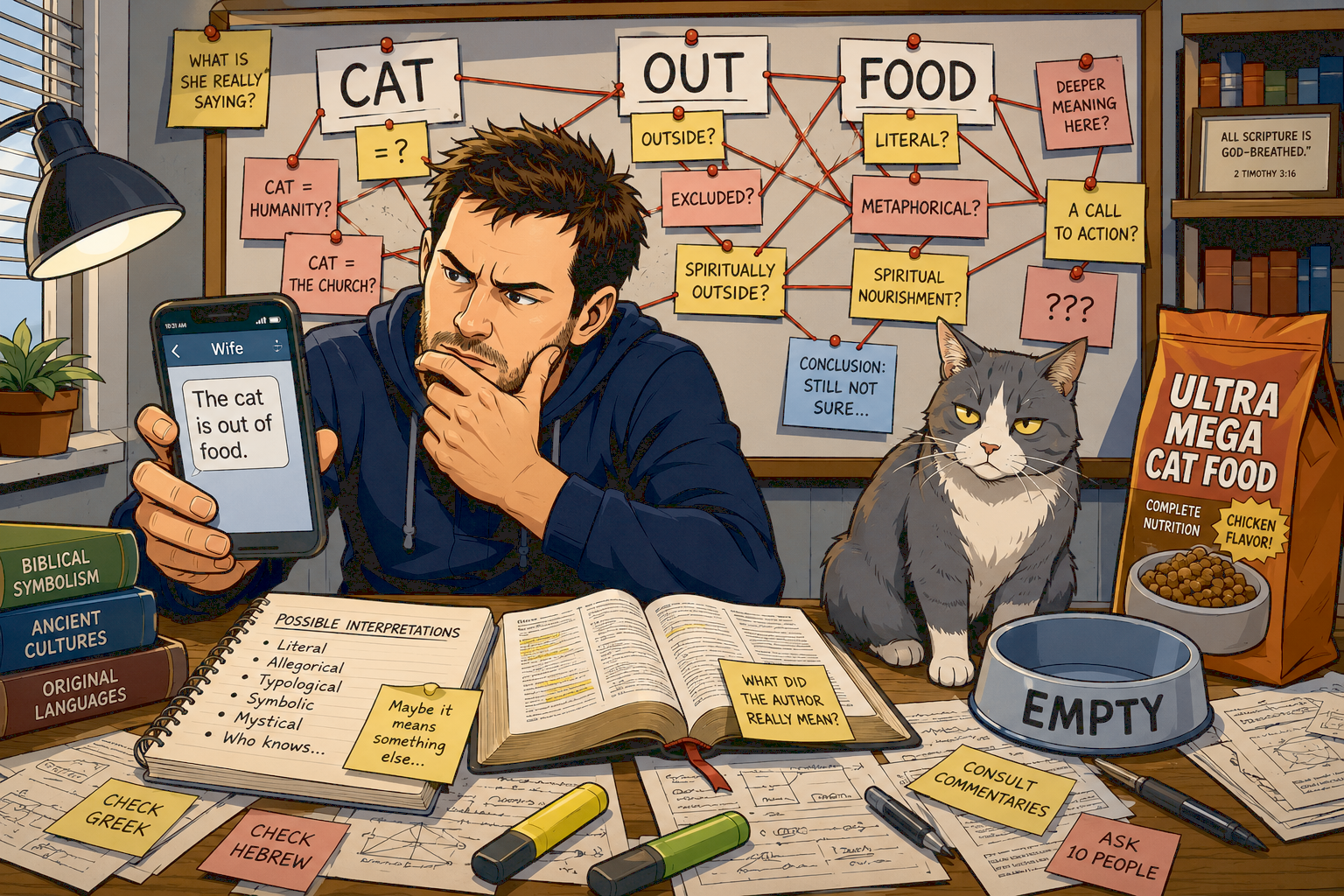
“The cat is out of food.”
Now, something interesting happens, and it happens so quickly that I don’t even think about it.
I don’t stop in the parking lot and ask myself what those words mean to me. I don’’t wonder if the cat symbolizes humanity or if the food represents spiritual nourishment. I don’’t call three friends to compare interpretations before deciding what the text really means. While that might make for an entertaining afternoon, it probably wouldn’t end well for the cat.
Instead, I instinctively ask a completely different question.
“What is Erika trying to tell me?”
I’ve never taken a college course on communication. I’ve never studied the philosophy of language. Yet I somehow know that those five words didn’t appear on my phone by accident. Someone wrote them. More importantly, someone wrote them because they wanted to communicate something to me.
You do exactly the same thing.
When your employer sends you an email, you want to know what they meant. When a friend sends you a text, you want to know what they meant. When you read a letter from a grandparent or a note left on the kitchen counter, your first instinct isn’t to create meaning. It’s to discover the meaning the author intended to communicate.
That’s so natural that we rarely stop to think about it.
Communication only works because both the writer and the reader are operating under the same basic assumption. The writer believes they can successfully communicate an idea, and the reader believes that idea can be understood. We may misunderstand one another from time to time. We may need clarification. We may even discover that we completely misread what was written. But none of those things lead us to conclude that communication itself is impossible.
In fact, the very reason we ask for clarification is because we believe there is a correct meaning to clarify.
Keep that thought in the back of your mind.
We haven’t said anything about the Bible yet.
We’ve simply observed how communication works in everyday life.
At this point, you may be thinking, “Well, that’s all fine and good, but the Bible isn’t a text message from your wife.”
You’re absolutely right.
In fact, if there’s one thing I hope you don’t take away from this chapter, it’s the idea that we should read the Bible exactly the way we read a modern text message. We shouldn’t. The differences between the two are significant, and over the course of this book we’ll spend a great deal of time learning why those differences matter.
The Bible wasn’t written yesterday.
It wasn’t written in English.
It wasn’t written directly to twenty-first-century Americans.
Its books were written over many centuries, by different human authors, in different places, to different audiences, for different purposes. Some books are history. Others are poetry. Others are prophecy. Others are personal letters. All of those differences are real, and all of them affect how we read the text.
But before we spend time exploring what makes the Bible unique, I want us to notice something even more fundamental.
For all of its uniqueness, the Bible still shares one essential characteristic with every letter ever written, every speech ever given, every law ever recorded, and every book ever published.
It is communication.
Someone is attempting to communicate something to someone else through language.
That observation may seem almost too obvious to mention, but I think it’s one of the most important we’ll make in this entire book. If we lose sight of that simple truth, we’ll eventually begin treating the Bible as something other than communication. We’ll begin looking for meanings hidden behind the words instead of first asking what those words were intended to communicate.
So our question becomes much more focused.
Do the things that make the Bible unique—its age, its languages, its cultures, its audiences, and its many authors— make it impossible to understand?
Or do they simply mean we must become more careful readers?
Those are two very different conclusions.
The first would mean this book serves very little purpose. If the Bible is fundamentally beyond our ability to understand, then no amount of study, no interpretive method, and no collection of tools can overcome that problem. We might admire the Bible, quote the Bible, or build traditions around the Bible, but we could never confidently say, “This is what God has communicated.”
The second conclusion is very different.
If those challenges do not make understanding impossible—if they simply require us to read more carefully—then there is every reason to continue our investigation. The goal of this book is not to remove the hard work of reading Scripture. It is to help us do that work well.
So let’s examine those challenges one at a time and ask a simple question.
Do any of them actually prevent God’s communication from being understood?
Let’s begin with what is probably the most obvious challenge.
Time.
The newest book of the Bible was written nearly two thousand years ago. Some of its earliest books are far older than that. Entire civilizations have risen and fallen since the biblical authors put pen to parchment. Languages have changed. Nations have disappeared. Customs that were once common are now completely foreign to us.
That’s a legitimate obstacle.
In fact, if someone were to argue that the Bible cannot be understood because it is simply too old, I wouldn’t dismiss that concern. I’d agree that age creates real challenges. It would be strange if it didn’t. We should expect an ancient document to require more work than yesterday’s newspaper.
But notice what we’re actually saying.
We’re saying it requires more work.
We are not saying it cannot be understood.
Those are very different claims.
Consider almost any other ancient document. Historians routinely study writings that are every bit as old as, and often older than, the books of the Bible. They reconstruct ancient civilizations, legal systems, political debates, military campaigns, and the personal beliefs of people who have been dead for thousands of years. Do historians debate certain details? Of course they do. Do they sometimes revise their conclusions as new evidence comes to light? Absolutely. But no serious historian concludes that ancient writings are, by their very nature, incapable of being understood. If that were true, the entire discipline of ancient history would collapse overnight.
Age, then, is not the enemy of understanding.
It is the reason careful reading is necessary.
That is an important distinction because it changes the burden of proof. The mere fact that the Bible is ancient does not make it unknowable. It simply means we should approach it with the humility to recognize that we are stepping into a world that is not our own. We may need to learn about its history. We may need to understand its customs. We may need to slow down and resist reading our modern assumptions into an ancient text.
None of those things prove the Bible cannot be understood.
They simply remind us that understanding something written long ago often requires us to become students of the world in which it was written.
Far from discouraging us, I think that’s encouraging.
It means the challenge isn’t that God has hidden His message from us.
The challenge is that we must be willing to do the work of listening carefully.
The next challenge is one nearly every Christian has thought about at some point.
Language.
Very few of us read the Bible in its original languages. Most of the Old Testament was written in Hebrew, with a small portion in Aramaic. The New Testament was written in Greek. Yet most of us are reading English, Spanish, French, German, or one of hundreds of other translations.
That immediately raises another fair question.
If I’m not reading the words the biblical authors actually wrote, how can I ever hope to understand what they meant?
I think that’s a reasonable concern, and it deserves more than a quick answer.
Let’s begin with something we already know.
Translation happens every day.
Governments conduct diplomacy through translators. International businesses negotiate contracts across multiple languages. Books written in one language are read all over the world in another. Doctors, scientists, historians, and teachers routinely communicate ideas across language barriers. Is something lost from time to time? Certainly. Some words carry shades of meaning that don’t fit neatly into another language. Some expressions are deeply connected to a particular culture. Good translators work hard to capture those nuances as faithfully as possible.
But notice what we do not conclude that translation is impossible.
If we did, the world would be a much smaller place. We would never read a Russian novel, a Greek philosopher, or a Japanese historian with any confidence that meaningful communication had taken place. Yet we do it all the time. Not perfectly, but successfully.
The Bible is no exception.
The fact that we read it in translation does not mean God’s message has become inaccessible. It means we should value good translations, appreciate the work of faithful translators, and recognize that there may be occasions when looking more closely at the original languages is helpful. But those realities are very different from saying that ordinary Christians cannot understand God’s Word unless they become experts in Hebrew and Greek.
If that were true, then for most of history God’s people would have had no meaningful access to His revelation. That seems difficult to reconcile with the God we meet in Scripture—a God who speaks to ordinary people, not merely to linguistic specialists.
So once again, we arrive at a familiar conclusion.
Language presents a challenge.
It does not present an impossibility.
The question is no longer whether communication can survive translation.
History demonstrates that it can.
The question is whether we are willing to read carefully enough to understand what has been communicated.
The third challenge is culture.
This one is a little more subtle because, unlike language, we often don’t realize when culture is influencing our reading.
The men and women we meet in Scripture did not live like we do. They didn’t drive to work, send text messages, order groceries online, or live in a society shaped by two thousand years of Christian thought. They lived in cultures with different governments, different family structures, different customs, different economies, and different ways of expressing ideas.
That matters.
In fact, one of the quickest ways to misunderstand the Bible is to assume the people in its pages thought exactly like we do. They didn’t.
But let’s ask the same question we’ve been asking all along.
Does cultural distance make understanding impossible?
I don’t think it does.
Think about your own life for a moment. Have you ever read a novel set during the American Civil War? Or perhaps a story about medieval Europe? Maybe you’ve watched a documentary about ancient Egypt or the Roman Empire. Chances are you encountered customs that seemed strange. People dressed differently, spoke differently, lived differently, and valued things that aren’t especially important in our own culture.
Did those differences prevent you from understanding the story?
No.
They simply meant you had to learn something about the world the story took place in.
The Bible asks the same thing of us.
Rather than forcing the biblical world to become like ours, it invites us to step into its world. That takes humility. It takes patience. It means admitting that our first assumption isn’t always the right one. Sometimes we have to slow down and ask, “How would the original audience have understood this?” before we ask, “How should I understand this?”
Notice what has happened throughout this chapter.
Every obstacle we’ve examined has turned out to be just that— an obstacle.
Not a wall.
Time requires careful reading.
Language requires faithful translation.
Culture requires thoughtful study.
None of those things have convinced us that understanding is impossible. They have simply reminded us that understanding rarely happens by accident.
In other words, the challenge before us is not whether the Bible can be understood.
The challenge is whether we are willing to become careful readers.
That also means we have to let go of an expectation that I hear quite often.
“I should be able to just read the Bible.”
At first, that sounds reasonable. In one sense, it’s true. You can pick up the Bible and understand a great deal of what it says. The central message of God’s redemption is not hidden behind a secret code that only scholars can unlock.
But if by that statement we mean, “I should never have to study, research, ask questions, or learn about the world in which the Bible was written,” then I don’t think that’s a reasonable expectation at all.
The Bible is understandable.
That does not mean it is effortless.
In fact, very few worthwhile things in life are.
A carpenter spends years learning his trade. A musician practices until sore fingers become second nature. A doctor studies for years before treating patients. We don’t accuse those professions of being poorly designed simply because they require effort. We recognize that things of great value are often worth the work they demand.
Why should we expect God’s Word to be any different?
Personally, I enjoy that work. I enjoy opening a map to see where a city was located. I enjoy learning about ancient customs, looking up unfamiliar words, comparing translations, and asking why a biblical author chose to say something in a particular way. To me, that’s part of the adventure.
I realize not everyone shares that enthusiasm.
For some, research feels like work in the worst sense of the word.
But the Christian life has never been presented in Scripture as a life of convenience. Jesus calls us to deny ourselves, take up our cross, and follow Him. The apostles repeatedly encourage diligence, perseverance, and growth in knowledge. Outside of a handful of television personalities promising that God exists to make your life comfortable, Christianity has never been marketed as easy.
So if becoming a better reader of Scripture requires patience, humility, and a willingness to do some homework, perhaps that shouldn’t surprise us.
Perhaps it should simply remind us that the God who gave us His Word considers it worthy of our best effort.
So where does all of this leave us?
We began this chapter with a simple question.
Can the Bible be understood?
I believe the answer is yes.
Not because reading it is effortless.
Not because every passage is immediately obvious.
Not because every Christian reaches the same conclusions.
And certainly not because this book claims to have all the answers.
The answer is yes because none of the objections we’ve examined have demonstrated that understanding is impossible.
The Bible’s age doesn’t make it unknowable. Ancient documents are understood every day.
Its languages don’t make it unknowable. Translation is one of the oldest and most common practices in human history.
Its cultures don’t make it unknowable. They require us to step into a world different from our own, but that is a challenge to be embraced, not a wall that cannot be crossed.
And the work required doesn’t make it unknowable. It simply reminds us that understanding something valuable often demands effort.
So I think we’ve earned our first conclusion.
The Bible can be understood.
That doesn’t mean every interpretation is equally good.
It doesn’t mean every reader will arrive at the correct conclu- sion.
It doesn’t mean we won’t make mistakes along the way.
It simply means that God has not given us an impossible task. When He chose to reveal Himself through human language, He did not leave us with a message forever locked beyond our reach. He gave us a book that can be read, studied, understood, and believed.
That conclusion should do two things.
First, it should encourage us. The task before us is not hopeless. We are not chasing a meaning that can never be found.
Second, it should humble us. If the Bible can be understood, then when sincere Christians disagree, we shouldn’t immediately assume the fault lies with God’s communication. We should first be willing to examine ourselves and ask whether we’ve read carefully, whether we’ve listened well, and whether we’ve allowed the text to speak on its own terms.
That brings us naturally to the next question.
If the Bible can be understood, why do faithful, intelligent, sincere Christians so often understand it differently?
That is where our journey takes us next.