
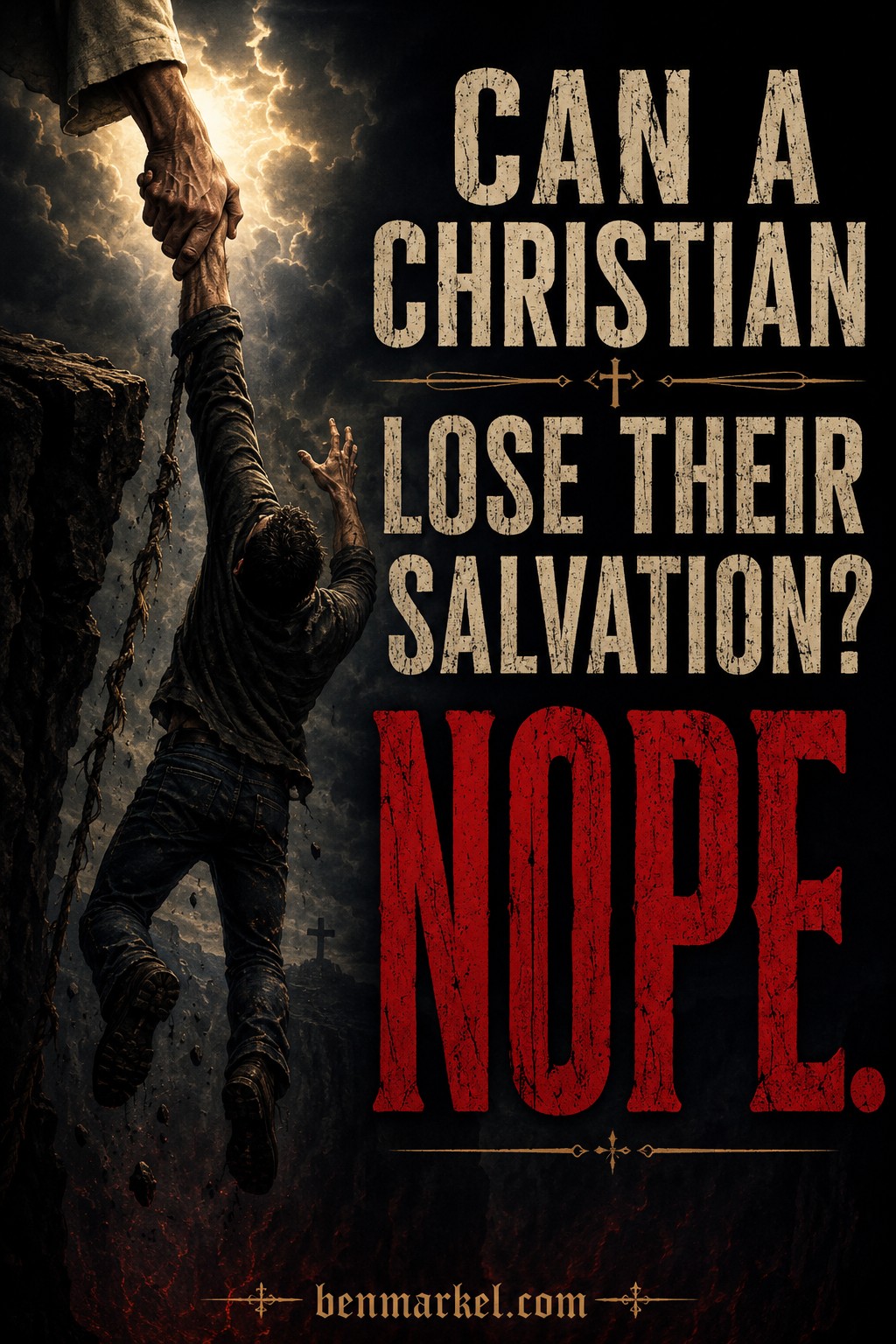
Can a Christian Lose Their Salvation?
Nope.
There. Article finished.
You can go home.
Actually, no, you can’t, because half of you are already typing “HEBREWS 6” in all caps, and the other half just opened Hebrews 10 like you’ve discovered a passage nobody who believes in eternal security has ever seen before.
They exist.
They just don’t mean what you think they mean.
Somewhere, Inigo Montoya nods approvingly.
So before we start throwing warning passages at each other, we need to establish what salvation actually is. Because if salvation is basically God giving you a clean slate and then standing back to see whether you can make it to the finish line without screwing everything up, then yes, losing it makes perfect sense.
That just isn’t how the New Testament describes salvation.
Who Is Keeping Whom?
Jesus says:
“All that the Father gives me will come to me, and whoever comes to me I will never cast out” (John 6:37).
That is already fairly inconvenient for the idea that Christ receives someone today and loses them tomorrow, but Jesus keeps going:
“And this is the will of him who sent me, that I should lose nothing of all that he has given me, but raise it up on the last day” (John 6:39).
Notice where Jesus puts the responsibility.
He does not say, “The Father has given these people to Me, and hopefully most of them manage to hang on.”
He says He will lose nothing the Father has given Him and will raise them up on the last day.
That same pattern appears again in John 10. Jesus describes His sheep as those who hear His voice and follow Him. Then He says, “I give them eternal life, and they will never perish, and no one will snatch them out of my hand” (John 10:28). He immediately adds that the Father is greater than all and that no one can snatch them from the Father’s hand either (John 10:29).
Apparently salvation comes with a fairly aggressive warranty.
The Christian is not pictured desperately clinging to Jesus’ fingertips while Jesus shouts encouragement from the cliff.
Christ is holding the Christian.
That distinction matters. Your assurance ultimately rests not in the strength of your grip on Christ, but in the strength of Christ’s grip on you.
But I Have Free Will
Yes.
Congratulations on having a will.
So do I.
Nothing about eternal security requires pretending Christians stop making real choices when they believe the gospel. The question is whether God’s act of saving someone amounts to nothing more than honoring one choice until that person makes another one.
Scripture describes something considerably bigger.
The believer has been justified (Romans 5:1). The believer has passed from death to life (John 5:24). The believer has been adopted as God’s child (Romans 8:15–17). The believer has been transferred from the domain of darkness into the kingdom of Christ (Colossians 1:13). The believer has been sealed with the Holy Spirit, who is called the guarantee of our inheritance (Ephesians 1:13–14).
Salvation is not God stamping APPROVED on your decision and then waiting to see whether you revoke it.
God actually does something to the person who believes.
Paul takes the security of that work so seriously that Romans 8 describes salvation as a chain running from God’s foreknowledge and purpose all the way to glorification:
“Those whom he justified he also glorified” (Romans 8:30).
Paul speaks of glorification in the past tense even though the believers receiving the letter had obviously not yet been resurrected and glorified. His point is the certainty of what God has purposed for those who belong to Christ.
Then Paul spends the rest of the chapter trying remarkably hard to destroy every escape hatch we might invent.
Tribulation?
No.
Distress?
No.
Persecution?
No.
Famine, nakedness, danger, sword?
Still no.
Death? Life? Angels? Rulers? Things present? Things to come? Powers? Height? Depth?
Paul eventually seems to run out of categories and simply says “anything else in all creation” will not be able to separate us from the love of God in Christ Jesus (Romans 8:35–39).
That is an impressively comprehensive list.
And unless you have recently stopped being part of creation, you appear to be included.
Then Why Does the Bible Warn Christians?
Now we get to the part everybody was waiting for.
If Christians cannot lose their salvation, why does the New Testament contain warnings about falling away?
Good question.
And “those verses aren’t talking to Christians” is not going to magically solve every one of them.
The warning passages are real. They are serious. They are supposed to make you uncomfortable. We do Scripture no favors by sanding their edges off until they cannot possibly warn anyone about anything.
But a warning about apostasy does not automatically establish that a regenerate person can become unregenerate.
Those are two different claims.
The New Testament repeatedly recognizes that people can participate extensively in the visible community of God’s people without actually belonging to Christ.
Judas did considerably more Christian-looking things than most people reading this article will ever do. He followed Jesus. Heard His teaching. Participated in ministry. Was sent out with the Twelve.
And betrayed Him.
John later describes people who departed from the Christian community this way: “They went out from us, but they were not of us” (1 John 2:19).
Notice what John does not say.
They were genuinely of us, stopped being of us, and therefore lost what they once possessed.
He says their departure revealed something about what had been true all along: “if they had been of us, they would have continued with us.”
Apostasy is real.
People really can confess Christ, participate in the church, experience enormous spiritual privileges, and eventually abandon the faith.
The question is whether apostasy proves salvation was lost or reveals that salvation was never possessed.
John gives us his answer.
Now we can finally open Hebrews.
Everybody happy?
Fine. Hebrews 6.
Here it comes.
Hebrews describes people who have “once been enlightened,” “tasted the heavenly gift,” “shared in the Holy Spirit,” “tasted the goodness of the word of God and the powers of the age to come,” and then fallen away (Hebrews 6:4–6).
Those are strong words.
We should let them be strong words.
These are not random pagans who accidentally walked past a church picnic. They have experienced profound blessings associated with the New Covenant community. Trying to make the language mean they barely encountered Christianity because our theology gets nervous is not serious exegesis.
But keep reading.
The author immediately gives an illustration.
Land receives the same rain. One field produces a useful crop and receives blessing. Another produces thorns and thistles and is destined for destruction (Hebrews 6:7–8).
The rain is real in both cases.
The difference is what the ground produces.
Then comes the sentence that tends to disappear when Hebrews 6 gets turned into a prooftext for losing salvation:
“Though we speak in this way, yet in your case, beloved, we feel sure of better things—things that belong to salvation” (Hebrews 6:9).
Well, that seems important.
The author has just described all of those extraordinary experiences and then distinguishes them from “things that belong to salvation.”
That should at least slow us down before declaring that verses 4–6 obviously describe someone possessing salvation and then losing it.
The warning is terrifying precisely because someone can experience extraordinary blessings within the covenant community without those experiences themselves being identical to salvation.
You can experience the rain.
The crop tells us what kind of ground received it.
And Yes, Hebrews 10 Exists Too
I can hear you turning pages.
Hebrews 10 warns about deliberately continuing in sin after receiving the knowledge of the truth. It speaks of judgment, trampling underfoot the Son of God, profaning the blood of the covenant, and outraging the Spirit of grace (Hebrews 10:26–31).
Again, terrifying language.
Again, we should not make it less terrifying.
Apostasy is not somebody accidentally committing one sin after becoming a Christian. If Hebrews 10:26 meant that any deliberate post-conversion sin permanently removed salvation, none of us would make it through the week.
The passage describes repudiation of Christ after receiving knowledge of Him. The entire argument of Hebrews has been urging people not to abandon Christ and retreat from the New Covenant realities they have encountered.
And then, once again, the author says something people have an unfortunate habit of stopping just before:
“But we are not of those who shrink back and are destroyed, but of those who have faith and preserve their souls” (Hebrews 10:39).
There are two groups.
Those who shrink back and are destroyed.
Those who have faith and are preserved.
Hebrews does not tell Christians that apostasy is imaginary. It warns the visible community because perseverance matters. Those who belong to Christ are called to continue in faith, and apostasy reveals something profoundly serious about the profession of the person who abandons Him.
The warnings are therefore not enemies of eternal security. They are among the means God uses to call His people to perseverance.
The warning sign saying BRIDGE OUT does not prove everyone driving toward it eventually goes over the edge.
It is there so you don’t.
What About Someone Who Walks Away?
This is where the question stops being theoretical.
We all know somebody.
Maybe they grew up in church. Maybe they knew Scripture better than you. Maybe they preached. Maybe they led worship. Maybe they once seemed more serious about Christianity than almost anybody around them.
And now they want nothing to do with Christ.
What happened?
We need to resist two equally bad answers.
The first is to say that anyone who ever prayed a prayer, walked an aisle, signed a card, or sincerely called themselves Christian is eternally secure regardless of what happens afterward.
The Bible does not teach salvation by successful completion of an altar call.
The second is to assume that because somebody appeared genuinely converted to us, their later apostasy proves genuine salvation can be lost.
We cannot see regeneration.
We see professions, behavior, fruit, perseverance, and eventually sometimes apostasy. God knows the heart.
Jesus Himself warns that some will receive the word with apparent joy and later fall away (Luke 8:13). Their initial response is real as an experience. It simply does not produce enduring fruit.
This is why eternal security should never be reduced to:
Once saved, always saved. Do whatever you want.
If “do whatever you want” is what you hear when somebody tells you Christ keeps His people, you have missed most of the New Testament.
The doctrine is not that everyone who once claimed Christianity is guaranteed heaven.
The doctrine is that Christ does not lose those who are His.
Those are very different claims.
Perseverance Matters
Jesus says His sheep hear His voice and follow Him. Paul tells Christians to continue in faith. Hebrews repeatedly commands believers to hold fast. The New Testament expects Christians to persevere.
That does not mean perseverance purchases salvation. It means perseverance belongs to the Christian life.
Philippians captures both sides beautifully. Christians are told to “work out your own salvation with fear and trembling,” and then Paul immediately explains why they can do so: “for it is God who works in you, both to will and to work for his good pleasure” (Philippians 2:12–13).
You work.
God works in you.
Apparently the Bible is comfortable saying both things in adjacent sentences.
Earlier in the same letter Paul says he is “sure of this, that he who began a good work in you will bring it to completion at the day of Jesus Christ” (Philippians 1:6).
God does not merely start salvation.
He finishes what He starts.
What If I’m Afraid I Lost Mine?
This is where the jokes stop.
Some people asking whether salvation can be lost are looking for a theological debate. Others are terrified.
Maybe you sinned badly. Maybe you have been distant from God. Maybe your faith feels weak. Maybe you have doubts you are ashamed to admit. Maybe you read Hebrews 6 at two in the morning and became convinced you had somehow crossed an invisible line from which repentance is impossible.
Your assurance should not come from pretending sin does not matter.
It should come from looking to Christ.
The answer to weak faith is not to stare harder at your faith until you determine whether it is sufficiently impressive. The object of saving faith is Christ, not the quality of your ability to believe in Him.
Repent where you need to repent. Confess your sin. Return to Christ. And stop imagining Jesus reluctantly standing at the door with a clipboard checking whether you have finally exceeded your allotted number of failures.
Jesus said He will never cast out the one who comes to Him. He said He gives His sheep eternal life. He said they will never perish. He said nobody will snatch them from His hand.
Paul says nothing in all creation can separate those in Christ from the love of God. The Spirit is given as the guarantee of our inheritance. God finishes what He begins.
That does not make apostasy unimportant. It does not make the warning passages fake. It does not give professing Christians permission to treat sin casually.
It tells us where our confidence ultimately belongs.
Not in the strength of your hands.
In His.
So, can a Christian lose their salvation?
Nope.
Turns out the guy on the graphic was worried about the wrong hand.