
Literally… Except When It’s Not
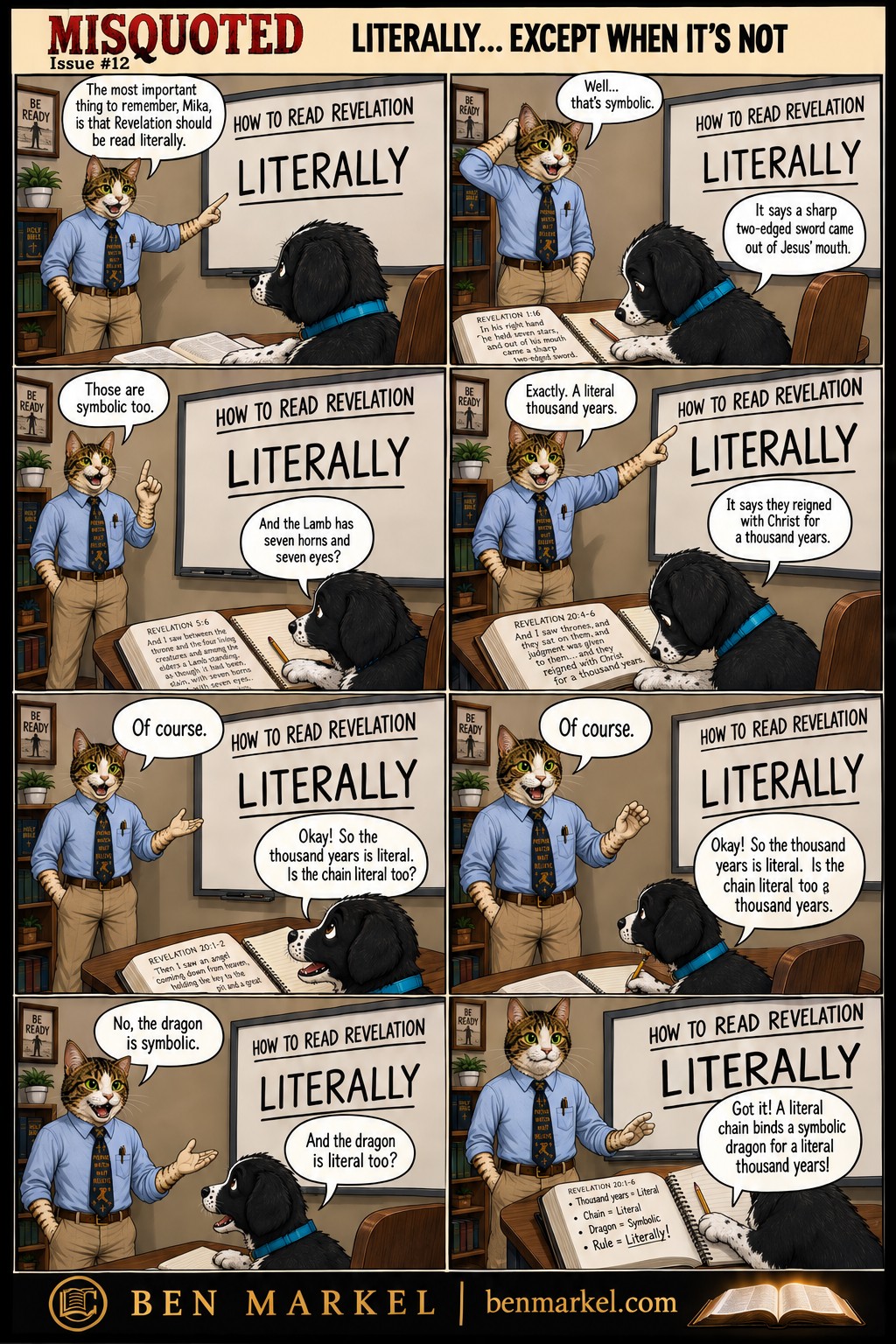
Yada had simplified hermeneutics. This was quite an accomplishment. Christians have spent centuries discussing language, context, genre, figures of speech, historical setting, authorial intent, biblical theology, and the relationship between different parts of Scripture. Entire libraries have been written about how we should interpret the Bible. Yada managed to fit his method on a teaching board with room to spare: HOW TO READ REVELATION — LITERALLY. There. Problem solved.
Mika, being Mika, immediately began testing the rule. Revelation describes a sharp two-edged sword coming from the mouth of Jesus. Surely that must be literal. Well, no. Yada explained that the sword is symbolic. Fair enough. Mika continued reading. Revelation describes Christ as a Lamb with seven horns and seven eyes. Seven literal horns? Seven literal eyes? No. Those are symbolic too. Then Mika reached Revelation 20, where Christ’s people reign with him for a thousand years. “Exactly,” Yada explained. “A literal thousand years.” Mika was beginning to understand. She continued reading. An angel descends from heaven carrying a great chain and binds the dragon for a thousand years. The thousand years are literal, so naturally the chain must be literal too. Of course. And the dragon? No. The dragon is symbolic. Mika dutifully recorded what she had learned: Thousand years = literal. Chain = literal. Dragon = symbolic. Rule = literally! Something has gone wrong.
The problem is not that Yada recognizes symbolism in Revelation. He has to. Everyone does. The problem is that the interpretive rule written in enormous letters behind him cannot explain his own interpretation. “Read it literally” sounds wonderfully objective until the actual reading begins. Then the sword becomes symbolic, the Lamb becomes symbolic, the horns become symbolic, the eyes become symbolic, the dragon becomes symbolic, the abyss may involve symbolic imagery, and somewhere in the middle of all of this we arrive at a number and announce that this part must be literal because the Bible says it. Of course the Bible says it. The Bible also says Jesus has a sword coming from his mouth. The question has never been whether the words are there. The question is what those words are intended to communicate.
Literal Is Not the Same Thing as Literalistic
Part of the confusion comes from the word literal. Christians can use that word in several different ways and then argue with each other without realizing they are defending different things. There is a perfectly legitimate sense in which we should seek the literal meaning of Scripture. Historically, the literal sense of a passage is not necessarily the woodenly physical meaning of every individual word. It is the meaning communicated by the text according to its language, grammar, context, literary form, and authorial intention. Understood that way, reading Scripture literally is simply an attempt to understand what the biblical author actually communicated.
Literalism is something different. Literalism assumes that words and images should ordinarily be understood in their most straightforward physical sense unless there is some compelling reason to abandon that reading. That may sound safer because it appears to minimize interpretation, but language does not work that way. When David says, “Yahweh is my shepherd” (Psalm 23:1, WEB), the literal meaning of the Psalm is not that David believed God walked around ancient Israel carrying a wooden staff and periodically sheared him. David is using shepherd imagery to communicate God’s provision, guidance, protection, and care. Recognizing the metaphor does not weaken David’s words. The metaphor is what David intended to say.
When Jesus says, “I am the door” (John 10:9, WEB), nobody imagines hinges attached to the incarnate Son of God. When Jesus calls Herod a fox, we do not begin investigating whether Herod possessed a tail. When Scripture speaks of God’s people sheltering beneath his wings, we do not conclude that God possesses feathers. When believers are called sheep, nobody expects wool. We understand these statements precisely because we do not read them literalistically. That does not mean we are refusing to take the Bible literally; it means we are taking language seriously. The intended meaning of a metaphor is the meaning of the text.
This distinction becomes especially important when we open Revelation, because Revelation does not read like Paul’s letter to Philemon. John is describing visions. Beasts rise from the sea. Stars fall. Dragons pursue women. Horns represent rulers. Lampstands represent churches. A Lamb appears as though slain. Souls cry out from beneath an altar. Death rides a horse. Babylon becomes a woman. A city descends from heaven adorned like a bride. Numbers, colors, creatures, objects, places, and actions carry meaning beyond their bare physical description. If our interpretive method cannot comfortably handle symbolism, Revelation will break it before we finish the first chapter.
Revelation Tells Us That It Uses Symbols
The symbolic character of Revelation is not something later theologians invented because they were uncomfortable with prophecy. The book itself repeatedly interprets its own imagery. John sees seven golden lampstands and, in Christ’s hand, seven stars. We do not have to speculate indefinitely about what they mean because Jesus explains them: “The seven stars are the angels of the seven assemblies. The seven lamp stands are seven assemblies” (Revelation 1:20, WEB). The lampstands are real features of John’s vision, but they signify churches. The stars are real features of John’s vision, but they signify angels or messengers associated with those churches. Revelation introduces us to its symbolic world almost immediately and then occasionally provides the interpretation.
The same thing happens elsewhere. Revelation 12 describes an enormous red dragon with seven heads, ten horns, and seven crowns. We are not left wondering whether Satan has recently developed several additional skulls. John tells us that the dragon is “the old serpent, he who is called the devil and Satan” (Revelation 12:9, WEB). Later, when John sees a woman seated upon many waters, the angel explains that “the waters which you saw, where the prostitute sits, are peoples, multitudes, nations, and languages” (Revelation 17:15, WEB). Notice what Revelation itself is teaching us to do. We see an image, but the image represents a reality beyond itself. The dragon is symbolic, but Satan is real. The waters are symbolic, but the nations are real. The lampstands are symbolic, but the churches are real. This gives us an important rule that is almost the opposite of the one Yada wrote on his board: symbolic does not mean unreal.
That distinction matters enormously because Christians sometimes hear a symbolic interpretation and assume someone is explaining the text away. If the chain in Revelation 20 is symbolic, then Satan was not really restrained. If the thousand years are symbolic, then there is no real reign of Christ. If an image is not a physical description, then apparently nothing happened. But symbols communicate realities. Jesus is not physically a lamb, yet calling him “the Lamb” communicates something profoundly real about who he is and what he has done. The sword coming from his mouth does not need to be forged from steel for it to communicate the reality of his authoritative and conquering word. Satan does not need seven literal heads for the dragon to reveal something true about him. Symbolism is not the opposite of truth; sometimes symbolism is how the truth is being communicated.
Everybody Interprets
This is why the phrase “I don’t interpret the Bible; I just believe what it says” sounds much better than it works. Everybody interprets. You interpreted Scripture when you decided that Jesus was not claiming to be a piece of architecture when he called himself a door. You interpreted Scripture when you concluded that God does not possess feathers. You interpreted Scripture when you decided that Jesus did not command people to engage in bodily mutilation when he spoke about tearing out an eye that causes sin. You interpreted Scripture when you read a parable and understood that its characters served a larger teaching purpose. Interpretation is unavoidable because reading is interpretation. The question is not whether we interpret; the question is whether we interpret well.
That means paying attention to the kind of literature we are reading. Historical narrative communicates differently from poetry. Proverbs function differently from covenant law. Letters function differently from visions. Parables communicate differently from genealogies. None of those differences make one genre more truthful than another; they tell us how the truth is being communicated. If someone tells you, “My heart is broken,” you do not call an ambulance because you respect language enough to recognize an idiom. If a newspaper says a political candidate “destroyed” an opponent in a debate, you do not begin searching for a body. If someone says they waited forever at the doctor’s office, you do not calculate the age of the universe. Nobody considers those readings dishonest. We recognize that ordinary human communication includes metaphor, hyperbole, symbolism, idiom, irony, analogy, and countless other ways of communicating meaning. The Bible uses human language, and we should permit it to behave like human language.
“But It Says a Thousand Years”
Eventually Mika reaches the point where Yada’s rule becomes particularly interesting. Revelation 20 says, “I saw an angel coming down out of heaven, having the key of the abyss and a great chain in his hand. He seized the dragon, the old serpent, which is the devil and Satan, who deceives the whole inhabited earth, and bound him for a thousand years” (Revelation 20:1–2, WEB). A few verses later, John describes those who “lived and reigned with Christ for a thousand years” (Revelation 20:4, WEB).
For premillennial interpreters, that thousand-year period describes a future reign of Christ associated with his return. In many forms of premillennialism, the number is understood as an actual chronological period of one thousand years. Amillennial interpreters generally understand the thousand years symbolically as describing the present reign of Christ and his saints during the period between Christ’s first and final coming. That is a real disagreement, and it deserves more than a slogan from either side.
The premillennial argument cannot simply be, “It says a thousand years, so I believe a thousand years.” Yes, it does say a thousand years, but it also says there is a dragon, that the dragon is bound with a chain, and that an angel possesses the key to an abyss. The question is not whether Revelation says these things; the question is how the vision communicates. Nor can the amillennial interpreter simply respond, “Revelation is symbolic, therefore the thousand years are symbolic.” That is the same shortcut traveling in the opposite direction. A book containing symbolic imagery can still refer to literal durations, literal people, literal places, and literal events. Identifying Revelation as apocalyptic literature does not give us permission to declare anything inconvenient symbolic. Both sides still have to interpret the passage.
The point of Mika’s question, therefore, is not that she has disproved a literal millennium by asking about the chain. She has exposed the inadequacy of Yada’s rule. If the answer to “Why is the thousand years literal?” is simply “because the Bible says a thousand years,” then the same reasoning should make the dragon a dragon. Yada already knows better than that, which means some interpretive judgment beyond the word LITERALLY on his board is doing the actual work.
Revelation Likes Numbers
There is another reason we should be cautious about assuming that a number in Revelation automatically functions as a precise quantity: Revelation is saturated with numbers. There are seven churches, seven seals, seven trumpets, seven bowls, seven spirits, seven lampstands, and seven stars. There are four living creatures and twenty-four elders. There are twelve tribes, twelve apostles, twelve gates, and twelve foundations. There are 144,000 sealed servants, twelve thousand from each tribe. The New Jerusalem is measured at twelve thousand stadia, while its wall measures 144 cubits.
This does not mean numbers in Revelation never refer to quantities; it means numbers clearly participate in Revelation’s symbolic vocabulary. Seven repeatedly communicates completeness. Twelve is repeatedly associated with the people of God. Multiplication and repetition produce numbers whose theological significance is difficult to miss. Whatever conclusions we reach about any individual number, Revelation itself gives us no reason to adopt the rule number = exact quantity unless proven otherwise.
Nor would such symbolic use of numbers be foreign to the rest of Scripture. God says in Psalm 50, “For every animal of the forest is mine, and the livestock on a thousand hills” (Psalm 50:10, WEB). Presumably the cattle on hill number 1,001 do not belong to someone else. The thousand communicates fullness and vastness; the point is God’s comprehensive ownership, not the establishment of a divine livestock property boundary. Again, Psalm 50 does not prove that the thousand years of Revelation 20 are symbolic. That would be another bad inference. It simply demonstrates that Scripture is perfectly capable of using the number one thousand non-literalistically. We therefore cannot settle Revelation 20 merely by pointing at the numeral. We still have to interpret it, and apparently there really is no escape from hermeneutics.
About That Chain
Mika’s next question is better than she realizes. If the thousand years are literal, is the chain literal too? Yada says yes, but what exactly would that mean? The dragon is explicitly identified as “the devil and Satan.” If the chain is a physical object, what kind of material restrains a spiritual being? How thick does it need to be? Does Satan have wrists? Does the angel wrap it around one of the dragon’s seven heads? What physical mechanism allows a metal chain to restrict the activity of the devil? What kind of lock secures the abyss? Those questions sound ridiculous because we instinctively understand that John is describing spiritual realities through visionary imagery.
That does not mean Satan’s restraint is imaginary; quite the opposite. The chain communicates restraint, the key communicates authority, the abyss communicates confinement, and the binding communicates a limitation placed upon Satan’s activity. The images tell us something real even if we would be very surprised to discover that heaven has a metallurgy department manufacturing devil-resistant chain. Once we recognize that, however, Mika’s question becomes unavoidable. If the dragon is symbolic and the chain communicates a real restraint through symbolic imagery, why must the thousand years function differently? Perhaps it does, but now we need a reason. That is the entire point.
We cannot place LITERALLY on the board, interpret half the vision symbolically, interpret selected portions physically, and then pretend the interpretive method itself produced those decisions. Something else is already guiding us, and our job is to identify what that something should be.
Let the Author Make the Rules
A better approach to Scripture is both more complicated and more humble. We begin by asking what kind of text we are reading. We pay attention to grammar and syntax. We examine the immediate context and ask how an argument develops. We recognize figures of speech and look for explanations the author provides. We pay attention to repeated images and themes. We consider how the passage uses earlier Scripture. We ask what the original audience could reasonably have understood. We distinguish between what a vision depicts and the reality that depiction represents. Above all, we keep asking what the author is trying to communicate.
Sometimes the result will be wonderfully straightforward: Jesus was crucified under Pontius Pilate, and we do not need to search for a symbolic crucifixion hiding behind the historical claim. Sometimes the intended meaning will be metaphorical: Jesus is the good shepherd. Sometimes it will be poetic: the heavens declare the glory of God. Sometimes it will be visionary and symbolic: a dragon sweeps stars from heaven with its tail. In every case, our responsibility is the same—to read the text according to the way the text asks to be read. That is more faithful than imposing a universal rule that Scripture itself refuses to obey.
The irony is that this approach actually takes the Bible more seriously than wooden literalism does. Literalism can force the biblical authors to communicate according to rules we have established for them; careful interpretation allows them to choose their own forms of communication. If John gives us a symbol, believe the symbol. If John interprets the symbol, believe the interpretation. If John describes an event, believe the event. If John uses imagery from Daniel, Ezekiel, Isaiah, Exodus, or the Psalms, follow him there and ask why. Our job is not to make Revelation easier by flattening everything into physical description. Our job is to hear what John actually wrote.
Literally… Except When It’s Not
There is nothing wrong with wanting a simple rule for reading Scripture. Simple rules feel safe. “Read it literally” seems to protect us from interpreters who can make the Bible mean anything they want. That concern is legitimate. Symbolism can absolutely be abused. Someone can declare inconvenient passages metaphorical simply because they do not like what those passages say, and allegory can become a playground where the interpreter’s imagination matters more than the text. The answer to irresponsible symbolism, however, is not irresponsible literalism. The guardrail is authorial intent.
We do not need to approach a passage asking whether we can make it symbolic or whether we can make it literal. We need to ask what the author is doing there. That question will not always produce easy answers. Revelation is difficult, and faithful Christians who share a high view of Scripture have disagreed about parts of it for centuries. Premillennialists, amillennialists, and postmillennialists can all affirm biblical inspiration while reaching different conclusions about Revelation 20. Recognizing that should produce humility rather than suspicion. Our disagreement is not settled by determining which person “believes the Bible literally,” because everyone in the conversation believes the words are there and everyone interprets them. The real work begins when we ask why.
Yada’s rule sounded wonderfully simple: Revelation should be read literally. Mika merely kept asking him to apply it. By the time she reached the sword, the Lamb, the horns, the eyes, the thousand years, the chain, and the dragon, the simplicity had disappeared, not because Scripture had failed, but because the rule had. The goal is neither to read everything literally nor to read everything symbolically, but to read everything as it was intended to be read. If your interpretive method eventually produces a literal chain restraining a symbolic dragon for a literal thousand years while a giant LITERALLY sign hangs behind you, it might be time to erase the board and start again.