
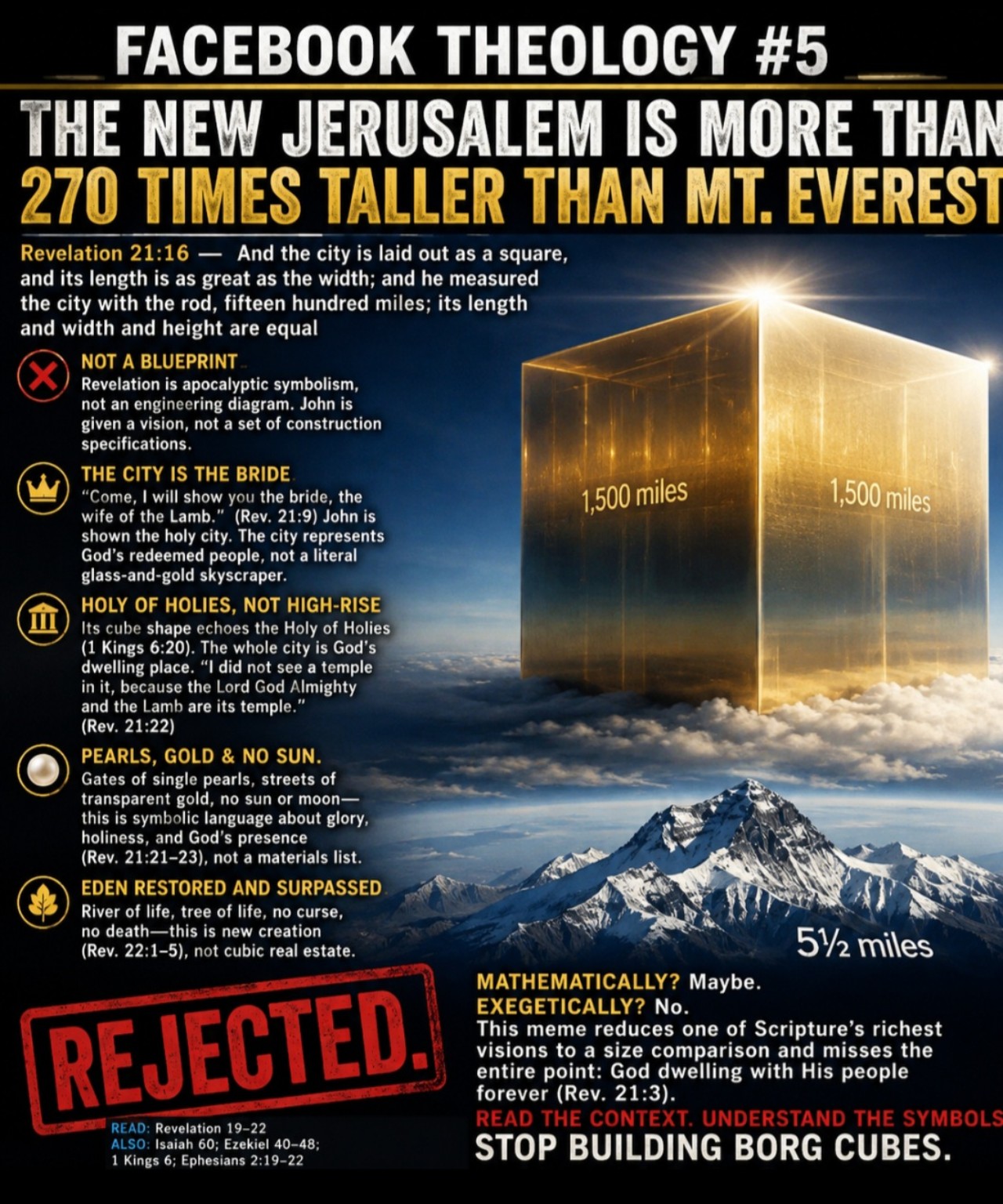
There is something magnificent about human confidence. John receives an apocalyptic vision in which a woman is a city, the city is a bride, the bride is the wife of a Lamb, the Lamb is Jesus, the city has twelve gates named after tribes, twelve foundations named after apostles, each gate consists of a single pearl, the street is transparent gold, there is no temple, there is no sun, and the nations walk by the city’s light. Facebook looked at all of this and concluded: Big cube.
Not merely a big cube, either. A cube approximately 1,500 miles tall, helpfully positioned above Mount Everest so that we can appreciate the scale. Thank you. I had been struggling with Revelation 21 because I foolishly thought John was describing the consummation of God’s redemptive purposes, the dwelling of God with His people, the union of Old and New Covenant imagery, the restoration of Eden, and the Church presented as the glorified bride of Christ. Turns out I needed a mountain for scale.
In fairness, the arithmetic behind the meme is not particularly outrageous. Revelation 21:16 gives the city’s measurement as twelve thousand stadia. Depending upon the length assigned to the stadion, that produces a distance somewhere around 1,400 miles. Mount Everest is about 5½ miles above sea level. So, yes, twelve thousand stadia is more than 250 Everests. Congratulations. We have successfully performed arithmetic. Now we have to read Revelation.
John Actually Tells Us What the City Is
The angel says, “Come, I will show you the bride, the wife of the Lamb” (Revelation 21:9). John is then shown “the holy city, Jerusalem, coming down out of heaven from God” (21:10). The angel says he will show John the bride; John is shown the city. The text does the identification for us. The city is the bride. Unless Jesus will marry a 1,500-mile gold cube, John’s architecture is doing something more sophisticated than supplying construction specifications.
Five verses earlier John had already heard that the dwelling of God is with humanity and that He will live with His peoples (Revelation 21:3). The central subject is not celestial real estate. It is God dwelling with His redeemed people. The architecture communicates that reality. Woman = not literally a city. Jesus = not literally a sheep. Bride = God’s redeemed people. City = God’s redeemed people dwelling eternally in God’s presence.
Why Twelve Keeps Appearing
The gates bear the names of the twelve tribes of Israel, while the foundations bear the names of the twelve apostles of the Lamb (Revelation 21:12, 14). Twelve tribes. Twelve apostles. Twelve gates. Twelve foundations. Twelve thousand stadia. A wall of one hundred forty-four cubits—twelve times twelve. Revelation is using symbolism. The entire image presents the people of God in the completed story of redemption.
Revelation has already played with these numbers in the 144,000 of chapters 7 and 14. John brings Israel and the apostles into the architecture of one city. There is one bride, one city, one people dwelling with God. Paul’s language in Ephesians 2:19–20 is strikingly similar: Gentile believers are fellow citizens in God’s household, built on the foundation of the apostles and prophets, with Christ as the cornerstone. Revelation turns that theological reality into apocalyptic architecture.
Why Is the City a Cube?
Revelation 21:16 says the city’s length, width, and height are equal. Geometrically, John describes a cube. Scripture has encountered another enormously important sacred space whose dimensions were equal: the Holy of Holies. First Kings 6:20 describes Solomon’s inner sanctuary as thirty feet long, thirty feet wide, and thirty feet high.
Under the Old Covenant, access to that sacred space was severely restricted. In Revelation, the entire city has the shape of the Holy of Holies. The dwelling place of God is no longer represented by one restricted chamber into which one man enters once per year. The whole city is the Holy of Holies. Revelation 21:22 makes the point explicit: there is no temple in the city because the Lord God Almighty and the Lamb are its temple. The cube is not principally telling us how much heavenly airspace Jerusalem occupies. It is screaming: HOLY OF HOLIES. The meme brought Everest. John brought the temple.
Twelve Thousand Stadia Is Not a Randomly Large Number
The measurements belong to the symbolic vocabulary governing the vision. Twelve thousand is twelve multiplied by a thousand, corresponding to fullness and completeness on an enormous scale. Symbolic does not mean fake. Jesus genuinely is Christ though Revelation portrays Him as a Lamb; Satan genuinely exists though portrayed as a dragon; the Church genuinely belongs to Christ though portrayed as a bride. Symbols communicate realities.
About Those Giant Pearls
Revelation 21:21 says each of the twelve gates is a single pearl. If every visual element is treated as straightforward physical description, the 1,500-mile city requires mollusks of theological significance. Or perhaps John is describing indescribable glory through apocalyptic imagery: precious stones, gold, pearls, radiance, enormous measurements, and perfect proportions. Everything communicates value, holiness, magnificence, permanence, and glory. Facebook Theology has responded by opening Google Maps.
The Streets of Transparent Gold
John describes the street as pure gold, like transparent glass (Revelation 21:21). Actual gold is not transparent. Once again, the imagery is not behaving like a contractor’s material specification sheet. The point is overwhelming purity and splendor. Trying to determine the metallurgical process by which heaven manufactures transparent gold is rather like reading Psalm 91:4 about God covering His people with His feathers and beginning a study of God’s wingspan.
There Is No Sun
The meme renders the cube glowing in sunlight, while John specifically says the city does not need the sun or moon because the glory of God illuminates it and the Lamb is its lamp (Revelation 21:23). The imagery draws deeply from Isaiah 60:19. John is gathering biblical imagery from Genesis, Isaiah, Ezekiel, Israel’s temple, the tribes, the apostles, Eden, and the whole story of redemption. Reading Revelation without the Old Testament is a reliable way to produce very impressive nonsense.
Eden Has Returned Too
Revelation 21 flows into Revelation 22 with the river of life, the tree of life, fruit, healing, the removal of the curse, God’s throne, His servants, and humanity dwelling in His presence. The Bible begins with humanity dwelling with God and losing access to the tree of life because of sin. It ends with the curse removed and the tree accessible again. The garden has become a city. Eden is restored and surpassed.
The Bride Has Finally Been Prepared
Revelation 19:7 announces the marriage of the Lamb and the preparation of His wife. Revelation 21 then shows the bride as the holy city. The imagery overlaps because the city is not primarily about buildings. A city is its people. Bride, city, temple, Holy of Holies, Israel, apostles, Eden, and nations all converge around one reality: God dwelling forever with the people He has redeemed through the Lamb.
Literalism Is Not the Same Thing as Taking Scripture Seriously
Taking Scripture seriously means interpreting language according to the kind of language the biblical author is using. When Jesus says “I am the door,” taking Him seriously does not require hinges. When John calls Jesus the Lamb of God, seriousness does not require wool. When Revelation portrays Satan as a dragon, seriousness does not require zoological classification. When an angel says “I will show you the bride” and shows John a jeweled city shaped like the Holy of Holies, seriousness means asking why the bride is portrayed that way.
Revelation announces from its opening that its message is communicated through signs, and then spends twenty-two chapters doing precisely that. Beasts are kingdoms. Lampstands are churches. Stars are angels. A dragon is Satan. A Lamb is Christ. A prostitute is Babylon. A woman is clothed with the sun. Finally a bride is shown as a city. Then someone reaches Revelation 21:16 and announces: Finally. Construction specifications. No. Read the book you are actually holding.
Facebook Theology Verdict
The meme’s arithmetic is close enough. Exegetically, it is rejected—not because the New Creation will be less glorious than the meme imagines, but because the meme takes one of Scripture’s richest theological visions and reduces it to a size comparison. John gives us the bride of Christ; Facebook gives us a cube. John gives us Israel and the apostles united in one redeemed people; Facebook gives us Everest. John gives us the whole city as the Holy of Holies because God dwells unrestricted among His people; Facebook gives us 1,500 miles.
The tragedy is not that the meme takes Revelation too seriously. It does not take Revelation seriously enough. The city is the bride. The gates bear Israel’s tribes. The foundations bear the apostles. The measurements express completeness on a staggering scale. The cube recalls the Holy of Holies. God and the Lamb are its temple. Gold and precious stones portray incomparable glory. God’s glory is its light. The river and tree announce Eden restored. The absence of death and the curse announces redemption completed. What humanity lost through sin has been restored through the Lamb, and God’s redeemed people will dwell in His unveiled presence forever. That is Revelation 21. It is considerably better than a 1,500-mile cube. And not once did we need to stack Mount Everest.