
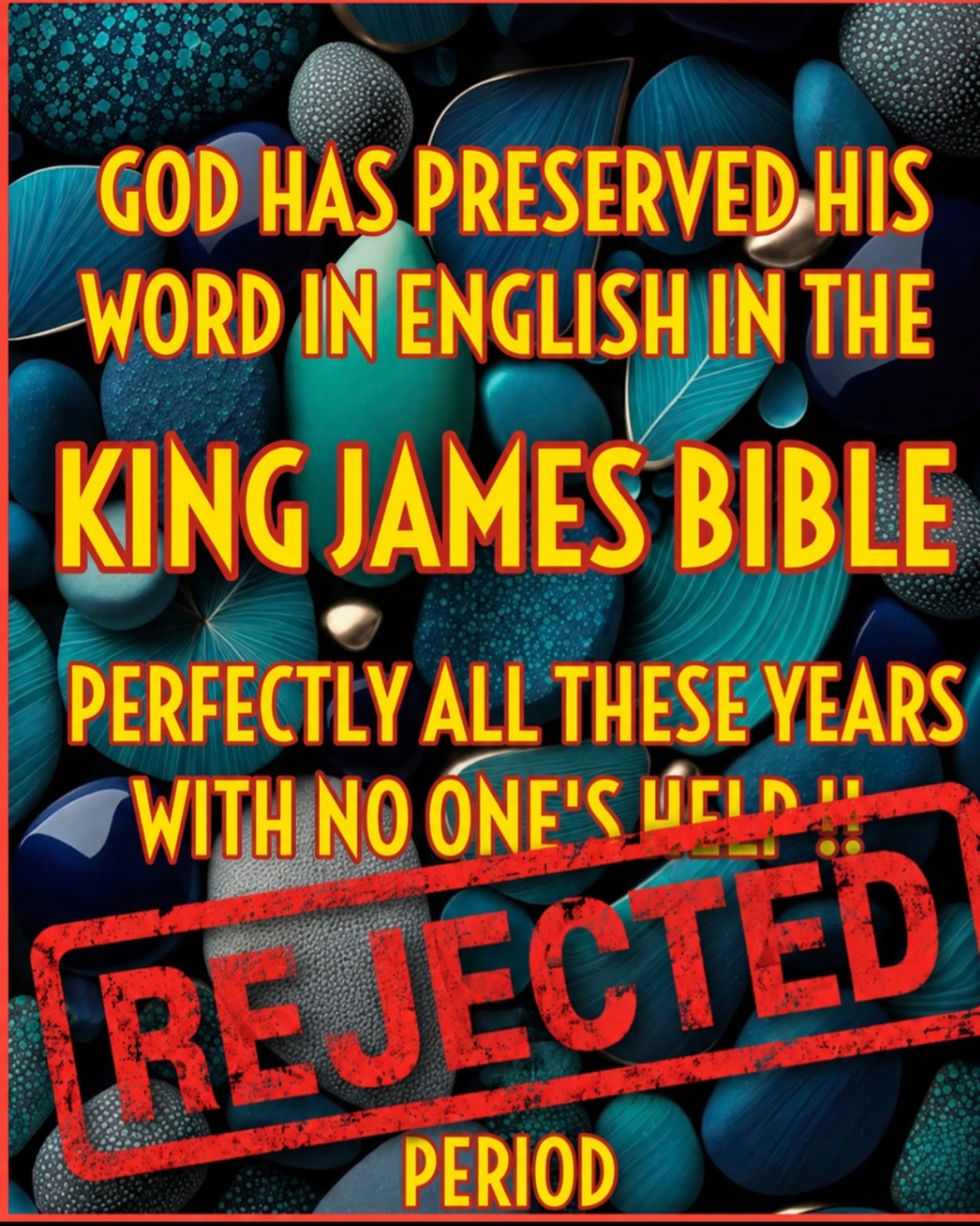
The meme makes a remarkably confident claim:
GOD HAS PRESERVED HIS WORD IN ENGLISH IN THE KING JAMES BIBLE PERFECTLY ALL THESE YEARS WITH NO ONE’S HELP!!
PERIOD
The word period is doing important work here. It informs us that the discussion has ended before anyone has the poor judgment to ask a historical question.
Unfortunately, we have several.
I like the King James Version. It is one of the most important English translations ever produced. Its language has shaped English-speaking Christianity for centuries and left an enormous mark on English literature and culture. Much of it remains beautiful. Christians were reading it profitably long before any of us arrived, and Christians can continue reading it profitably long after Facebook has disappeared.
None of that establishes what this meme claims.
The claim is not merely that the King James Version is a good translation. It is not that someone prefers it. It is not even that someone considers it the best available English translation. The meme makes a theological claim about divine preservation: God has preserved His Word perfectly in English in the King James Bible.
That is an enormous claim.
It requires evidence.
And typing PERIOD underneath it does not count.
We Should Probably Ask Where the Bible Was Before 1611
The first problem is embarrassingly simple.
The King James Bible was published in 1611.
Christianity was not.
Christians possessed, copied, translated, preached, studied, and died confessing the Scriptures for roughly sixteen centuries before King James authorized a new English translation.
So where was the perfectly preserved Word of God in 1610?
What Bible did Christians possess in 1510?
What about 1010?
What about 410?
What exactly was the Church reading while waiting for early modern England to solve the preservation problem?
The question becomes particularly awkward because English did not exist during the apostolic period in anything resembling its modern form. Paul did not write Romans in English. John did not write Revelation in English. Moses did not write Genesis in English. The prophets were not waiting for a seventeenth-century British monarchy to provide the language in which God’s revelation could finally become perfectly preserved.
The Old Testament was written primarily in Hebrew, with portions in Aramaic. The New Testament was written in Greek.
English translations are therefore exactly what their name says they are:
Translations.
That does not diminish them. Translation is one of the great gifts by which Scripture has gone throughout the world. The translators of the KJV themselves argued for the necessity of giving people Scripture in languages they could understand.
But translation and inspiration are not interchangeable categories.
God inspired Scripture.
English translators translate Scripture.
Once those categories are confused, the theology begins wandering into very strange territory.
“With No One’s Help” Is an Especially Ambitious Addition
The meme does not merely say God preserved His Word perfectly in the King James Bible.
It adds:
WITH NO ONE’S HELP!!
This is perhaps unfortunate wording for a Bible produced by a committee of translators.
The 1611 title page itself describes the Bible as newly translated from the original languages and produced with earlier translations “diligently compared and revised.”
In other words, the King James Bible announces on its own title page that people helped make it.
Quite a few of them.
The translators worked with Hebrew and Greek. They consulted previous English translations. The KJV stood at the end of a substantial English translation tradition involving Tyndale, Coverdale, the Great Bible, the Geneva Bible, the Bishops’ Bible, and others. Cambridge textual scholar David Norton describes the KJV as the culmination of this preceding history rather than a translation appearing independently from nowhere.
And the translators themselves openly said so.
They explained that their purpose was not to create a good translation from a bad one, but to improve what was already good—to make, from multiple good translations, one principal good translation.
Apparently nobody told the King James translators that previous English Bibles were supposed to be defective vessels awaiting the arrival of God’s perfectly preserved English text.
They seemed rather grateful for them.
In fact, they praised previous translators as people raised up by God for the benefit of His Church.
So the meme’s theology encounters an unusual opponent:
The people who actually translated the King James Bible.
That is rarely a promising beginning for a theory about the King James Bible.
The KJV Translators Were Not KJV-Onlyists
This is where the historical situation becomes almost comical.
Modern King James Only arguments sometimes speak about other translations as though accepting more than one English rendering somehow undermines confidence in God’s Word.
The KJV translators themselves explicitly rejected that reasoning.
In The Translators to the Reader, they defended the legitimacy of English Bible translations even when a translation was not equally successful in every expression. They argued that an English translation could rightly be called the Word of God despite imperfections in translation.
That is a remarkably healthy doctrine of translation.
The authority belongs ultimately to the Word God gave, not to the perfection of one particular English rendering.
Translations can therefore be better or worse. A translation can render one passage beautifully and another awkwardly. Translators can disagree over the best English word for a Hebrew or Greek expression without causing Scripture to evaporate.
This is why responsible Bible translation requires scholarship.
Languages do not correspond word-for-word with mathematical precision. Words possess semantic ranges. Grammar differs. Idioms differ. Historical contexts matter. Sometimes more than one English expression reasonably communicates an original expression.
The KJV translators knew this.
Modern KJV-onlyism frequently requires pretending they did not.
There is something deeply ironic about defending the King James Bible by constructing a doctrine of the King James Bible that its own translators would not recognize.
Then We Have to Ask Which King James Bible
Suppose, however, we grant the meme’s premise.
God perfectly preserved His Word in English in the King James Bible.
Fine.
Which one?
This is not a trick question.
The King James text did not descend from the printing press in 1611 and remain typographically and textually frozen forever.
There were even two issues bearing the date 1611, and subsequent printings introduced corrections as well as additional errors. Later editors continued working on the text. Significant editorial work occurred in 1629 and afterward; spelling was modernized, punctuation changed, and readings were examined and corrected. The process continued through major eighteenth-century editions, with the 1769 Oxford edition becoming the basis for the form familiar to most modern KJV readers.
Cambridge’s history of the text is wonderfully inconvenient for the meme because the history is precisely that: a history.
Printers printed it.
Editors edited it.
Mistakes were corrected.
Other mistakes appeared.
Spellings changed.
Punctuation changed.
Readings were compared.
The text reached the standardized form familiar today through human editorial work extending well beyond 1611.
This does not embarrass me in the slightest.
It should not embarrass anyone.
That is what happens when human beings copy, print, edit, and translate texts.
What it embarrasses is the claim that God deposited a perfectly fixed English text into history in 1611 “with no one’s help.”
History refuses to cooperate.
Preservation Does Not Mean God Re-Inspired an English Translation
There is a sound Christian conviction hiding underneath the meme.
God has preserved His Word.
Christians have good reason to believe that Scripture has not vanished into history. We possess an enormous manuscript tradition through which the biblical text can be studied. We have ancient translations. We have quotations from early Christian writers. We have textual evidence from different locations and periods. Scholars compare this evidence carefully when examining places where manuscripts differ.
Textual variants are real.
They are not a secret.
Neither do they mean that nobody knows what the Bible says.
The existence of variants is exactly what one would expect from a text copied repeatedly by human beings over centuries before modern printing. A scribe might skip a line, repeat something, alter spelling, transpose words, or occasionally attempt to clarify a difficult reading. Because we possess many witnesses, those differences can themselves be compared.
Preservation does not require pretending that copying never happened.
And it certainly does not require inventing a second act of inspiration in seventeenth-century England.
The biblical doctrine of inspiration concerns the Scriptures God gave through His prophets and apostles. Paul writes:
“All Scripture is inspired by God and is profitable for teaching, for rebuking, for correcting, for training in righteousness.” —2 Timothy 3:16
Peter describes men speaking from God as they were carried along by the Holy Spirit (2 Peter 1:21).
Neither passage says that centuries later God would select one translation in one language and grant that translation an additional quality of verbal perfection unavailable to Christians who read Scripture in other languages.
That doctrine has to come from somewhere else.
And that is the central problem.
English Is Not God’s Special Language
KJV-onlyism can become strangely provincial.
Christianity is not an English religion.
The overwhelming majority of human beings who have lived since Christ did not speak the English of the King James Bible. Vast numbers of Christians today do not speak English at all.
A believer reading Scripture in Spanish is not reading an inferior species of God’s Word because he lacks seventeenth-century English.
Neither is the Korean Christian.
Neither is the Arabic-speaking Christian.
Neither is the believer reading Scripture in Swahili, German, French, Portuguese, Mandarin, or any of the other languages into which Scripture has been translated.
And the first Christians certainly were not spiritually disadvantaged because they had never encountered the word thee.
The gospel crossed linguistic boundaries almost immediately.
Indeed, Pentecost itself presents the mighty works of God being proclaimed across languages. Christianity moves outward rather than demanding that the nations acquire one sacred human tongue before they may hear God’s revelation.
Translation serves that mission.
The King James Version belongs to that magnificent history.
It does not stand above it.
You Do Not Have to Attack the KJV to Reject KJV-Onlyism
This distinction matters because discussions about KJV-onlyism can become needlessly contemptuous toward the translation itself.
There is no reason for that.
The King James Version deserves respect.
Its translators were serious scholars. Its influence on the English-speaking world is extraordinary. Its phrasing has entered English literature, public speech, hymnody, and Christian memory. Some passages possess a rhythm and literary beauty that newer translations struggle to reproduce.
If you have read the KJV your entire life and understand it well, keep reading it.
If you memorize from it, keep memorizing.
If your church preaches from it, wonderful.
If its language helps you recognize biblical connections because decades of reading have embedded those phrases in your memory, that is a genuine benefit.
None of that requires claiming that the ESV, NASB, NKJV, CSB, NIV, or every other translation is therefore corrupt.
And none of it requires claiming that God performed a unique miracle of perfect English preservation in 1611.
We can honor the KJV without turning it into something its translators never claimed it was.
In fact, respecting the translators might begin with listening to them.
The Doctrine of Preservation Is Better Than This Meme
There is something pastorally important underneath all of this.
Christians sometimes encounter textual criticism and become frightened.
Someone points out that manuscripts differ in places. Someone mentions the longer ending of Mark or the woman caught in adultery. Someone explains that a verse appearing in the KJV may be absent or bracketed in a modern translation.
For a Christian who was taught that confidence in Scripture depends upon possessing one absolutely perfect English text, that information can feel catastrophic.
The problem is not the manuscript evidence.
The problem is the fragile doctrine of Scripture they were given.
If your confidence in the Bible requires believing that every word of one seventeenth-century English edition was miraculously preserved without meaningful textual history, then ordinary historical facts become threats to your faith.
They do not need to be.
Christian confidence in Scripture survived for sixteen centuries before the KJV existed.
The Church possessed Scripture before movable-type printing.
Christians possessed Scripture while manuscripts were copied by hand.
Christians translated Scripture before 1611.
And the KJV translators themselves believed they possessed God’s Word in earlier English translations even while believing those translations could be improved.
That position is considerably stronger than the meme’s.
We do not need to pretend God preserved Scripture by eliminating every human element from its transmission.
God preserved His Word through history.
Through manuscripts.
Through scribes.
Through churches.
Through scholars.
Through translators.
Through printers.
Through people who compared copies precisely because copies sometimes differed.
And, yes, through the scholars who produced the King James Bible.
That is not “God needed man’s help,” as though God and human action were competing explanations.
God routinely accomplishes His purposes through human means.
The same God who inspired Paul’s letters used ordinary people to carry those letters to churches.
Providence is not defeated when God uses people.
“With No One’s Help” Accidentally Makes the Whole Thing Worse
This may therefore be the weakest sentence in the entire meme.
God preserved His Word:
WITH NO ONE’S HELP!!
The Bible sitting on your table exists because an astonishing number of people helped.
Someone preserved manuscripts.
Someone copied them.
Someone transported them.
Someone studied ancient languages.
Someone compared textual witnesses.
Someone translated them.
Someone checked the translation.
Someone edited it.
Someone typeset it.
Someone printed it.
Someone bound it.
Someone taught you how to read.
And centuries before any of them, Christians guarded, copied, read, preached, and transmitted these texts because they believed they were the Word of God.
None of those people displaced God.
They were means through which His providence operated.
The KJV itself is a monument to exactly this kind of labor.
Its translators did not hide that fact. They advertised it.
The title page says previous translations were compared and revised. Their preface praises earlier translators. Their own explanation describes their work as making existing good translations better.
To honor their Bible by denying the process that produced it is a peculiar form of gratitude.
Facebook Theology Verdict
The meme begins with a conviction worth preserving:
God has preserved His Word.
Good.
Keep that.
Then it adds claims Scripture does not make and history does not sustain.
God did not promise that His Word would be perfectly preserved in one seventeenth-century English translation.
The King James translators did not claim to be producing a newly inspired English text.
They did not believe every other English translation ceased to be God’s Word.
They openly used previous translations.
They openly discussed translation as translation.
And the KJV text itself continued through printing, correction, revision, and standardization after 1611.
The King James Bible does not need this mythology.
It is already a remarkable achievement.
It deserves better than being defended with claims contradicted by its own history and, remarkably, by its own translators.
Read the King James Version.
Love the King James Version.
Memorize the King James Version.
Prefer the King James Version.
Argue that particular KJV renderings are superior to those of another translation when the textual and linguistic evidence supports the argument.
Just do not transform a translation into an object of faith.
The Word of God existed before 1611.
It existed before English.
And Christians throughout the world do not need to learn the language of King James I before God can speak to them through Scripture.
The meme wanted the final word:
PERIOD.
It does not get it.
History gets another sentence.
The translators get another sentence.
And Scripture gets the final authority.
REJECTED.
Not because the King James Bible is bad.
Because the King James Bible is far too good to require bad theology to defend it.