
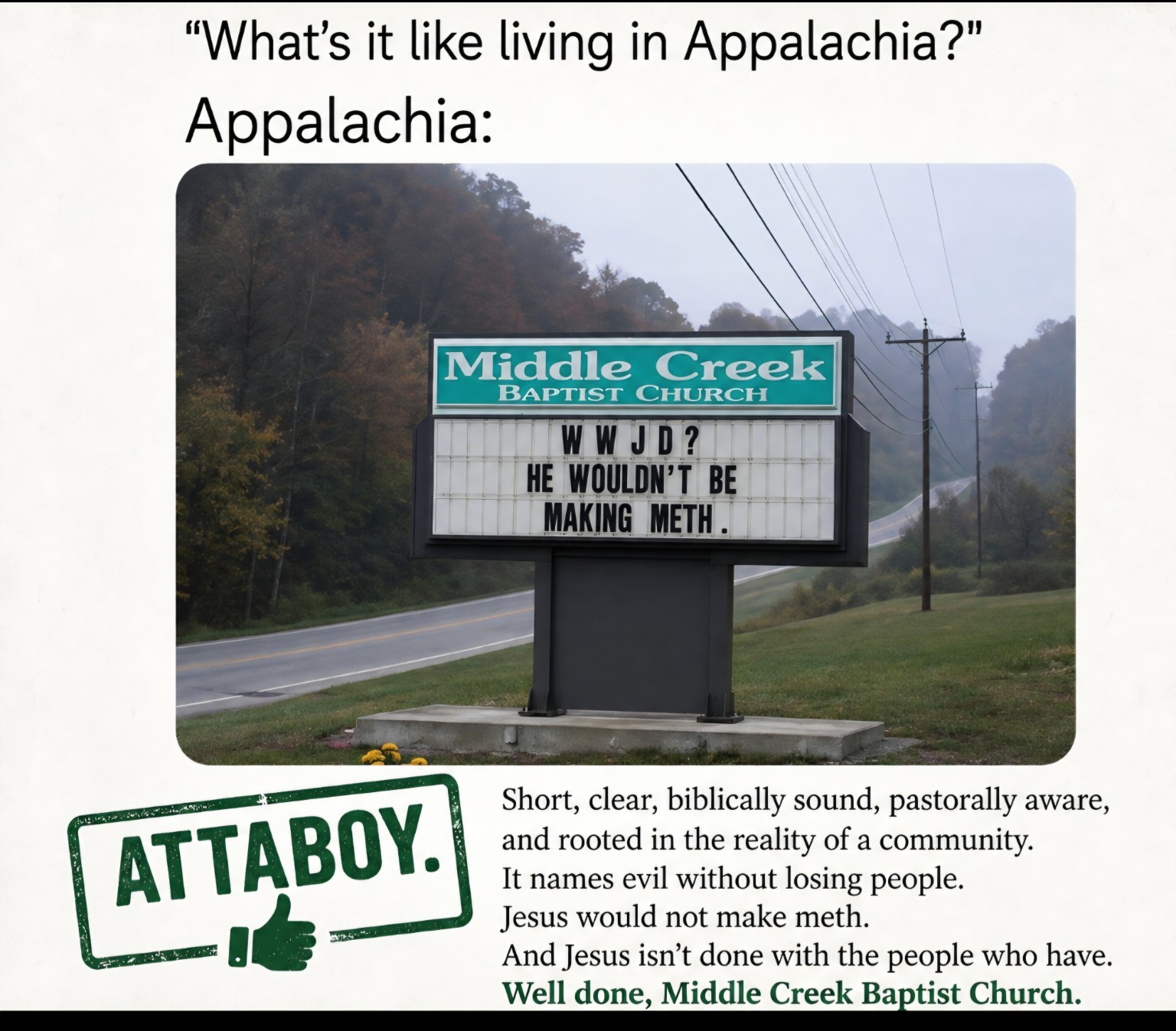
Every so often, Facebook theology produces something so concise, so direct, and so remarkably resistant to theological corruption that there is simply nothing left to reject.
Middle Creek Baptist Church asks:
WWJD?
HE WOULDN’T BE MAKING METH.
After examining the biblical text, the principles of Christian ethics, and what I assume were some very specific local circumstances behind the decision to put this particular message on the church sign, the verdict is straightforward:
Approved.
Jesus would not make meth.
The conclusion is so obviously correct that attempting to prove it at great length would risk becoming considerably more ridiculous than the sign. There is no biblical command reading, “You shall not manufacture methamphetamine,” just as there are no explicit commands concerning ransomware, drunk driving, identity theft, or stealing catalytic converters from the church parking lot. Scripture does not attempt to anticipate every particular form human wickedness might eventually take. It gives moral categories by which actions can be understood and judged.
Methamphetamine production manages to collide with quite a few of them.
Christian Ethics Does Not Require a Verse for Everything
Jesus identified love of God and love of neighbor as the great commandments, telling His hearers, “Love your neighbor as yourself” (Matthew 22:39). Paul develops the same moral principle when he writes that “love does no wrong to a neighbor” (Romans 13:10). Those statements provide considerably more moral guidance than a search for a verse containing the word methamphetamine ever could.
Manufacturing an addictive street drug for distribution is incompatible with love of neighbor for reasons that hardly require an advanced degree in Christian ethics. The enterprise depends upon supplying something capable of enslaving and devastating the people purchasing it. Addiction destroys bodies, judgment, employment, marriages, families, and communities. A business model sustained by another person’s bondage has already encountered a serious problem when measured against the command to love that person.
The New Testament’s repeated emphasis upon sobriety and self-control strengthens the point. Christians are called toward lives in which desires are governed rather than allowed to become masters. Paul can say, “I will not be mastered by anything” (1 Corinthians 6:12), while self-control appears among the fruit of the Spirit in Galatians 5:23. These texts should not be flattened into the simplistic claim that anything capable of altering the body or mind is inherently sinful. Medicine alters the body. Anesthesia alters consciousness. Scripture requires more careful moral reasoning than chemical affects brain, therefore chemical bad.
The relevant categories include purpose, effect, stewardship, mastery, harm, legality, and love of neighbor. An illicit methamphetamine operation intended to supply recreational drug use does not present a particularly difficult case under any of them.
Even submission to lawful government manages to enter the discussion. Paul instructs Christians concerning governing authorities in Romans 13, while Peter commands submission to human authorities in 1 Peter 2. Christian obedience to government is not absolute; when authorities command what God forbids or forbid what God commands, Christians obey God rather than men. Peter and John demonstrate precisely that principle when ordered to stop proclaiming Christ.
The sheriff shutting down your meth lab is not that situation.
If Gary has converted the fellowship hall into a clandestine pharmaceutical operation, “We must obey God rather than men” is not the verse Gary needs.
Gary needs an attorney.
And probably a lengthy period of reflection.
The Sign Is Right, but There Is a More Important Question
The phrase What Would Jesus Do? Has always had a potential weakness. It can become a substitute for asking what Jesus actually taught. Rather than studying Scripture and allowing Christ’s teaching to shape Christian obedience, we can construct an imaginary Jesus who conveniently behaves exactly as we think He should.
That is not what is happening here.
The life and teaching of Jesus leave little difficulty determining the answer. Christ’s ministry was characterized by holiness, obedience to the Father, love of neighbor, mercy toward suffering people, and compassion toward those whose lives had been devastated by sin. He healed the suffering rather than exploiting their suffering for personal benefit. He showed mercy toward people whom respectable society preferred to discard.
Jesus would not make meth.
But there is another question that matters much more once the joke has landed:
What would Jesus do with the person who did?
That is where the church sign becomes more interesting than it first appears.
Jesus Would Not Make Meth. Jesus Saves People Who Have.
Christianity does not divide humanity into respectable people whom Jesus welcomes and ruined people whom He avoids. The gospel begins with the considerably less flattering assessment that all of us need mercy.
Paul describes the Christian message in language that leaves little room for respectable self-congratulation: “Christ Jesus came into the world to save sinners” (1 Timothy 1:15). Jesus Himself was criticized precisely because He received people whose reputations made religious observers uncomfortable. The accusation that He welcomed sinners was intended as an indictment. The Gospel writers allow us to see how badly His critics misunderstood the significance of what they were witnessing.
The person manufacturing meth is not beyond Christ. Neither is the person using it, the dealer who has profited from somebody else’s destruction, the parent who has lost custody, the spouse who has shattered a marriage, the person returning from jail with almost nothing, or the addict who has promised the family six times that this attempt at recovery will finally be different. The gospel does not require us to minimize what those choices have done before we are permitted to speak about mercy.
Christian grace is not God’s decision to stop caring about sin. Forgiveness does not transform destruction into virtue, and compassion does not require calling bondage freedom. Christ receives sinners and calls sinners to repentance. The grace that forgives also begins remaking the person it receives.
The Church therefore ought to be capable of saying two things simultaneously:
Do not make meth.
And:
If you have made meth, come meet Jesus.
There is no contradiction between those statements. Christian moral seriousness and Christian mercy require one another. A church that refuses to name destructive behavior cannot offer meaningful repentance from it. A church that names sin enthusiastically but has no place for the sinner who wants to come home has forgotten why Christ came.
That distinction matters far beyond methamphetamine.
The Church Sign Is Funny. The Situation Behind It Probably Is Not.
There is another reason I am reluctant to treat the sign merely as material for an Appalachian joke.
Appalachia is frequently treated as a cultural punchline by people who have never lived among the communities they are mocking. Poverty, addiction, unemployment, family instability, incarceration, and generational hardship become stereotypes attached to people whose actual lives are considerably more complicated than the joke.
Methamphetamine and other drugs have inflicted genuine damage throughout communities where churches like Middle Creek actually minister. A pastor serving such a community does not encounter addiction primarily as a hypothetical case in a seminary ethics course. He encounters people: grandparents raising children because their own children cannot, marriages strained or destroyed by addiction, men and women returning from incarceration and attempting to construct lives from what remains, families who have heard promises of sobriety before and desperately want to believe this time will be different, and children living with consequences they did not create.
He also encounters addicts who are simultaneously responsible for terrible decisions and human beings desperately in need of mercy. Christian theology should be mature enough to hold both truths at once.
The church sign is funny because its statement is almost absurdly obvious. Yet the very specificity that makes it funny may also reveal that the church knows its community. Somebody did not choose a generic inspirational quotation about reaching your dreams. They put HE WOULDN’T BE MAKING METH beside the road.
One suspects the message was not selected because methamphetamine was an especially pressing concern in first-century Galilee.
The joke has an address.
That deserves some respect.
Christian ethics eventually has to leave the classroom. Love of neighbor sometimes requires careful arguments concerning economics, medicine, warfare, technology, criminal justice, and political authority. Christians should be capable of doing that work seriously. Sometimes love of neighbor also means telling the guy three hollers over that he needs to stop cooking meth.
Both count.
The People Inside the Theology
This is where an unexpectedly sound piece of Facebook theology connects with the reason this series exists.
Theology eventually lands on somebody.
Bad theology does. Good theology does too.
When Christians distort the gospel, real people hear the distortion. When Christians misrepresent Scripture, real people learn to misread Scripture. When churches turn grace into permission for sin, people remain in bondage. When churches turn holiness into a performance required before someone is worthy of mercy, broken people conclude that Christ is for respectable people rather than sinners.
Sound theology gives us something better. A person can be told truthfully that the thing destroying his life really is evil without being told that he is therefore beyond redemption. A mother can face what addiction has done to her children without being told that Christ wants nothing to do with mothers who have failed. A man leaving jail can be held responsible for what put him there while also being welcomed into a community willing to help him become someone different. A family exhausted by another relapse can refuse to enable destruction without refusing to love the person destroying himself.
Christian theology is not merely an arrangement of correct propositions. Those propositions describe reality, and eventually somebody has to live in that reality.
The doctrine of sin tells us why destruction should not be renamed freedom. The doctrine of humanity tells us why the person caught in that destruction still bears God’s image. The doctrine of grace tells us why guilt does not place someone beyond God’s mercy. The doctrine of sanctification tells us why receiving that mercy cannot mean remaining comfortably enslaved to what was destroying us. The gospel tells us why any of this can end somewhere other than condemnation.
That is considerably more useful than merely observing that meth is bad.
And perhaps that is why this ridiculous little church sign deserves more credit than it initially appears to.
It got the first part right.
Jesus would not make meth.
The Church’s responsibility is to make sure we get the second part right too.
Facebook Theology Verdict
Facebook Theology exists because Facebook provides an apparently inexhaustible supply of theological claims worth examining. Many deserve correction. Some deserve outright rejection. Occasionally, however, somebody puts six words on a church sign and manages to say something funny, practical, and entirely defensible.
Middle Creek Baptist Church has submitted its theological proposition:
WWJD?
HE WOULDN’T BE MAKING METH.
The proposition survives examination. It is consistent with love of neighbor, Christian sobriety and self-control, lawful conduct, stewardship, and the character of Christ’s ministry. More importantly, following the statement beyond its obvious moral conclusion leads us directly to the people Christian ethics must never reduce to their worst behavior.
Jesus would not make meth.
Jesus saves people who have.
That is where a funny church sign becomes unexpectedly good theology. Holiness does not require us to abandon sinners, and grace does not require us to pretend their destruction is harmless. Christ receives sinners, forgives sinners, and calls sinners into a new life.
So, after examining the biblical evidence and considering the historical probability that Jesus of Nazareth operated a clandestine methamphetamine laboratory, Facebook Theology renders its verdict:
APPROVED.
Well done, Middle Creek.
That’s an attaboy.