
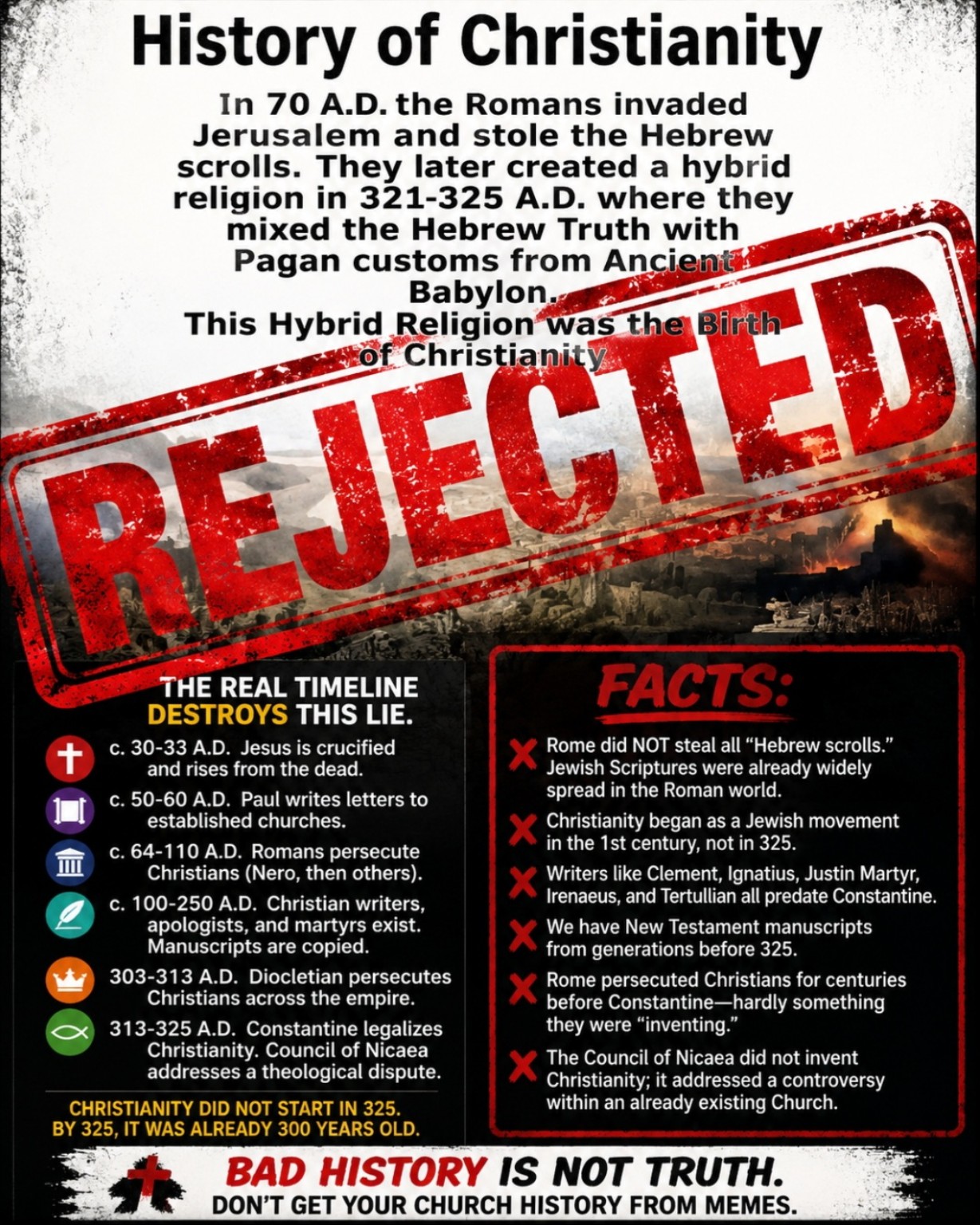
There are bad historical arguments, and then there are arguments that require approximately three hundred years of documented history to quietly leave the room before they can begin.
This meme belongs to the second category.
Its account of Christian history is straightforward:
“In 70 A.D. the Romans invaded Jerusalem and stole the Hebrew scrolls. They later created a hybrid religion in 321–325 A.D. where they mixed the Hebrew Truth with Pagan customs from Ancient Babylon. This Hybrid Religion was the Birth of Christianity.”
There is something almost admirable about fitting this much historical confusion into so little space.
The Romans destroyed Jerusalem in A.D. 70. That part happened.
Then the meme takes the scenic route through fantasy.
Rome supposedly stole “the Hebrew scrolls,” sat on them for roughly two and a half centuries, mixed their contents with paganism imported from Babylon, and somewhere between A.D. 321 and 325 produced the religion we now call Christianity.
There is one rather inconvenient problem.
Christianity already existed.
Not secretly. Not hypothetically. Not according to some reconstruction developed by Christian theologians fifteen centuries later.
Christians had churches. Christians wrote books. Christians argued with one another. Christians argued with pagans. Christians argued with Jews. Christians copied Scripture. Christians wrote theology. Christians had bishops. Christians celebrated the Lord's Supper. Christians baptized converts. Christians were arrested. Christians were executed.
The Roman government itself knew Christians existed.
That makes Rome an exceptionally poor candidate for secretly inventing Christianity three centuries after Christianity began.
This is not a small chronological difficulty.
It is the historical equivalent of claiming that the United States invented automobiles in 2025.
Christianity Existed Before Jerusalem Fell
The meme begins with A.D. 70 as though the destruction of Jerusalem provides the starting point from which Christianity could eventually be manufactured.
Unfortunately for the meme, Christianity predates A.D. 70.
Paul's letters alone are fatal to the theory.
First Thessalonians is commonly dated around A.D. 50. Galatians, 1 and 2 Corinthians, Romans, Philippians, and several other Pauline letters belong to the decades before or around the destruction of Jerusalem. Whatever debates scholars have concerning the precise dates or authorship of particular New Testament books, nobody doing serious ancient history needs Constantine to explain where Christianity came from.
Paul was already writing to established Christian communities throughout the Roman world generations before Nicaea.
Think about what that means.
Paul did not write Romans to establish Christianity in Rome. He wrote to Christians who were already there.
He did not invent Christianity for Corinth. There was already a church at Corinth to receive his letters.
He wrote to Christians in Galatia, Philippi, Thessalonica, and elsewhere.
By the middle of the first century, the question is not whether Christianity existed.
The evidence requires us to explain how it had already spread so far.
And our sources place its origin exactly where the meme apparently does not want it:
among Jewish followers of Jesus in first-century Judea.
Christianity did not begin when Romans stole Judaism.
It began with Jews proclaiming that the crucified Jesus of Nazareth had risen from the dead and was Israel's Messiah and Lord.
One may reject that proclamation. One may dispute the resurrection. One may deny Christianity altogether.
But one does not get to move Christianity's existence forward three centuries simply because the actual chronology is inconvenient.
History has dates.
They matter.
Rome Apparently Forgot It Invented Christianity
The theory becomes considerably funnier once Roman sources enter the discussion.
Around A.D. 112, Pliny the Younger, governor of Bithynia-Pontus, wrote to Emperor Trajan asking how Christians should be handled. His correspondence describes people accused of Christianity and refers to their practice of gathering and singing to Christ.
That is more than two centuries before Nicaea.
Tacitus, writing in the early second century, discusses Nero's punishment of Christians following the great fire at Rome in A.D. 64. He connects their name with Christus, who had been executed during the reign of Tiberius by Pontius Pilate.
Whether one likes everything Tacitus says about Christians is irrelevant. Tacitus was certainly not writing Christian propaganda.
He despised them.
Which makes him rather useful here.
Apparently the Romans were persecuting adherents of the religion they would not invent until approximately 260 years later.
That is impressive administrative foresight.
Perhaps Nero's government accidentally began persecuting Christianity before Rome remembered to create it.
The historical problem gets worse.
The emperor Trajan was dealing with Christians around A.D. 112. Marcus Aurelius reigned during a period in which Christians suffered persecution in the second century. Decius launched an empire-wide program requiring sacrifices in the third century that placed Christians in grave danger. Valerian's policies targeted Christian leadership. Diocletian's Great Persecution began in A.D. 303.
Then Constantine comes along in the fourth century.
According to the meme, somewhere around this point Rome invented Christianity.
That raises a fairly obvious question:
Why had Roman authorities spent generations trying to suppress a religion Rome had not invented yet?
The meme does not tell us.
Presumably the Babylonian department lost the paperwork.
We Also Have Christian Writers Before Constantine
Perhaps Roman testimony is not enough.
Fine.
We can ask the Christians.
Clement of Rome wrote near the end of the first century.
Ignatius of Antioch wrote Christian letters in the early second century while being transported toward his execution. He speaks extensively about Jesus Christ, the Church, bishops, Christian unity, suffering, and the Eucharist.
Polycarp of Smyrna belongs to this same early Christian world.
Justin Martyr wrote defenses of Christianity during the second century and described Christian beliefs and worship long before Constantine.
Irenaeus wrote extensively against heresies in the late second century. Tertullian produced Christian theological works around the turn of the third century. Origen became one of Christianity's most prolific scholars during the third.
These people were not waiting around for Rome to invent Christianity.
They were already arguing about what Christianity taught.
That distinction matters.
By the second century, Christians could disagree over doctrine precisely because an identifiable Christian faith already existed.
Irenaeus could argue against Gnostic teachers because Christianity already possessed recognized beliefs against which competing claims could be evaluated.
Tertullian could defend Christianity against pagan criticism because pagans already knew Christianity existed.
Origen could write biblical commentaries because Christians already possessed and studied Christian Scriptures.
The historical record is not remotely subtle about this.
You do not need to believe these Christian writers were correct.
You merely need to notice that they existed.
Then There Are the Manuscripts
The conspiracy becomes even more difficult once physical evidence joins the witnesses.
We possess New Testament manuscript evidence predating Constantine.
The famous Rylands fragment of John's Gospel, commonly designated P52, is generally placed somewhere in the second century, though its exact dating remains debated. More substantial papyri such as P46, P66, and P75 also preserve portions of New Testament writings well before the Council of Nicaea.
That creates another awkward situation.
If fourth-century Rome manufactured Christianity by transforming Hebrew religion into a pagan hybrid, someone apparently traveled backward in time and distributed Christian manuscripts before the manufacturing process occurred.
That would certainly solve the chronology.
Unfortunately, time travel is not presently among the recognized tools of Roman religious policy.
The simpler explanation is considerably less exciting:
Christians possessed Christian writings because Christianity already existed.
So What Happened in A.D. 325?
This is usually where memes of this kind eventually arrive.
Constantine.
Nicaea.
A.D. 325.
Cue ominous music.
The Council of Nicaea has become the theological conspiracy theorist's Swiss Army knife. Whatever one dislikes about Christianity can apparently be blamed on Nicaea.
The Trinity? Nicaea.
The Bible? Nicaea.
Jesus being divine? Nicaea.
Paganism entering Christianity? Nicaea.
Christianity itself? Apparently Nicaea now gets that one too.
The actual council is simultaneously more interesting and considerably less useful for conspiracy theories.
Constantine summoned bishops to Nicaea in A.D. 325 amid a serious controversy associated especially with Arius and his teaching concerning the Son. The central theological dispute concerned the relationship of the Son to the Father.
Notice what had to exist for this controversy to happen.
Christians.
Churches.
Bishops.
Scripture.
Established worship of Jesus.
Existing theological claims about Christ.
Competing interpretations of those claims.
Nicaea could not invent Christianity because Christianity's existence is the reason Nicaea happened.
The bishops did not arrive asking, “What religion should we create?”
They arrived embroiled in an argument over how the Christian confession of God and Christ should be articulated.
One may criticize Constantine's involvement in ecclesiastical affairs. One may study the political dimensions surrounding the council. One may examine the later enforcement of theological decisions and reasonably ask whether imperial power should ever have become so entangled with the Church.
Those are legitimate historical questions.
“Did Constantine invent Christianity at Nicaea?” is not one of history's great mysteries.
No.
And No, Nicaea Did Not Invent Jesus' Divinity Either
The usual conspiracy requires another move.
Perhaps Christianity technically existed before Constantine, but the Christianity we recognize today was supposedly created at Nicaea when Jesus was transformed from an ordinary Jewish teacher into a divine figure.
That also collides with embarrassingly early evidence.
Paul writes in Philippians 2 of Christ existing in the form of God, humbling Himself, becoming obedient unto death, and then being exalted so that every knee bows and every tongue confesses Jesus Christ as Lord.
Whatever precise questions scholars debate concerning that passage, Paul wrote it centuries before Constantine.
John's Gospel opens:
“In the beginning was the Word, and the Word was with God, and the Word was God.”
Again: pre-Constantine.
Thomas addresses the risen Jesus:
“My Lord and my God!”
Pre-Constantine.
Ignatius of Antioch refers to Jesus Christ as God in the early second century.
Very inconveniently pre-Constantine.
Nicaea did not take a previously ordinary Jesus and hold an imperial election concerning whether He should become divine.
The council addressed a controversy that had arisen precisely because Christians were already making extraordinarily high claims about Jesus.
Arius himself was not arguing that Christianity should abandon some newly invented pagan Jesus and return to a merely human Jewish teacher. The controversy concerned how the preexistent Son related to the Father.
The debate presupposed centuries of Christian theological development.
Again, history refuses to cooperate with the meme.
What About the “Hebrew Scrolls”?
The claim that Rome “stole the Hebrew scrolls” in A.D. 70 is doing enormous work while explaining almost nothing.
Romans certainly carried spoils from the destroyed temple. The Arch of Titus famously depicts Roman soldiers carrying temple treasures, including the menorah.
That does not establish that Rome obtained some mysterious master collection of “Hebrew Truth,” concealed it, and later used it as raw material for Christianity.
Jewish Scripture did not exist in one magical set of scrolls stored exclusively inside Jerusalem.
Jewish communities existed throughout the Mediterranean world.
Greek translations of Jewish Scripture had circulated long before Christianity. The Septuagint's history reaches back centuries before A.D. 70.
Jesus and the apostles did not require Roman soldiers to deliver the Hebrew Scriptures to them.
Neither did early Christians.
The meme takes an actual historical event—the destruction of Jerusalem—and attaches an invented chain of consequences to it without supplying evidence for the chain.
That is not historical reasoning.
It is historical Mad Libs.
Rome destroyed Jerusalem, therefore [insert conspiracy here], therefore Babylon, therefore Christianity.
Babylon is especially useful because once Babylon appears in a meme, apparently citations become optional.
The Babylon Button
“Ancient Babylon” has become one of the easiest buttons to push in pseudo-historical religious arguments.
Find something in Christianity you dislike.
Locate something vaguely similar somewhere in the ancient pagan world.
Declare the Christian practice pagan.
Mention Babylon.
Case closed.
The method sounds impressive until applied consistently.
Pagans prayed.
Christians pray.
Therefore Christian prayer came from paganism.
Pagans sang religious songs.
Christians sing.
Paganism.
Pagans used buildings for religious purposes.
Christians use buildings.
Paganism.
Pagans ate communal meals.
Christians ate communal meals.
Babylon strikes again.
This is called parallelomania: treating similarity as proof of dependence without establishing a historical connection.
Historical influence must be demonstrated.
Who borrowed what?
From whom?
When?
Through what identifiable mechanism?
Where is the evidence of transmission?
What did the practice mean in its original setting?
What did Christians say it meant?
Did the supposed Christian borrowing already exist before the alleged source of influence became relevant?
Those are historical questions.
“Looks kind of pagan to me” is not one.
Christianity Really Does Have Jewish Roots
The strangest feature of this theory is that Christianity's Jewish origins do not need to be rescued from Roman conspirators.
They are sitting openly throughout the New Testament.
Jesus is Jewish.
Mary is Jewish.
The apostles are Jewish.
Paul is Jewish.
The earliest Jerusalem church is Jewish.
The Messiah is understood through Israel's Scriptures.
The Passover provides essential categories for understanding Christ's death.
Abraham, Moses, David, Isaiah, Jeremiah, and the Psalms appear throughout Christian Scripture.
Paul describes the gospel as promised beforehand through God's prophets in the holy Scriptures.
Hebrews is nearly incomprehensible without Israel's priesthood, sacrifices, covenants, tabernacle, and Scriptures.
Christianity did not conceal its Jewish roots particularly well for a religion supposedly designed to conceal its Jewish roots.
They occupy most of the Bible.
The real historical development is far more complicated and, frankly, more interesting. Christianity began as a Jewish messianic movement centered upon Jesus. Gentiles entered the movement in increasing numbers. Serious disputes arose concerning circumcision, Torah observance, table fellowship, and Gentile inclusion. The destruction of Jerusalem changed the religious landscape. Jewish and Christian communities increasingly developed distinct identities. Christianity spread throughout the Roman world, encountered Greek philosophical vocabulary and Roman culture, developed institutions, fought internal theological battles, endured periods of persecution, and eventually entered a radically different relationship with imperial power under Constantine.
That history contains plenty worth criticizing.
We do not need to invent one.
Constantine Changed Christianity's Political Situation
There is an important truth hiding beneath the conspiracy.
Something enormous did happen during Constantine's reign.
Christianity's relationship to imperial power changed dramatically.
Christians who had recently suffered under imperial persecution eventually found themselves enjoying imperial favor. Constantine patronized the Church, became involved in ecclesiastical disputes, funded church construction, and summoned bishops.
That development deserves serious theological scrutiny.
Christians can reasonably debate whether Constantine's influence ultimately helped or damaged the Church. The union of ecclesiastical authority and political power produced consequences that should not be romanticized.
But “the Roman Empire began favoring Christianity” and “the Roman Empire invented Christianity” are wildly different claims.
One concerns the changing political status of an existing religion.
The other requires us to erase three centuries.
You cannot solve that problem by writing “Babylon” underneath it.
Christianity Does Not Need Fake History to Be Criticized
This is perhaps the most frustrating part.
Christian history contains genuine failures.
Christians have sometimes pursued political power.
Church leaders have sometimes abused authority.
Christians have sometimes accommodated surrounding cultures when they should have resisted them.
Church institutions have accumulated wealth, protected corruption, persecuted opponents, and behaved in ways entirely unworthy of Christ.
If someone wants to criticize Christianity historically, there is material available.
Study it.
Document it.
Name it.
Christians should not be frightened by truthful criticism of Christian history. Our faith does not require pretending every bishop, council, institution, emperor, denomination, pastor, or Christian civilization behaved faithfully.
But fabricated history does not become courageous merely because its target is religion.
And Christians should not respond to bad history by manufacturing equally bad apologetics.
Truth does not need us to lie for it.
Someone Will Believe This
The meme would merely be funny if nobody took it seriously.
People do.
Someone who knows very little about Christian history will encounter this graphic and discover a wonderfully simple explanation for an enormously complicated subject.
Christianity was fake.
Rome invented it.
Babylon supplied the paganism.
Constantine finished the job.
Mystery solved.
No need to read Clement.
No need to read Ignatius.
No need to read Justin Martyr.
No need to read Irenaeus.
No need to examine Roman sources.
No need to study manuscript history.
No need to distinguish the legalization of Christianity from its origin.
No need to investigate the Jewish environment from which the Christian movement emerged.
A meme has saved us all the inconvenience of scholarship.
That is precisely why these things spread.
Real history is difficult.
Conspiracy history is wonderfully efficient.
Every complicated development receives one villain, one secret meeting, one suppressed truth, and preferably one reference to Babylon.
The result feels like discovering something.
Usually what has been discovered is that nobody checked the dates.
The Timeline Alone Destroys the Claim
We do not need an elaborate theological defense of Christianity to refute this meme.
We need a calendar.
Jesus was crucified in the first century.
Paul's letters circulated in the first century.
Christian communities existed throughout the Roman world in the first century.
Roman writers discussed Christians by the early second century.
Christian writers produced extensive literature throughout the second and third centuries.
Christian manuscripts survive from before Constantine.
Christians suffered major Roman persecution before Constantine.
Diocletian's Great Persecution began in A.D. 303.
Constantine and Licinius issued the agreement commonly called the Edict of Milan in A.D. 313, establishing toleration for Christianity.
The Council of Nicaea met in A.D. 325.
And the meme concludes that Christianity was born around A.D. 321–325.
No.
By A.D. 325 Christianity was old enough to possess centuries of history, geographical diversity, institutional structures, theological controversies, martyrs, theologians, manuscripts, liturgical practices, competing movements, and enough argumentative bishops to make Constantine wish everyone would settle down.
Nicaea was not Christianity's delivery room.
It was a family argument several generations after the family already existed.
Please Stop Getting Church History From Memes
There is a useful principle here extending far beyond this particular graphic.
When someone presents a breathtaking claim about history, ask what evidence would have to exist if the claim were true.
If Christianity was invented in the fourth century, first-, second-, and third-century Christianity becomes extraordinarily difficult to explain.
If Constantine invented Christian doctrine, pre-Constantinian Christian theology becomes difficult to explain.
If Rome created Christian Scripture, pre-Constantinian Christian manuscripts become difficult to explain.
If Roman paganism produced Christianity, Christianity's unmistakably Jewish first-century origins become difficult to explain.
Eventually a theory can accumulate so many inconvenient facts that the problem is no longer the facts.
It is the theory.
This one reaches that point almost immediately.
The Romans really did destroy Jerusalem.
Constantine really did transform Christianity's relationship with imperial power.
Nicaea really did matter enormously for Christian doctrinal history.
Christianity really did interact with surrounding Greek and Roman culture.
Those are historical claims worth studying.
But Rome did not wait until A.D. 325, throw stolen Hebrew scrolls into a Babylonian theological blender, press the CHRISTIANITY button, and hand the resulting religion to the world.
That story is not suppressed history.
It is simply bad history.
And if your account of Christianity requires Christians to spend three centuries writing, worshiping, arguing, spreading, copying manuscripts, and occasionally being killed for Christianity before Christianity existed, perhaps Ancient Babylon is not the first place we should investigate.
Perhaps we should investigate the meme.
REJECTED.