
A Word?
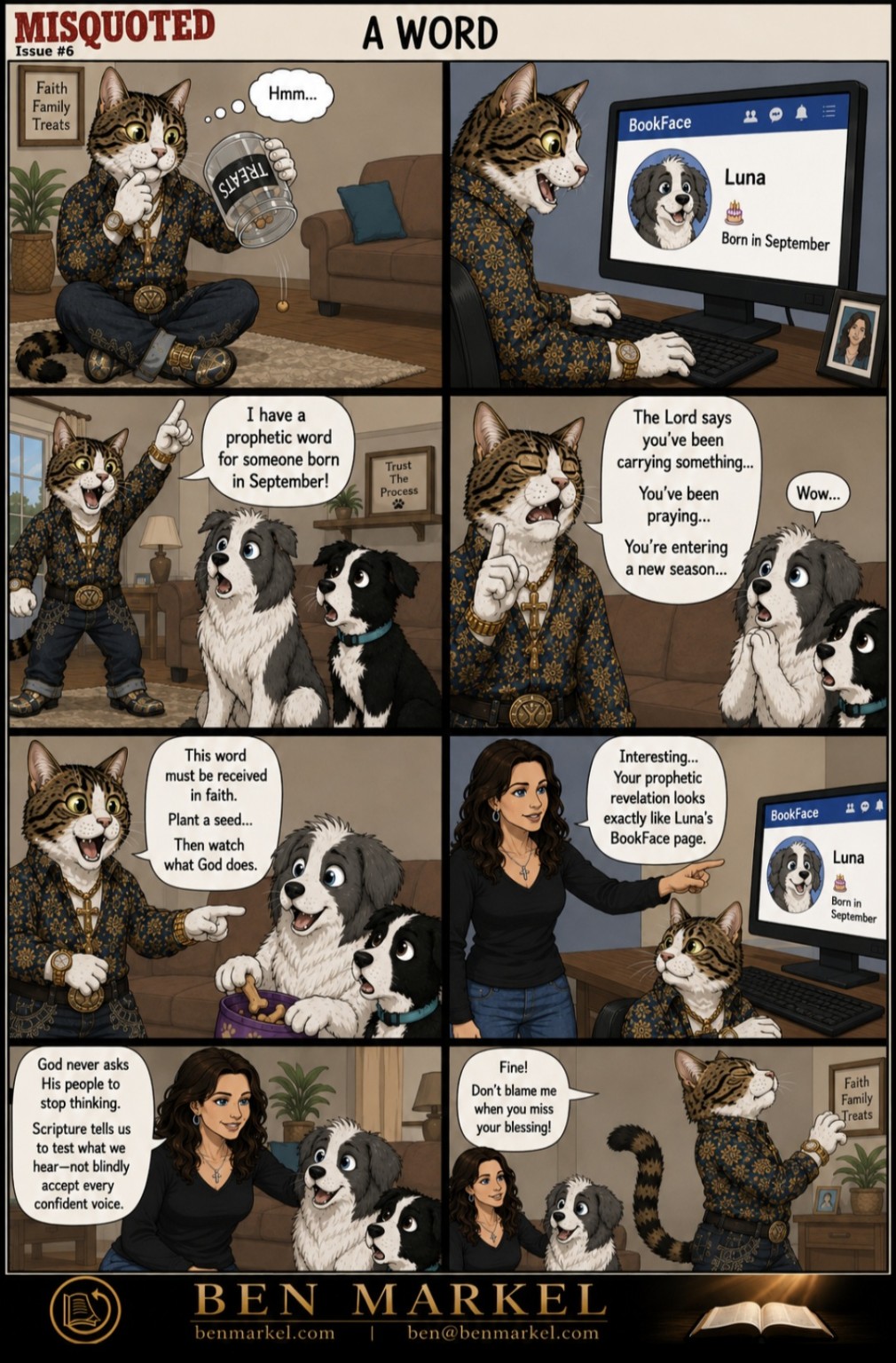
While the comic exaggerates the situation for humor, it portrays a pattern many Christians have encountered. A claim of supernatural knowledge establishes credibility. Vague statements create the appearance of personal revelation. Financial or emotional pressure follows. Finally, any attempt to exercise discernment is portrayed as unbelief, skepticism, or resistance to the Holy Spirit. What begins as a claimed message from God often ends by discouraging the very testing that Scripture commands.
The purpose of this article is not to mock sincere believers or deny that God is active in the lives of His people. Rather, it is to ask an important biblical question: How should Christians respond when someone claims to speak on God’s behalf? Scripture never asks us to suspend our discernment simply because a message sounds spiritual or is delivered with confidence. Instead, it repeatedly calls us to test every claim against the Word of God.
God Has Spoken
Few words carry greater weight than, “The Lord says.” Throughout Scripture, those words are never treated casually. When God spoke through Moses, Isaiah, Jeremiah, or the other prophets, they were not merely sharing an impression, offering encouragement, or expressing a personal opinion. They were declaring the very words of God. To speak in His name was to speak with His authority, and for that reason Scripture treats anyone who claimed divine authority with the utmost seriousness.
That seriousness has not diminished under the New Covenant. God has spoken definitively through His Son (Hebrews 1:1–2), and the apostolic witness has been preserved for the Church in the Scriptures. Because God’s Word carries His authority, Christians should never treat claims of divine revelation lightly. To tell another person, “God told me,” “The Lord showed me,” or “I have a word from God for you,” is to claim that the Creator of heaven and earth has spoken. Such a claim demands careful examination, not unquestioning acceptance.
The purpose of this article is not to deny that God guides His people or faithfully keeps His promises. Rather, it is to ask a simple but necessary question: When someone claims to speak for God, how does Scripture tell us to respond? Before we accept any message as coming from the Lord, we must first understand how seriously the Bible treats those who speak in His name.
Why Does Scripture Tell Us to Test?
One of the most common misunderstandings surrounding prophecy is the reason Scripture commands believers to test it. Many assume the purpose of testing is to determine whether a sincere prophet has accurately communicated what God revealed. According to this view, God speaks perfectly, but the prophet may misunderstand, misinterpret, or imperfectly relay the message. While this explanation has become common in some circles, it is striking that Scripture never presents prophecy in those terms.
Instead, the biblical emphasis falls elsewhere. From the Law to the Prophets and throughout the New Testament, God’s people are repeatedly warned about false prophets—people who claim to speak in God’s name when He has not sent them. Jesus warned that false prophets would arise and deceive many (Matthew 7:15; 24:11, 24). John instructed believers, “Do not believe every spirit, but test the spirits to see whether they are from God, because many false prophets have gone out into the world” (1 John 4:1). Peter and Jude likewise warned the Church about false teachers who would secretly introduce destructive errors. The consistent concern is not that God’s revelation might become distorted through an otherwise genuine prophet, but that people would falsely claim God’s authority for words He never spoke.
The same pattern appears in the Old Testament. Deuteronomy warns against the prophet who presumes to speak in the name of the Lord when the Lord has not commanded him to speak (Deuteronomy 18:20–22). Jeremiah repeatedly condemns those who proclaim, “Thus says the Lord,” when God had not sent them (Jeremiah 23). Ezekiel rebukes prophets who followed their own spirit while claiming divine authority (Ezekiel 13). Again and again, the issue is not misunderstood revelation but unauthorized revelation.
This distinction matters because it changes the question Christians should ask. Rather than asking, “How much error is acceptable in a prophet?” Scripture leads us to ask, “Has God actually spoken?” God has never misunderstood His own message. The responsibility of the believer is therefore not to excuse inaccurate claims of revelation but to carefully test whether anyone claiming to speak for God truly speaks according to His Word.
God’s Prophets Spoke God’s Words
When we examine the prophets of Scripture, we find something remarkably consistent. Their failures were many, but misunderstanding God’s message was not presented as one of them. Moses disobeyed God by striking the rock, yet he knew exactly what God had commanded him to do. Jonah fled from the Lord because he understood the message perfectly and did not want to deliver it. Balaam’s heart was corrupt, yet he repeatedly confessed that he could speak only the words God placed in his mouth. Even Nathan, after initially encouraging David to build the temple from his own judgment, immediately returned to correct himself when the Lord revealed His actual word. Scripture carefully distinguishes Nathan’s personal counsel from God’s revelation.
This pattern continues throughout the Old Testament. Isaiah, Jeremiah, Ezekiel, Amos, and the other prophets did not present themselves as men trying to interpret vague impressions or piece together incomplete revelations. They stood before God’s people declaring, “Thus says the LORD.” Their authority rested entirely upon the fact that the message belonged to God rather than to themselves. When God spoke, His prophets were expected to faithfully deliver what He had said.
This observation raises an important question for the modern church. If God’s prophets consistently delivered God’s message under the Old Covenant, why would we assume that God’s revelation became less certain after the coming of Christ? The New Covenant is repeatedly described as better because it is established on better promises through a better Mediator. Scripture never suggests that God’s communication became more uncertain or more dependent upon human interpretation. Instead, it points believers to God’s final revelation in His Son and to the apostolic testimony preserved in the Scriptures.
For that reason, Christians should exercise great caution before attributing their thoughts, impressions, or feelings to the voice of God. The Bible presents God’s revelation as truthful, authoritative, and worthy of complete confidence. The question has never been whether God can communicate clearly. The question has always been whether He has actually spoken.
Borrowing God’s Authority
Claiming to speak for God is one of the most serious claims a person can make. Whether the words are, “The Lord told me,” “God showed me,” “I have a word for you,” or “I feel the Holy Spirit is saying,” the claim is ultimately the same: that the message which follows carries divine authority. While the wording may become softer or more cautious, changing the phrasing does not change the nature of the claim. If the message is presented as coming from God rather than from personal wisdom or conviction, it asks the listener to receive it as something more than human opinion.
Scripture consistently warns against speaking in God’s name when He has not spoken. The third commandment is often reduced to avoiding profanity, but throughout the Bible one of the clearest ways God’s name is taken in vain is by attaching it to words He never said. The Lord condemned those who declared, “Thus says the LORD,” when He had not sent them (Jeremiah 23:21). Ezekiel rebuked prophets who followed their own spirit while claiming divine authority (Ezekiel 13:6–7). Deuteronomy warned against the prophet who presumed to speak in the Lord’s name without His command (Deuteronomy 18:20). In each case, the offense was not merely speaking falsely—it was using God’s name to give human words divine authority.
For that reason, Christians should be slow to attribute their own thoughts, impressions, or desires to the voice of God. There is nothing wrong with offering biblical encouragement, wise counsel, or personal conviction while making it clear that these are our own words. The danger begins when we attach God’s authority to what He has not revealed. Once we say, “God told me,” the discussion is no longer about the quality of our advice but about whether the Lord Himself has spoken.
James reminds teachers that they will be judged with greater strictness (James 3:1). Those who publicly claim to speak for God should feel the full weight of that warning. It is a fearful thing to place God’s name behind our own words. The safest course is not to speak less boldly about what God has clearly revealed in Scripture, but to speak far more cautiously where He has remained silent.
Vague Words Feel Personal
One reason modern prophetic words can be so persuasive is that they are often intentionally broad. A message such as, “You’ve been carrying a burden,” “God is about to open a door,” or “You’re entering a new season,” may sound deeply personal, yet it could apply to countless people. Nearly every Christian has prayed through hardship, waited for God’s direction, or hoped for His blessing. The fact that a statement resonates emotionally does not, by itself, demonstrate that God has spoken.
This is one reason Scripture never tells us to evaluate a message by how accurately it describes our circumstances or how strongly it moves our emotions. Instead, we are told to test it. Feelings are real, but they are not infallible. A message can be encouraging, emotionally powerful, and widely applicable while still lacking any divine authority. Our confidence must rest in God’s revealed Word, not in how personally a statement seems to fit our lives.
This does not mean every encouraging word is wrong. Christians should encourage one another, pray for one another, and remind each other of God’s promises. The difference is one of authority. There is a world of difference between saying, “I want to encourage you with a passage of Scripture,” and saying, “God gave me this message specifically for you.” The first points someone to what God has already revealed. The second claims new revelation and therefore carries a burden of proof that Scripture treats with great seriousness.
For that reason, Christians should be careful not to confuse familiarity with revelation or emotional impact with divine authority. God’s truth is not established because it feels personal. It is established because God has spoken. Every claim to speak in His name should therefore be measured, not by how convincing it sounds, but by the standard of His Word.
The Sufficiency of Scripture
Behind the desire for a personal prophetic word often lies an unspoken assumption: that what God has already revealed is somehow not enough. The believer begins looking for a fresh message tailored to the present moment, believing that certainty or direction can only come if God speaks again. Yet the Bible consistently points Christians back to what God has already revealed rather than encouraging them to seek new revelation.
The opening words of Hebrews declare that while God spoke in many ways through the prophets, He has now spoken definitively through His Son (Hebrews 1:1–2). The apostles, commissioned by Christ Himself, faithfully preserved His teaching in the New Testament so that the Church would possess an enduring and authoritative witness. Rather than directing believers to continually seek new messages, Scripture continually directs us back to the message already given.
Paul likewise reminds Timothy that the Scriptures are inspired by God and are sufficient to equip the man of God for every good work (2 Timothy 3:16–17). This does not mean the Bible answers every question we might ask or tells us which job to accept or where to live. It means God has already revealed everything necessary for knowing Him, understanding the gospel, living faithfully, and growing in holiness. We are not lacking revelation. We are called to believe, obey, and apply the revelation we have already received.
None of this denies God’s providence. God faithfully guides His people through His Word, through prayer, through the wisdom of mature believers, and through the circumstances He sovereignly ordains. He opens and closes doors, grants wisdom to those who ask, and directs the steps of His children. But there is a profound difference between recognizing God’s providential guidance and claiming new revelation from God. The first humbly acknowledges God’s sovereign care. The second claims to speak with His authority.
For that reason, Christians should find their confidence not in the next prophetic word, but in the Word God has already spoken. The Scriptures remain the only infallible rule of faith and practice, the standard by which every teacher, every sermon, every impression, and every claimed revelation must be tested. God’s people do not live by chasing new words from heaven. We live by every word that has already proceeded from the mouth of God.
A Word to Christians
None of this should make us cynical. Scripture does not call us to reject every claim simply because someone speaks with confidence, nor does it encourage us to live in constant suspicion of one another. Instead, God calls His people to exercise discernment. Discernment is not unbelief; it is an act of obedience. The same God who commands us to believe His Word also commands us to test those who claim to speak in His name.
The Bereans provide a wonderful example of this balance. When the Apostle Paul preached in their synagogue, they did not reject his message, but neither did they accept it uncritically. Luke commends them because they “received the word with all eagerness, examining the Scriptures daily to see if these things were so” (Acts 17:11). If the Bereans were praised for testing the teaching of an apostle against the Scriptures, then every modern teacher, preacher, prophet, or ministry should welcome the very same examination.
As Christians, our confidence should never rest in the personality of a speaker, the size of a ministry, the sincerity of a messenger, or the emotional impact of a message. Our confidence rests in God’s Word. Every sermon, every book, every podcast, every impression, and every claimed revelation should be measured by the Scriptures. God has never asked His people to suspend their discernment. He has called us to love Him with all our heart, soul, and mind.
The safest place for the Christian is not in the pursuit of the next prophetic word but in faithful submission to the Word God has already spoken. There we find the voice of our Shepherd, the truth that cannot fail, and the wisdom that is able to make us wise unto salvation through faith in Jesus Christ. When we treasure His Word above every competing voice, we need not fear being led astray, for the God who has spoken in Scripture has given His Church everything necessary for life and godliness.
The purpose of this article has not been to explain every technique used by modern prophetic ministries, nor to question the sincerity of every person who claims to have received a word from God. It has simply been to remind Christians of the standard Scripture gives us whenever someone claims divine authority. God has never asked His people to suspend their discernment. He has called us to test every claim against His revealed Word, remembering that the Bible warns repeatedly about false prophets rather than encouraging unquestioning acceptance of those who speak in God’s name.
Many of the methods commonly used to make modern prophetic words appear convincing involve principles that deserve careful examination in their own right. How do vague predictions feel so personal? Why do so many people become convinced they have received a supernatural message? What role do psychology, suggestion, confirmation bias, and emotional manipulation play in the process? Those questions are important, but they deserve their own discussion.
Investigations · Coming Soon
How Modern Prophetic Words Work
A future investigation into vague predictions, information gathering, confirmation bias, suggestion, and emotional manipulation.